
Introduction – Chapter 13 13.1 A sea voyage helped Darwin frame
... 13.7 Evolution occurs within populations A gene pool is the total collection of genes in a population at any one time. Microevolution is a change in the relative frequencies of alleles in a gene pool over time. Population genetics studies how populations change genetically over time. The mod ...
... 13.7 Evolution occurs within populations A gene pool is the total collection of genes in a population at any one time. Microevolution is a change in the relative frequencies of alleles in a gene pool over time. Population genetics studies how populations change genetically over time. The mod ...

12_Review1 - Life Sciences
... Developmental homeostasis: Development of specific behaviors despite variation in environment This category includes, but is not limited to innate behaviors Proximate reason: Developmental process not influenced by environmental variation. ...
... Developmental homeostasis: Development of specific behaviors despite variation in environment This category includes, but is not limited to innate behaviors Proximate reason: Developmental process not influenced by environmental variation. ...

File
... studies, Thomas Malthus. The book was called An Essay on the Principle of Population. Malthus got the idea for this essay from Benjamin Franklin, the American who invented the lightning conductor among other things. Franklin had made the point that if there were no limiting factors in nature, one si ...
... studies, Thomas Malthus. The book was called An Essay on the Principle of Population. Malthus got the idea for this essay from Benjamin Franklin, the American who invented the lightning conductor among other things. Franklin had made the point that if there were no limiting factors in nature, one si ...

Reconnection and Rates of Speciation
... c.Gradual speciation is most likely to occur in species that live in a stable climate. d.Gradual speciation and punctuated equilibrium both result in the divergence of species. The primary in uencing factor on changes in speciation rate is environmental conditions. Under some conditions, selection o ...
... c.Gradual speciation is most likely to occur in species that live in a stable climate. d.Gradual speciation and punctuated equilibrium both result in the divergence of species. The primary in uencing factor on changes in speciation rate is environmental conditions. Under some conditions, selection o ...


Microsoft Word 97
... individuals in societies. It favoured such ideas as the divine right of kings and, that once established, social and economic positions of individuals in societies would remain unchanged. For instance, an individual born into some low-ranking position or order would remain there. These early theorie ...
... individuals in societies. It favoured such ideas as the divine right of kings and, that once established, social and economic positions of individuals in societies would remain unchanged. For instance, an individual born into some low-ranking position or order would remain there. These early theorie ...

Natural Selection in REal time - Serrano High School Biology I
... and it was almost identical to what we had predicted” – Peter Grant Darwin thought that evolution took place over hundreds or thousands of years and was impossible to witness in a human lifetime. Peter and Rosemary Grant have seen evolution happen over the course of just two years. The Grants study ...
... and it was almost identical to what we had predicted” – Peter Grant Darwin thought that evolution took place over hundreds or thousands of years and was impossible to witness in a human lifetime. Peter and Rosemary Grant have seen evolution happen over the course of just two years. The Grants study ...

Click www.ondix.com to visit our student-to
... In the middle of evolution and creation is Intervention. Interventionists believe that evolution did take place and that human beings have always been evolving as the theory of evolution states. Interventionists believe that, in some point in human development, something from somewhere in the univer ...
... In the middle of evolution and creation is Intervention. Interventionists believe that evolution did take place and that human beings have always been evolving as the theory of evolution states. Interventionists believe that, in some point in human development, something from somewhere in the univer ...
Kinds, individuals, organisms
... essential properties. Historically it is related to the pre-evolutionary stage based on the description and classification of organic types. The second rejects the notion of class and is attached to the mereological notion of individual. Organisms, as well as species (and other categories in the hie ...
... essential properties. Historically it is related to the pre-evolutionary stage based on the description and classification of organic types. The second rejects the notion of class and is attached to the mereological notion of individual. Organisms, as well as species (and other categories in the hie ...
SLU Biology 100-Level Course Descriptions
... Lecture three hours, laboratory three hours per week. First semester of a two-semester course covering the basic principles of biology. Course emphasizes origin and definition of life; cells, their organization, chemical composition, and metabolic activity; the basis of heredity; evolution. BIOL 106 ...
... Lecture three hours, laboratory three hours per week. First semester of a two-semester course covering the basic principles of biology. Course emphasizes origin and definition of life; cells, their organization, chemical composition, and metabolic activity; the basis of heredity; evolution. BIOL 106 ...


Name: Date: Period: ______ Unit 8, Part 2 Notes: Theories of
... h) Today, we know that there are several issues with Lamarck’s theory. We know that certain traits (ex: increased muscle mass) can be acquired during an organisms lifetime, but these traits cannot be passed down to offspring. These traits cannot be passed down because they are not controlled by gen ...
... h) Today, we know that there are several issues with Lamarck’s theory. We know that certain traits (ex: increased muscle mass) can be acquired during an organisms lifetime, but these traits cannot be passed down to offspring. These traits cannot be passed down because they are not controlled by gen ...

EVOLUTION
... • Natural selection, or the survival of the fittest (where ‘fittest’ refers to organisms that are better suited to survive and successfully reproduce) is a complex process where the whole environment governs whether members of a species survive to reproduce and pass on their genes to the next genera ...
... • Natural selection, or the survival of the fittest (where ‘fittest’ refers to organisms that are better suited to survive and successfully reproduce) is a complex process where the whole environment governs whether members of a species survive to reproduce and pass on their genes to the next genera ...


Name: Period: ______ Biology Final Review Worksheet (24 pts
... __C__ 23. According to Darwin, evolution occurs a. only through artificial selection. b. during half-life periods of 5,715 years. c. because of natural selection. d. so rapidly that it can be observed easily. __D__ 24. The major idea that Darwin presented in his book The Origin of Species was that a ...
... __C__ 23. According to Darwin, evolution occurs a. only through artificial selection. b. during half-life periods of 5,715 years. c. because of natural selection. d. so rapidly that it can be observed easily. __D__ 24. The major idea that Darwin presented in his book The Origin of Species was that a ...

Regents Biology Regents Biology Vestigial organs Structures of
... Change over time The theory of evolution proposes that modern forms of life have descended from earlier forms of life and changed as they descended. What caused the “changes” or differences in traits? ...
... Change over time The theory of evolution proposes that modern forms of life have descended from earlier forms of life and changed as they descended. What caused the “changes” or differences in traits? ...

Primary purpose/ student learning goal(s)
... the information they need to focus on regarding the suitability of an organism to its environment. Day 2: Here I will provide information to the students regarding Darwin's theory of natural selection. They will then have the tools to perform their own inquiry into the meaning of the terms as they r ...
... the information they need to focus on regarding the suitability of an organism to its environment. Day 2: Here I will provide information to the students regarding Darwin's theory of natural selection. They will then have the tools to perform their own inquiry into the meaning of the terms as they r ...

Bos Taurus
... “Texas Longhorns are noted for being remarkably free of genetic defects that plague some other breeds of cattle. This is largely a result of the natural selection against deleterious (harmful) traits that occurred when Texas Longhorns lived wild on the open range. Most other breeds of cattle have un ...
... “Texas Longhorns are noted for being remarkably free of genetic defects that plague some other breeds of cattle. This is largely a result of the natural selection against deleterious (harmful) traits that occurred when Texas Longhorns lived wild on the open range. Most other breeds of cattle have un ...

Evolution and Diversity - McGraw Hill Higher Education
... organisms, evolved about 3.5 billion years ago. The eukaryotic cell arose about 2.1 billion years ago, but multicellularity didn’t begin until perhaps 700 million years ago. This means that only unicellular organisms were present for 80% of the time that life has existed on Earth. Most evolutionary ...
... organisms, evolved about 3.5 billion years ago. The eukaryotic cell arose about 2.1 billion years ago, but multicellularity didn’t begin until perhaps 700 million years ago. This means that only unicellular organisms were present for 80% of the time that life has existed on Earth. Most evolutionary ...

evolution - Big Picture
... evolutionary impact. In fact, neutral changes are important, thanks to a random process known as genetic drift. Because of chance events in breeding, the frequency of alleles may fluctuate or ‘drift’ over time. How much evolutionary change is due to drift is not certain. So the presence of a common a ...
... evolutionary impact. In fact, neutral changes are important, thanks to a random process known as genetic drift. Because of chance events in breeding, the frequency of alleles may fluctuate or ‘drift’ over time. How much evolutionary change is due to drift is not certain. So the presence of a common a ...

CH. 4
... 4-2 How Does the Earth’s Life Change Over Time? • Concept 4-2A The scientific theory of evolution explains how life on earth changes over time through changes in the genes of populations. • Concept 4-2B Populations evolve when genes mutate and give some individuals genetic traits that enhance their ...
... 4-2 How Does the Earth’s Life Change Over Time? • Concept 4-2A The scientific theory of evolution explains how life on earth changes over time through changes in the genes of populations. • Concept 4-2B Populations evolve when genes mutate and give some individuals genetic traits that enhance their ...

Lecture Powerpoint Here
... Evolution is technically defined as: "a gradual process in which something changes into a different and usually more complex or better form." As it is most famously used, "evolution" is the process by which an organism becomes more sophisticated over time and in response to its environment. The Theo ...
... Evolution is technically defined as: "a gradual process in which something changes into a different and usually more complex or better form." As it is most famously used, "evolution" is the process by which an organism becomes more sophisticated over time and in response to its environment. The Theo ...

SF Ev L4 Speciation in animals
... If variation is continuous then it’s not a species e.g. different galapagos finches are sufficiently different on each island that they are clearly distinct species, with no gene flow between them. The red backed thrush, on the other hand, was defined as a sub-species. ...
... If variation is continuous then it’s not a species e.g. different galapagos finches are sufficiently different on each island that they are clearly distinct species, with no gene flow between them. The red backed thrush, on the other hand, was defined as a sub-species. ...
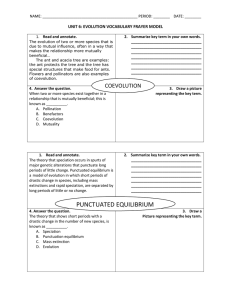
FRAYER MODEL
... Marked difference or deviation from the normal or recognized form, function or structure. Darwin noticed that the animals and plants on the Galápagos Islands were a lot like those in Ecuador. However, they were not exactly the same. The finches of the Galápagos Islands, for example, were a little di ...
... Marked difference or deviation from the normal or recognized form, function or structure. Darwin noticed that the animals and plants on the Galápagos Islands were a lot like those in Ecuador. However, they were not exactly the same. The finches of the Galápagos Islands, for example, were a little di ...