

Biol-1406_Ch15Notes.ppt
... individuals. • Variation must result in differences in __________ of viable offspring produced. • Variation must be genetically __________ . – Natural Selection is a __________ , and Evolution is an __________ . ...
... individuals. • Variation must result in differences in __________ of viable offspring produced. • Variation must be genetically __________ . – Natural Selection is a __________ , and Evolution is an __________ . ...
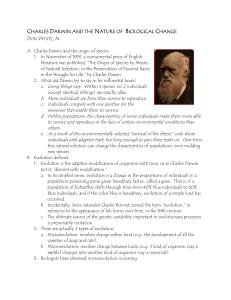
CHARLES DARWIN AND THE NATURE OF BIOLOGICAL CHANGE
... 2) Most everyone is familiar with the results of selective breeding with dogs, cats, cattle, roses, and so on. c. "So," Darwin said in effect, "we see what selective breeding by humans can do. I wonder if selection can also occur in nature?" d. Selective breeding can be compared to playing a piano. ...
... 2) Most everyone is familiar with the results of selective breeding with dogs, cats, cattle, roses, and so on. c. "So," Darwin said in effect, "we see what selective breeding by humans can do. I wonder if selection can also occur in nature?" d. Selective breeding can be compared to playing a piano. ...

chapter 21: the evidence for evolution
... fully understand the information in this chapter. A complete knowledge of Chapter 21 is essential for understanding the principles of organic evolution covered in Chapter 22. In addition, any coverage of organismic diversity and adaptations relies on the concepts expounded in this chapter. SYNOPSIS ...
... fully understand the information in this chapter. A complete knowledge of Chapter 21 is essential for understanding the principles of organic evolution covered in Chapter 22. In addition, any coverage of organismic diversity and adaptations relies on the concepts expounded in this chapter. SYNOPSIS ...

Bos Taurus - Texas Longhorn Conservancy
... (C) identify some changes in genetic traits that have occurred over several generations through natural selection and selective breeding such as the Galapagos Medium Ground Finch (Geospiza fortis) or domestic animals. ...
... (C) identify some changes in genetic traits that have occurred over several generations through natural selection and selective breeding such as the Galapagos Medium Ground Finch (Geospiza fortis) or domestic animals. ...

Unit H: Evolution - myLearning | Pasco County Schools
... SC.912.L.15.10 Identify basic trends in hominid evolution from early ancestors six million years ago to modern humans, including brain size, jaw size, language, and manufacture of tools. SC.912.L.15.13 Describe the conditions required for natural selection, including: overproduction of offspring, in ...
... SC.912.L.15.10 Identify basic trends in hominid evolution from early ancestors six million years ago to modern humans, including brain size, jaw size, language, and manufacture of tools. SC.912.L.15.13 Describe the conditions required for natural selection, including: overproduction of offspring, in ...

SC.912.L.15.12 - List the conditions for Hardy
... Simulating Evolutionary Processes with Poker Chips: ...
... Simulating Evolutionary Processes with Poker Chips: ...
Lecture PPT - Carol Eunmi LEE - University of Wisconsin–Madison
... independently They decided on a joint presentation at the Linnean Society in 1858, but it received little attention After which Darwin rushed to publish his book in 1859 ...
... independently They decided on a joint presentation at the Linnean Society in 1858, but it received little attention After which Darwin rushed to publish his book in 1859 ...

Opinión The evolutionary approach: the lost dimension of medicine
... gene that provides adaptive value (ability to reproduce) by enhancing early fixation of calcium, thus allowing for more efficient repair of fractures at the price, however, of the possibility of coronary artery calcification at older ages.3 The central issue is that around the Paleolithic period, wh ...
... gene that provides adaptive value (ability to reproduce) by enhancing early fixation of calcium, thus allowing for more efficient repair of fractures at the price, however, of the possibility of coronary artery calcification at older ages.3 The central issue is that around the Paleolithic period, wh ...

Evolution Review
... never observed because it was so easily spotted and eaten by predatory birds. With the advent of the industrial revolution, soot killed the pollutionsensitive lichens, exposing the dark tree bark below. As a result, the dark form of the moth became the better camouflaged of the two forms, and increa ...
... never observed because it was so easily spotted and eaten by predatory birds. With the advent of the industrial revolution, soot killed the pollutionsensitive lichens, exposing the dark tree bark below. As a result, the dark form of the moth became the better camouflaged of the two forms, and increa ...

Evolutionary Progress
... such as certain cellular transport mechanisms and parts of certain metabolic pathways. But we do not know how to identify general adaptations in any rigorous way, or how to test whether they have become more prevalent. All that is clear now is that both alternatives, a long-term trend and its absenc ...
... such as certain cellular transport mechanisms and parts of certain metabolic pathways. But we do not know how to identify general adaptations in any rigorous way, or how to test whether they have become more prevalent. All that is clear now is that both alternatives, a long-term trend and its absenc ...

The Origin of Species
... • Darwin’s observations of biogeography, the geographic distribution of species, formed an important part of his theory of evolution. • Islands have many endemic (not found any where else in the world) species that are often closely related to species on the nearest mainland or island. ...
... • Darwin’s observations of biogeography, the geographic distribution of species, formed an important part of his theory of evolution. • Islands have many endemic (not found any where else in the world) species that are often closely related to species on the nearest mainland or island. ...

File jeopardy evolution
... What did Lyell and Hutton determine that helped spark Darwin’s theory of Natural Selection ...
... What did Lyell and Hutton determine that helped spark Darwin’s theory of Natural Selection ...

NGSS Lesson Plan Template
... in number, (2) the genetic variation of individuals in a species due to mutation and sexual reproduction, (3) competition for an environment’s limited supply of the resources that individuals need in order to survive and reproduce, and (4) the ensuing proliferation of those organisms that are better ...
... in number, (2) the genetic variation of individuals in a species due to mutation and sexual reproduction, (3) competition for an environment’s limited supply of the resources that individuals need in order to survive and reproduce, and (4) the ensuing proliferation of those organisms that are better ...

Natural Selection lab
... Name_______________________________________________________________________Date__________Hr______ ...
... Name_______________________________________________________________________Date__________Hr______ ...


LIVING ENVIRONMENT SUMMER PACKET Ecology
... 16) Besides Mutations, what are some other sources of genetic variability? 17) Evolution is the consequence of which factors? 18) The great diversity of organisms is the result of: ...
... 16) Besides Mutations, what are some other sources of genetic variability? 17) Evolution is the consequence of which factors? 18) The great diversity of organisms is the result of: ...


Theories: Theory of Evolution
... Years later, Darwin discovered that each specimen was actually a separate species, meaning they could not interbreed. So, even though these species resembled related species from other parts of South America, they were still uniquely different. But how could this be??? ...
... Years later, Darwin discovered that each specimen was actually a separate species, meaning they could not interbreed. So, even though these species resembled related species from other parts of South America, they were still uniquely different. But how could this be??? ...

RevLessAQA_GCSESciB1_8PPt
... • Particular genes or accidental changes in the genes of plants or animals may give them characteristics that enable them to survive better. Over time this may result in entirely new species. • There are different theories of evolution. Darwin’s theory is the most widely accepted. ...
... • Particular genes or accidental changes in the genes of plants or animals may give them characteristics that enable them to survive better. Over time this may result in entirely new species. • There are different theories of evolution. Darwin’s theory is the most widely accepted. ...


Non-random reproduction
... and reproduction of the one group of individuals (particularly their genotypes) compared with another group of organisms. SELECTION: occurs when individuals of one genotype survive and reproduce more successfully on average than those of a different genotype) (Genotype= the genetic-components of an ...
... and reproduction of the one group of individuals (particularly their genotypes) compared with another group of organisms. SELECTION: occurs when individuals of one genotype survive and reproduce more successfully on average than those of a different genotype) (Genotype= the genetic-components of an ...


Z-Biology Midterm Review Bank-2 (15-16)
... b. all populations evolve through natural selection. c. Earth is a few thousand years old. d. past geological events must be explained in terms of processes observable today. One scientist who attempted to explain how rock layers form and change over time was a. Thomas Malthus. c. Charles Darwin. b. ...
... b. all populations evolve through natural selection. c. Earth is a few thousand years old. d. past geological events must be explained in terms of processes observable today. One scientist who attempted to explain how rock layers form and change over time was a. Thomas Malthus. c. Charles Darwin. b. ...