
Charles Darwin`s paradigm shift - Ohio State Mansfield
... Biotechnology, whether in the form of genetically modified crops, designer drugs, gene therapy, or the human genome project all derive from Darwin’s profound insight. Darwin had no knowledge of genes, chromosomes, or how inheritance worked. This required additional input from the understanding of Gr ...
... Biotechnology, whether in the form of genetically modified crops, designer drugs, gene therapy, or the human genome project all derive from Darwin’s profound insight. Darwin had no knowledge of genes, chromosomes, or how inheritance worked. This required additional input from the understanding of Gr ...

evolution - Way of Life Literature
... 2. The four-wing fruit fly would be eliminated by natural selection. The Darwinian law of “survival of the fittest” would not “select” the four-wing fruit fly, since it is a crippled, ...
... 2. The four-wing fruit fly would be eliminated by natural selection. The Darwinian law of “survival of the fittest” would not “select” the four-wing fruit fly, since it is a crippled, ...


File
... • Heritability is the ability of a trait to be passed down. • There is a struggle for survival due to overpopulation and limited resources. Populations would grow geometrically if resources were unlimited. • Darwin proposed that adaptations arose over many generations. • Natural selection is a mech ...
... • Heritability is the ability of a trait to be passed down. • There is a struggle for survival due to overpopulation and limited resources. Populations would grow geometrically if resources were unlimited. • Darwin proposed that adaptations arose over many generations. • Natural selection is a mech ...

Evolution Extra Credit - Red Hook Central Schools
... The image to the right shows two homologous chromosomes with alleles for three different genes—P, A, and B. The genotype letters and descriptions are given below the chromosome images. Connections to Evolution: Evolution is defined as the change in allele frequencies within a population over genera ...
... The image to the right shows two homologous chromosomes with alleles for three different genes—P, A, and B. The genotype letters and descriptions are given below the chromosome images. Connections to Evolution: Evolution is defined as the change in allele frequencies within a population over genera ...


AP Biology Life`s Natural History is a record of
... Find a new group Add a title page called EVOLUTION to your notebook ...
... Find a new group Add a title page called EVOLUTION to your notebook ...

Section 2: Energy Flow in Ecosystems
... mechanism for inheritance. • At different times, Darwin proposed or accepted several ideas for such a mechanism, but none of them were correct. ...
... mechanism for inheritance. • At different times, Darwin proposed or accepted several ideas for such a mechanism, but none of them were correct. ...

2/10/2015 1 Adaptation and Natural Selection
... interpreted as random. • Genetic variation resulting from mutations have random effects on an organisms survival and repro success. • Mutations can be beneficial, neutral, or harmful. • Mutations do not "try" to supply what the organism needs. • In this respect, mutations are random — whether a ...
... interpreted as random. • Genetic variation resulting from mutations have random effects on an organisms survival and repro success. • Mutations can be beneficial, neutral, or harmful. • Mutations do not "try" to supply what the organism needs. • In this respect, mutations are random — whether a ...

Herbert W. Conn: Formative decades of microbiology
... populations, mutations and recombination events that are rare on a per-capita level can become accessible to a population. How do these properties affect speciation of bacteria? One consequence of the rarity of recombination is that speciation does not require either geographic isolation or reduced ...
... populations, mutations and recombination events that are rare on a per-capita level can become accessible to a population. How do these properties affect speciation of bacteria? One consequence of the rarity of recombination is that speciation does not require either geographic isolation or reduced ...


File - Mr. Shanks` Class
... - Ex. cold – blooded, fur, large beak size Natural Selection - The way in which nature favours the reproductive success of some individuals within a population over others - Some individuals would have a better chance of success than others - Those individual organisms who happen to be best suited t ...
... - Ex. cold – blooded, fur, large beak size Natural Selection - The way in which nature favours the reproductive success of some individuals within a population over others - Some individuals would have a better chance of success than others - Those individual organisms who happen to be best suited t ...

alexander and evolution - the alexander technique
... survival, provided they did not put the creatures possessing them at a disadvantage, the characteristics tended to endure. This accounts for flightless birds, such as ostriches and penguins; their wings did not provide a decisive advantage in the battle for survival in the areas in which they lived ...
... survival, provided they did not put the creatures possessing them at a disadvantage, the characteristics tended to endure. This accounts for flightless birds, such as ostriches and penguins; their wings did not provide a decisive advantage in the battle for survival in the areas in which they lived ...

natural selection
... blend in with a nearby species of tree. In the 1800s factories released large amounts of soot, which changed the tree color, so the birds were able to more easily find the lighter moths instead of the ...
... blend in with a nearby species of tree. In the 1800s factories released large amounts of soot, which changed the tree color, so the birds were able to more easily find the lighter moths instead of the ...

Evidence - Biology Junction
... Closely related species (branches) share same line of descent until their divergence from a common ancestor ...
... Closely related species (branches) share same line of descent until their divergence from a common ancestor ...

04Ch22EvolutionEvide..
... Closely related species (branches) share same line of descent until their divergence from a common ancestor ...
... Closely related species (branches) share same line of descent until their divergence from a common ancestor ...

Evolution Mini
... 11. Both insects and bats have developed wings, but they are not closely related. This is most likely an example of a. co-evolution c. microevolution b. convergent evolution d. genetic drift 12. Which best describes Lamarck’s older (& incorrect theory of evolution)? a. Organisms change in their lif ...
... 11. Both insects and bats have developed wings, but they are not closely related. This is most likely an example of a. co-evolution c. microevolution b. convergent evolution d. genetic drift 12. Which best describes Lamarck’s older (& incorrect theory of evolution)? a. Organisms change in their lif ...
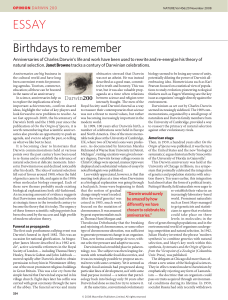
20.11 Essay Darwin.indd MH AY.indd
... Theodosius Dobzhansky that the breaking flow of genes through populations; and in the and rejoining of chromosomes, or some other environmental world of organisms undergotype of chromosome alteration, was sufficient ing competition and natural selection. In 1942, to generate permanent change in an o ...
... Theodosius Dobzhansky that the breaking flow of genes through populations; and in the and rejoining of chromosomes, or some other environmental world of organisms undergotype of chromosome alteration, was sufficient ing competition and natural selection. In 1942, to generate permanent change in an o ...

Word
... elegantly, in the title of his 1973 essay, “Nothing in biology makes sense except in light of evolution.” The same can be said of human biology and medicine. Pathogens, parasites, symbionts, and their victims or hosts evolve. Training in evolutionary thinking enables biologists to understand biologi ...
... elegantly, in the title of his 1973 essay, “Nothing in biology makes sense except in light of evolution.” The same can be said of human biology and medicine. Pathogens, parasites, symbionts, and their victims or hosts evolve. Training in evolutionary thinking enables biologists to understand biologi ...
NAME
... Which one of the following scientists first suggested that populations of organisms could change over time and that changes acquired within the lifetime of the individual could be passed onto its offspring? a. b. c. d. ...
... Which one of the following scientists first suggested that populations of organisms could change over time and that changes acquired within the lifetime of the individual could be passed onto its offspring? a. b. c. d. ...

Word
... elegantly, in the title of his 1973 essay, “Nothing in biology makes sense except in light of evolution.” The same can be said of human biology and medicine. Pathogens, parasites, symbionts, and their victims or hosts evolve. Training in evolutionary thinking enables biologists to understand biologi ...
... elegantly, in the title of his 1973 essay, “Nothing in biology makes sense except in light of evolution.” The same can be said of human biology and medicine. Pathogens, parasites, symbionts, and their victims or hosts evolve. Training in evolutionary thinking enables biologists to understand biologi ...

Ladybirds - Stellenbosch University
... defence against a changing climate. What about evolution? Rapid evolution: will it tip the balance? Since Charles Darwin first put forth his theory of evolution by natural selection in 1859, most scientists have considered evolution to be such a painfully slow process that we could only observe it i ...
... defence against a changing climate. What about evolution? Rapid evolution: will it tip the balance? Since Charles Darwin first put forth his theory of evolution by natural selection in 1859, most scientists have considered evolution to be such a painfully slow process that we could only observe it i ...

EXAM 1 Study Guide 2006 - University of Arizona | Ecology and
... On average, how much energy flows from one trophic level to the next? Why? How have we altered the stratospheric ozone in the past 50 years? Is this trend continuing? What decades were well represented in our discussion of the history of the U.S. Environmental Movement. What is the goal of the Kyoto ...
... On average, how much energy flows from one trophic level to the next? Why? How have we altered the stratospheric ozone in the past 50 years? Is this trend continuing? What decades were well represented in our discussion of the history of the U.S. Environmental Movement. What is the goal of the Kyoto ...

Ecology and Evolution
... Who were these ecologists? This ecologist was the first to promote the concept of the "food web". The concept focuses on feeding relationships as the links connecting the organisms of an ecological system into a single functional entity. This ecologist coined the term "ecosystem," recognizing that t ...
... Who were these ecologists? This ecologist was the first to promote the concept of the "food web". The concept focuses on feeding relationships as the links connecting the organisms of an ecological system into a single functional entity. This ecologist coined the term "ecosystem," recognizing that t ...