
Reece9e_Lecture_C26
... Morphological divergence between closely related species can be small or great, because morphological diversity may be controlled by relatively few genetic differences. o Consider the Hawaiian silversword plants, which vary from tall, twiggy trees to dense, groundhugging shrubs. These phenotypic dif ...
... Morphological divergence between closely related species can be small or great, because morphological diversity may be controlled by relatively few genetic differences. o Consider the Hawaiian silversword plants, which vary from tall, twiggy trees to dense, groundhugging shrubs. These phenotypic dif ...


Chapter 9. NATURAL SELECTION AND BIOLOGICAL EVOLUTION
... invoked by Darwin’s teachers under the name of the “argument from design”; the Craftsman is necessary to explain the Wonders of Nature. Darwin’s population approach turned all this on its head. He looked for the cause of adaptation and diversification in the grubby events of the everyday lives of or ...
... invoked by Darwin’s teachers under the name of the “argument from design”; the Craftsman is necessary to explain the Wonders of Nature. Darwin’s population approach turned all this on its head. He looked for the cause of adaptation and diversification in the grubby events of the everyday lives of or ...
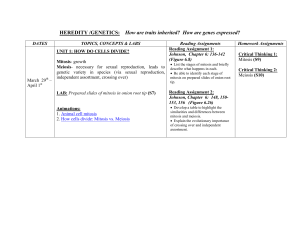
HEREDITY /GENETICS: How are traits inherited? How are genes
... (Focus only on these concepts.) • Explain Mendel’s laws of segregation and independent assortment and show how they are important in genetic crosses. • Recognize ratios of offspring from a dihybrid cross and a dihybrid testcross. • Define epistasis and understand an example. • Define codominant and ...
... (Focus only on these concepts.) • Explain Mendel’s laws of segregation and independent assortment and show how they are important in genetic crosses. • Recognize ratios of offspring from a dihybrid cross and a dihybrid testcross. • Define epistasis and understand an example. • Define codominant and ...

7sci_cfa_naturalselection_ac-1nd0j1h
... 9. The above image shows four different finches that Charles Darwin found while on the Galapagos Islands. This information led Darwin to develop his ideas for natural selection. According to Darwin, what would be the likeliest reason their beaks are different? A. They all ate different food. B. They ...
... 9. The above image shows four different finches that Charles Darwin found while on the Galapagos Islands. This information led Darwin to develop his ideas for natural selection. According to Darwin, what would be the likeliest reason their beaks are different? A. They all ate different food. B. They ...

vertebrates - Dr Magrann
... eggs on their back, in their mouths, or even in their stomach. Some species make nests, and others abandon their eggs in water or in moist environments on land. Many amphibians exhibit complex and diverse social behaviors, especially during their breeding seasons. Frogs are usually quiet, but the ma ...
... eggs on their back, in their mouths, or even in their stomach. Some species make nests, and others abandon their eggs in water or in moist environments on land. Many amphibians exhibit complex and diverse social behaviors, especially during their breeding seasons. Frogs are usually quiet, but the ma ...

36968-156363-1
... Darwin developed of the theory of evolution that is accepted by most scientists today. He described his ideas in a book called On the Origin of Species, which was published in 1859. After many years, Darwin’s hypothesis became known as the theory of evolution by natural selection. Natural selection ...
... Darwin developed of the theory of evolution that is accepted by most scientists today. He described his ideas in a book called On the Origin of Species, which was published in 1859. After many years, Darwin’s hypothesis became known as the theory of evolution by natural selection. Natural selection ...

Evolution Alone Explains Life on Earth
... Although many young-Earth creationists, such as Duane Gish, also allow what they refer to as microevolution within kinds, progressive creationists—because they accept long spans of geological time—at least don't find themselves in the awkward position of having to concede more evolution than even th ...
... Although many young-Earth creationists, such as Duane Gish, also allow what they refer to as microevolution within kinds, progressive creationists—because they accept long spans of geological time—at least don't find themselves in the awkward position of having to concede more evolution than even th ...

(Part 2) The formulation of Theory of natural selection
... • every group of organisms has descended from a common ancestor. • all species can ultimately be traced to a single origin of life on earth. • this “dethroned” man from the pinnacle of “scala naturae” ...
... • every group of organisms has descended from a common ancestor. • all species can ultimately be traced to a single origin of life on earth. • this “dethroned” man from the pinnacle of “scala naturae” ...

BIOL212lec3APR2012
... • In 1844, Darwin wrote an essay on natural selection as the mechanism of descent with modification, but did not introduce his theory publicly • Natural selection is a process in which individuals with favorable inherited traits are more likely to survive and reproduce • In June 1858, Darwin receiv ...
... • In 1844, Darwin wrote an essay on natural selection as the mechanism of descent with modification, but did not introduce his theory publicly • Natural selection is a process in which individuals with favorable inherited traits are more likely to survive and reproduce • In June 1858, Darwin receiv ...

Dov Ospovat. The development of Darwin`s theory
... branching conception of organic nature, a developmental conception in which diversity was seen as proceeding out of an initial unity’’ (p. 116). By giving classificatory and embryological problems preeminence, Ospovat has minimized Darwin’s confrontation with the problem of the copiousness and ubiqu ...
... branching conception of organic nature, a developmental conception in which diversity was seen as proceeding out of an initial unity’’ (p. 116). By giving classificatory and embryological problems preeminence, Ospovat has minimized Darwin’s confrontation with the problem of the copiousness and ubiqu ...

Darwin`s Theory of Evolution The Puzzle of Life`s Diversity Chapter
... Living things pass changes on to their offspring, leading to species changes Sooner or later growing populations run out of resources Living things change slowly over time because of competition for resources, and pass those changes on to their offspring ...
... Living things pass changes on to their offspring, leading to species changes Sooner or later growing populations run out of resources Living things change slowly over time because of competition for resources, and pass those changes on to their offspring ...
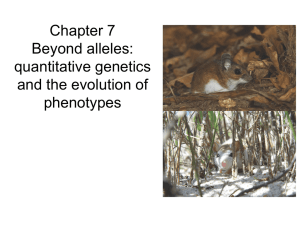
Chapter 7 Beyond alleles: quantitative genetics and the
... can be attributed to polygenic effects, i.e., product of two or more genes, and their environment. ...
... can be attributed to polygenic effects, i.e., product of two or more genes, and their environment. ...

Survival of the Fakest
... But a century and a half of continued fossil collecting has only aggravated the problem. Instead of slight differences appearing first, then greater differences emerging later, the greatest differences appear right at the start. Some fossil experts describe this as “top-down evolution,” and note tha ...
... But a century and a half of continued fossil collecting has only aggravated the problem. Instead of slight differences appearing first, then greater differences emerging later, the greatest differences appear right at the start. Some fossil experts describe this as “top-down evolution,” and note tha ...

Big Ideas PPT
... • 2A – Growth, reproduction and maintenance of the organization of living systems require free energy and matter. • 2B – Growth, reproduction and dynamic homeostasis require that cells create and maintain internal environments that are different from their external environments. • 2C – Organisms use ...
... • 2A – Growth, reproduction and maintenance of the organization of living systems require free energy and matter. • 2B – Growth, reproduction and dynamic homeostasis require that cells create and maintain internal environments that are different from their external environments. • 2C – Organisms use ...

Chapter 22 Practice Multiple Choice
... fashion to perform the same function. Which information would best help distinguish between an explanation based on homology versus one based on convergent evolution? a. The two species live at great distance from each other. b. The two species share many proteins in common, and the nucleotide seque ...
... fashion to perform the same function. Which information would best help distinguish between an explanation based on homology versus one based on convergent evolution? a. The two species live at great distance from each other. b. The two species share many proteins in common, and the nucleotide seque ...

Evidence of Evolution Ch. 22 PPT
... Geologist give us time for evolution Charles Lyell (1797-1875) studied the Temple of Scrapis (Sicily) built on land & used until 200 AD high tide now above temple floor erosion in columns well above high tide ...
... Geologist give us time for evolution Charles Lyell (1797-1875) studied the Temple of Scrapis (Sicily) built on land & used until 200 AD high tide now above temple floor erosion in columns well above high tide ...

Darwin`s theory of evolution is correct for $75.00
... Continue to play until all questions have been answered. The team with the most points wins. ...
... Continue to play until all questions have been answered. The team with the most points wins. ...

Answers to Mastering Concepts Questions
... 1. How did James Hutton, Georges Cuvier, Georges-Louis Buffon, Jean Baptiste de Lamarck, Charles Lyell, and Thomas Malthus influence Charles Darwin’s thinking? James Hutton influenced Darwin by suggesting that changes in nature were gradual and uniform (a concept called uniformitarianism). Georges C ...
... 1. How did James Hutton, Georges Cuvier, Georges-Louis Buffon, Jean Baptiste de Lamarck, Charles Lyell, and Thomas Malthus influence Charles Darwin’s thinking? James Hutton influenced Darwin by suggesting that changes in nature were gradual and uniform (a concept called uniformitarianism). Georges C ...

Boone County Biology Curriculum Map Unit 1, Matter and Energy
... HS-LS3-1. Ask questions to clarify relationships about the role of DNA and chromosomes in coding the instructions for characteristic traits passed from parents to offspring. HS-LS3-2. Make and defend a claim based on evidence that inheritable genetic variations may result from: (1) new genetic combi ...
... HS-LS3-1. Ask questions to clarify relationships about the role of DNA and chromosomes in coding the instructions for characteristic traits passed from parents to offspring. HS-LS3-2. Make and defend a claim based on evidence that inheritable genetic variations may result from: (1) new genetic combi ...

Patterns of evolution worksheet answers
... worldview, and more. Evidence of Evolution-Answers in gray Background When Charles Darwin first proposed the idea that all new species descend from an ancestor, he. An introduction to evolution Evolution briefly defined and explained. The history of life: looking at the patterns How does evolution l ...
... worldview, and more. Evidence of Evolution-Answers in gray Background When Charles Darwin first proposed the idea that all new species descend from an ancestor, he. An introduction to evolution Evolution briefly defined and explained. The history of life: looking at the patterns How does evolution l ...

13.1 A sea voyage helped Darwin frame his theory of evolution
... 13.1 A sea voyage helped Darwin frame his theory of evolution • Consequently, scientists regard Darwin’s concept of evolution by means of natural selection as a theory 2. In a particular environment some individuals of a population or species are better suited to survive (variation) and have more o ...
... 13.1 A sea voyage helped Darwin frame his theory of evolution • Consequently, scientists regard Darwin’s concept of evolution by means of natural selection as a theory 2. In a particular environment some individuals of a population or species are better suited to survive (variation) and have more o ...

David Sloan Wilson - The Good News Now
... levels of selection is not static, but can itself evolve. Mechanisms can evolve that suppress the potential for disruptive selection within groups, so that between-group selection becomes the primary evolutionary force. In human terms, good triumphs over evil. And when this happens, the group become ...
... levels of selection is not static, but can itself evolve. Mechanisms can evolve that suppress the potential for disruptive selection within groups, so that between-group selection becomes the primary evolutionary force. In human terms, good triumphs over evil. And when this happens, the group become ...

Charles Darwin`s paradigm shift
... Biotechnology, whether in the form of genetically modified crops, designer drugs, gene therapy, or the human genome project all derive from Darwin’s profound insight. Darwin had no knowledge of genes, chromosomes, or how inheritance worked. This required additional input from the understanding of Gr ...
... Biotechnology, whether in the form of genetically modified crops, designer drugs, gene therapy, or the human genome project all derive from Darwin’s profound insight. Darwin had no knowledge of genes, chromosomes, or how inheritance worked. This required additional input from the understanding of Gr ...

Charles Darwin – Report
... were already under discussion among earlier and contemporaneous naturalists working on the “species problem” as Darwin began his research. Darwin’s original contributions were the mechanism of natural selection and copious amounts of evidence for evolutionary change from many sources. He also provid ...
... were already under discussion among earlier and contemporaneous naturalists working on the “species problem” as Darwin began his research. Darwin’s original contributions were the mechanism of natural selection and copious amounts of evidence for evolutionary change from many sources. He also provid ...