
Unit 9: Evolution (Part 1)
... b. HOMOLOGOUS STRUCTURES = parts with similar patterns (but with differing functions) to show a common ancestor ...
... b. HOMOLOGOUS STRUCTURES = parts with similar patterns (but with differing functions) to show a common ancestor ...


Understanding the Food Chain and Natural Selection
... SCIENCE CONNECTION: Natural Selection The term “natural selection” was introduced by Charles Darwin in his 1859 book The Origin of Species. In the book, he described natural selection as the process by which species adapt to their environment. In the process, favorable heritable traits become more c ...
... SCIENCE CONNECTION: Natural Selection The term “natural selection” was introduced by Charles Darwin in his 1859 book The Origin of Species. In the book, he described natural selection as the process by which species adapt to their environment. In the process, favorable heritable traits become more c ...
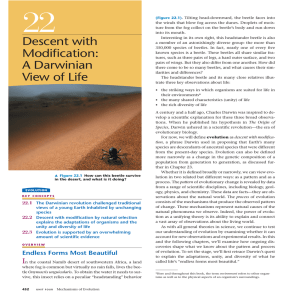
Descent with Modification: A Darwinian View of Life
... stretching its neck to reach leaves on high branches. The second principle, inheritance of acquired characteristics, stated that an organism could pass these modifications to its offspring. Lamarck reasoned that the long, muscular neck of the living giraffe had evolved over many generations as giraff ...
... stretching its neck to reach leaves on high branches. The second principle, inheritance of acquired characteristics, stated that an organism could pass these modifications to its offspring. Lamarck reasoned that the long, muscular neck of the living giraffe had evolved over many generations as giraff ...

Chapter 15 ppt
... genetic makeup of populations over time. Population—a group of individuals of a single species that live and interbreed in a particular geographic area at the same time. Individuals do not evolve; populations do. ...
... genetic makeup of populations over time. Population—a group of individuals of a single species that live and interbreed in a particular geographic area at the same time. Individuals do not evolve; populations do. ...

Evolutionary Science and Society
... of education to attack science. In one recent case, a school board in Cobb County, Georgia, voted to include a disclaimer sticker on biology textbooks that read, in part, “This textbook contains material on evolution. Evolution is a theory, not a fact, regarding the origin of living things,” (Cobb C ...
... of education to attack science. In one recent case, a school board in Cobb County, Georgia, voted to include a disclaimer sticker on biology textbooks that read, in part, “This textbook contains material on evolution. Evolution is a theory, not a fact, regarding the origin of living things,” (Cobb C ...

From Evidence to Inference
... • A population tends to grow until it begins to exhaust environmental resources—food, shelter from predators, etc • When resources become scarce, individuals must compete for them ...
... • A population tends to grow until it begins to exhaust environmental resources—food, shelter from predators, etc • When resources become scarce, individuals must compete for them ...

6.4_EVOLUTION_DIVERSITY OF LIFE NOTES_3_Part 2
... – All Living Organisms Are Related – Single Tree of Life »DNA, Body Structures, Energy Sources Common Descent – All Species, Living & Extinct, Were Derived From Common Ancestors copyright cmassengale ...
... – All Living Organisms Are Related – Single Tree of Life »DNA, Body Structures, Energy Sources Common Descent – All Species, Living & Extinct, Were Derived From Common Ancestors copyright cmassengale ...

4 Macroevolution - Allopatric Speciation PPT
... area where diverse geographic or ecological conditions are available for colonization. • Variants of the ancestral species diverge as populations specialize for each set of conditions • Common during incidences of founder effect because there is many niches available to be filled • Also common after ...
... area where diverse geographic or ecological conditions are available for colonization. • Variants of the ancestral species diverge as populations specialize for each set of conditions • Common during incidences of founder effect because there is many niches available to be filled • Also common after ...

Origins of Diversity
... taxa, they are presenting a hypothesis about the evolutionary history, or phylogeny, of the organisms. For example, Figure 11.24 illustrates the phylogeny of four species of hooved mammals in a phylogenetic tree. Like a family tree, the roots or base of the phylogenetic tree represents the oldest an ...
... taxa, they are presenting a hypothesis about the evolutionary history, or phylogeny, of the organisms. For example, Figure 11.24 illustrates the phylogeny of four species of hooved mammals in a phylogenetic tree. Like a family tree, the roots or base of the phylogenetic tree represents the oldest an ...

Evolution by Natural Selection
... The Vastness of Geologic Time Evidence for the Earth’s vast age began to mount in the late 1700s with James Hutton’s proposal of the principle of uniformitarianism—the idea that geological processes occurring today are similar to what occurred in the past. Hutton reached his geological insight by e ...
... The Vastness of Geologic Time Evidence for the Earth’s vast age began to mount in the late 1700s with James Hutton’s proposal of the principle of uniformitarianism—the idea that geological processes occurring today are similar to what occurred in the past. Hutton reached his geological insight by e ...
Peer-reviewed Article PDF
... variant form that may be transmitted to subsequent generations, These mutations are "'tested" by nature in which the organism exists. Geneticists say; most of mutations (which make changes) are harmful to organisms. Most organisms will die before serious harmful genes are passed on to its offspring ...
... variant form that may be transmitted to subsequent generations, These mutations are "'tested" by nature in which the organism exists. Geneticists say; most of mutations (which make changes) are harmful to organisms. Most organisms will die before serious harmful genes are passed on to its offspring ...

Genetics in conservation biology
... • Leads to increased homozygosity i.e. a greater probability of identical alleles across loci Consequences include inbreeding depression: low survival and reproduction. In worst case scenario, we get an accumulation of deleterious mutations in the homozygous state resulting in mutational meltdown an ...
... • Leads to increased homozygosity i.e. a greater probability of identical alleles across loci Consequences include inbreeding depression: low survival and reproduction. In worst case scenario, we get an accumulation of deleterious mutations in the homozygous state resulting in mutational meltdown an ...

Accounting Jeopardy… - Bi-YOLO-gy
... What are predator/prey, plant/pollinator, and parasite/host? ...
... What are predator/prey, plant/pollinator, and parasite/host? ...

Natural Selection of the Galapagos Origami Bird
... Differences between this DNA connection version and Karin Westerling's original Origami Bird: 1. In the original, mutation always caused a phenotype change, whereas in the DNA version it does not. 2. In the original, mutation occurs in only two thirds of the offspring; in the DNA version, mutation o ...
... Differences between this DNA connection version and Karin Westerling's original Origami Bird: 1. In the original, mutation always caused a phenotype change, whereas in the DNA version it does not. 2. In the original, mutation occurs in only two thirds of the offspring; in the DNA version, mutation o ...
26 Chapter Notes Phylogenetics
... Scientists have sequenced more than 100 billion bases’ worth of nucleic acid data from thousands of species. The new data have supported hypotheses about many evolutionary relationships and have ...
... Scientists have sequenced more than 100 billion bases’ worth of nucleic acid data from thousands of species. The new data have supported hypotheses about many evolutionary relationships and have ...

Darwin`s `one special difficulty`: celebrating Darwin 200
... that coefficients of relatedness can increase a worker’s inclusive fitness only if the sex ratio of fertile females to males becomes female biased (with an equal sex ratio, the advantage of the increased relatedness to sisters, three-quarters, is exactly counterbalanced by their reduced relatedness ...
... that coefficients of relatedness can increase a worker’s inclusive fitness only if the sex ratio of fertile females to males becomes female biased (with an equal sex ratio, the advantage of the increased relatedness to sisters, three-quarters, is exactly counterbalanced by their reduced relatedness ...

document
... B) the outcome of a tradeoff: webbed feet perform poorly on land, but are very helpful in diving for food. C) an example of a trait that has not evolved. D) a curiosity that has little to teach us regarding evolution. ...
... B) the outcome of a tradeoff: webbed feet perform poorly on land, but are very helpful in diving for food. C) an example of a trait that has not evolved. D) a curiosity that has little to teach us regarding evolution. ...

Instructions for SQ3R Notes (with sample)
... share similar structural or genetic features but could have changed enough over time to form a new species. Common ancestors provide clear evidence for how a species has evolved or changed over time. 39. What did Charles Darwin propose? Darwin proposed that modern species came from a common ancestor ...
... share similar structural or genetic features but could have changed enough over time to form a new species. Common ancestors provide clear evidence for how a species has evolved or changed over time. 39. What did Charles Darwin propose? Darwin proposed that modern species came from a common ancestor ...
Ch. 26 - Phillips Scientific Methods
... Morphological divergence between closely related species can be small or great. o Morphological diversity may be controlled by relatively few genetic differences. o Consider the Hawaiian silversword plants, which vary from tall, twiggy trees to dense, groundhugging shrubs. These phenotypic differenc ...
... Morphological divergence between closely related species can be small or great. o Morphological diversity may be controlled by relatively few genetic differences. o Consider the Hawaiian silversword plants, which vary from tall, twiggy trees to dense, groundhugging shrubs. These phenotypic differenc ...
chapter 25 - Biolympiads
... Morphological divergence between closely related species can be small or great. o Morphological diversity may be controlled by relatively few genetic differences. o Consider the Hawaiian silversword plants, which vary from tall, twiggy trees to dense, groundhugging shrubs. These phenotypic differenc ...
... Morphological divergence between closely related species can be small or great. o Morphological diversity may be controlled by relatively few genetic differences. o Consider the Hawaiian silversword plants, which vary from tall, twiggy trees to dense, groundhugging shrubs. These phenotypic differenc ...
Class Notes
... Morphological divergence between closely related species can be small or great. o Morphological diversity may be controlled by relatively few genetic differences. o Consider the Hawaiian silversword plants, which vary from tall, twiggy trees to dense, groundhugging shrubs. These phenotypic differenc ...
... Morphological divergence between closely related species can be small or great. o Morphological diversity may be controlled by relatively few genetic differences. o Consider the Hawaiian silversword plants, which vary from tall, twiggy trees to dense, groundhugging shrubs. These phenotypic differenc ...
22LecturePresentation
... 1795 Hutton proposes his theory of gradualism. 1798 Malthus publishes “Essay on the Principle of Population.” 1809 Lamarck publishes his hypothesis of evolution. 1830 Lyell publishes Principles of Geology. 1831–1836 Darwin travels around the world on HMS Beagle. 1837 Darwin begins his notebooks. 184 ...
... 1795 Hutton proposes his theory of gradualism. 1798 Malthus publishes “Essay on the Principle of Population.” 1809 Lamarck publishes his hypothesis of evolution. 1830 Lyell publishes Principles of Geology. 1831–1836 Darwin travels around the world on HMS Beagle. 1837 Darwin begins his notebooks. 184 ...

document
... B) the outcome of a tradeoff: webbed feet perform poorly on land, but are very helpful in diving for food. C) an example of a trait that has not evolved. D) a curiosity that has little to teach us regarding evolution. ...
... B) the outcome of a tradeoff: webbed feet perform poorly on land, but are very helpful in diving for food. C) an example of a trait that has not evolved. D) a curiosity that has little to teach us regarding evolution. ...