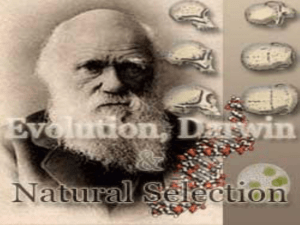

4. Evolution by Boardworks MA File
... Victorian scientists found it difficult to test Darwin’s theory. For his theory to work, the Earth needed to be millions of years old, but its age was not known at that time. In addition, little was known about the process of fossilization or how to explain gaps in the fossil record. 21 of 38 ...
... Victorian scientists found it difficult to test Darwin’s theory. For his theory to work, the Earth needed to be millions of years old, but its age was not known at that time. In addition, little was known about the process of fossilization or how to explain gaps in the fossil record. 21 of 38 ...
Introduction to Evolu- tionary Anthropology
... you picture researchers studying primitive human cultures deep in the jungle, archaeologists struggling to locate treasures in the ruins of ancient cities, or scientists digging for fossils under the blazing sun in Africa. Certainly, some aspects of all these activities relate to anthropology. Anthr ...
... you picture researchers studying primitive human cultures deep in the jungle, archaeologists struggling to locate treasures in the ruins of ancient cities, or scientists digging for fossils under the blazing sun in Africa. Certainly, some aspects of all these activities relate to anthropology. Anthr ...

The Philosophical Foundations of Darwinism
... such genetic variation is a response to the adaptive needs of an organism. Such a response never occurs, and genetics has shown that there is no inheritance of acquired characters. In spite of his uncertainties Darwin certainly was one of the great pioneers in making the chance nature of many biolog ...
... such genetic variation is a response to the adaptive needs of an organism. Such a response never occurs, and genetics has shown that there is no inheritance of acquired characters. In spite of his uncertainties Darwin certainly was one of the great pioneers in making the chance nature of many biolog ...

Four Big Ideas and Enduring Understandings
... Investigations: 2 (Hardy-Weinberg, classic) and 3 (Blast Lab) Enduring Understanding 1.A. Change in the genetic makeup of a population over time is evolution. Chapters: 17-18 1.A.1 Natural selection is a major mechanism of evolution. 1.A.2 Natural selection acts on phenotypic variations in populatio ...
... Investigations: 2 (Hardy-Weinberg, classic) and 3 (Blast Lab) Enduring Understanding 1.A. Change in the genetic makeup of a population over time is evolution. Chapters: 17-18 1.A.1 Natural selection is a major mechanism of evolution. 1.A.2 Natural selection acts on phenotypic variations in populatio ...


16-4
... Evolutionary theory explains the existence of homologous structures adapted to different purposes as the result of descent with modification from a common ancestor. Biologists test whether structures are homologous by studying anatomical details, the way structures develop in embryos, and the pattern ...
... Evolutionary theory explains the existence of homologous structures adapted to different purposes as the result of descent with modification from a common ancestor. Biologists test whether structures are homologous by studying anatomical details, the way structures develop in embryos, and the pattern ...

A Macrobiological Perspective on Microbial Species
... Periodic selection theory predicts that ecologically specialized populations (ecotypes) evolve through a series of events in which one most-fit population member outcompetes (quite contrary to the opinion I started all others within the ecotype, squashing diversity within the population; subsequentl ...
... Periodic selection theory predicts that ecologically specialized populations (ecotypes) evolve through a series of events in which one most-fit population member outcompetes (quite contrary to the opinion I started all others within the ecotype, squashing diversity within the population; subsequentl ...

Prentice Hall Biology
... When Darwin developed his theory of evolution, he didn’t know how ____________ HEREDITY worked. inheritance in peas Mendel’s work on ______________ was published during Darwin’s NOT recognized lifetime, but ________________ as decades later important until __________________. ...
... When Darwin developed his theory of evolution, he didn’t know how ____________ HEREDITY worked. inheritance in peas Mendel’s work on ______________ was published during Darwin’s NOT recognized lifetime, but ________________ as decades later important until __________________. ...
The opposable THUMB
... thought to have triggered changes in human development which makes us different from chimpanzees and other apes. Other observable differences between chimpanzees and ...
... thought to have triggered changes in human development which makes us different from chimpanzees and other apes. Other observable differences between chimpanzees and ...
Fundamental Questions in Biology
... that information is organized, how it is distributed over the biota, and why specific genes are associated with particular regions of the ecosystem. Are there particular conditions that select for novelty and for high mutation or recombination rates? What about for cooperative behavior? What is the r ...
... that information is organized, how it is distributed over the biota, and why specific genes are associated with particular regions of the ecosystem. Are there particular conditions that select for novelty and for high mutation or recombination rates? What about for cooperative behavior? What is the r ...

Evolution of Galapagos Island Finches The finches on the
... Q. 3 Using beak size as an example, identify two things that must be true in order for natural selection to be capable of producing the diversity observed. Peter and Rosemary Grant from Princeton University spent twenty years studying the finches in order to test the hypothesis that natural selectio ...
... Q. 3 Using beak size as an example, identify two things that must be true in order for natural selection to be capable of producing the diversity observed. Peter and Rosemary Grant from Princeton University spent twenty years studying the finches in order to test the hypothesis that natural selectio ...

Chapter 15 Lecture Slides
... genetic makeup of populations over time. Population—a group of individuals of a single species that live and interbreed in a particular geographic area at the same time. Individuals do not evolve; populations do. ...
... genetic makeup of populations over time. Population—a group of individuals of a single species that live and interbreed in a particular geographic area at the same time. Individuals do not evolve; populations do. ...

Mechanisms of Evolution
... genetic makeup of populations over time. Population—a group of individuals of a single species that live and interbreed in a particular geographic area at the same time. Individuals do not evolve; populations do. ...
... genetic makeup of populations over time. Population—a group of individuals of a single species that live and interbreed in a particular geographic area at the same time. Individuals do not evolve; populations do. ...

Exam 2 Study Guide
... Make sure to get a copy of someone’s notes for any days you missed. Study vocabulary so that you can recognize words used in context. Make sure that you understand the concepts that we discussed. Chapter 14 Evolution and Natural Selection Natural selection – definition, role of heritable variation T ...
... Make sure to get a copy of someone’s notes for any days you missed. Study vocabulary so that you can recognize words used in context. Make sure that you understand the concepts that we discussed. Chapter 14 Evolution and Natural Selection Natural selection – definition, role of heritable variation T ...
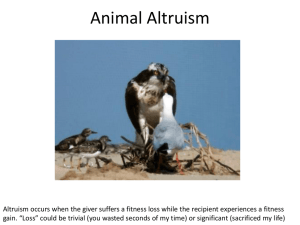
animal altruism
... contrast between the extravagances of court life and the poverty of Russian peasants. • Studied biology and geography; volunteered for expedition to eastern Siberia. Expected Darwin’s prediction of competition, instead saw cooperation in both society and nature. • Published Mutual Aid: A Factor of E ...
... contrast between the extravagances of court life and the poverty of Russian peasants. • Studied biology and geography; volunteered for expedition to eastern Siberia. Expected Darwin’s prediction of competition, instead saw cooperation in both society and nature. • Published Mutual Aid: A Factor of E ...

Evolution Part 2
... • Darwin was convinced a process like artificial selection was at work in nature. • Darwin recalled the work of Malthus on population growth – having too many offspring to all survive would result in a competition for resources. • Which ones, Darwin wondered, would be the most likely to survive and ...
... • Darwin was convinced a process like artificial selection was at work in nature. • Darwin recalled the work of Malthus on population growth – having too many offspring to all survive would result in a competition for resources. • Which ones, Darwin wondered, would be the most likely to survive and ...

Lesson Overview
... Lesson Overview Fitness describes how well an organism can survive and reproduce in its environment. Individuals with adaptations that are well-suited to their environment can survive and reproduce and are said to ...
... Lesson Overview Fitness describes how well an organism can survive and reproduce in its environment. Individuals with adaptations that are well-suited to their environment can survive and reproduce and are said to ...
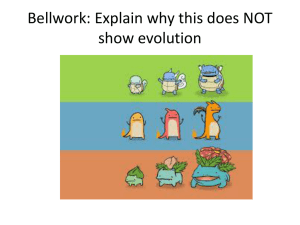
(natural selection).
... is adapted to survive in every ecosystem. Plants are specialists and thrive in environments that they are best adapted to, but could die in the wrong environment. A cactus would die in a wetland. A palm tree would freeze during a winter. • Plant populations adapt to survive in different ...
... is adapted to survive in every ecosystem. Plants are specialists and thrive in environments that they are best adapted to, but could die in the wrong environment. A cactus would die in a wetland. A palm tree would freeze during a winter. • Plant populations adapt to survive in different ...

PDF | 474.8KB
... a. The wing and the forelimb are vestigial structures from a common ancestor. b. The cat and the bat evolved similar structures from separate ancestors. c. Disruptive selection caused similar structures in each animal. d. The wing and the forelimb are homologous structures from a common ancestor. 16 ...
... a. The wing and the forelimb are vestigial structures from a common ancestor. b. The cat and the bat evolved similar structures from separate ancestors. c. Disruptive selection caused similar structures in each animal. d. The wing and the forelimb are homologous structures from a common ancestor. 16 ...

APBiology 11
... ___Helped to determine the age of organisms and therefore when they evolved and how they progressed or changed over time. _______________________________________ How did the ideas of Hutton and Lyell influence Darwin’s thinking about the evolution of life? ___Geologists had studied the changes in th ...
... ___Helped to determine the age of organisms and therefore when they evolved and how they progressed or changed over time. _______________________________________ How did the ideas of Hutton and Lyell influence Darwin’s thinking about the evolution of life? ___Geologists had studied the changes in th ...

File
... Natural selection can only occur if there is variation among members of the same species. Mutation, meiosis and sexual reproduction cause variation between individuals in a species. Adaptations are characteristics that make an individual suited to its environment and way of life. Species tend to pro ...
... Natural selection can only occur if there is variation among members of the same species. Mutation, meiosis and sexual reproduction cause variation between individuals in a species. Adaptations are characteristics that make an individual suited to its environment and way of life. Species tend to pro ...

Fact 1 - NESCent
... How do they store the energy of light? How does the stored light energy get to you? How does this formula represent the 1st law of Thermodynamics? (Teacher Note: What do students need to know to answer these questions?) ...
... How do they store the energy of light? How does the stored light energy get to you? How does this formula represent the 1st law of Thermodynamics? (Teacher Note: What do students need to know to answer these questions?) ...

15-3 Darwin Presents His Case
... Evolution by Natural Selection Darwin compared processes in nature to artificial selection. By doing so, he developed a scientific hypothesis to explain how evolution occurs. Now, with the work of others, it is a theory: a well-tested explanation that unifies a broad range of observations. Slide 5 o ...
... Evolution by Natural Selection Darwin compared processes in nature to artificial selection. By doing so, he developed a scientific hypothesis to explain how evolution occurs. Now, with the work of others, it is a theory: a well-tested explanation that unifies a broad range of observations. Slide 5 o ...
Darwin
... • In reassessing his observations, Darwin perceived adaptation to the environment and the origin of new species as closely related processes • From studies made years after Darwin’s voyage, biologists have concluded that this is what happened to the Galápagos finches ...
... • In reassessing his observations, Darwin perceived adaptation to the environment and the origin of new species as closely related processes • From studies made years after Darwin’s voyage, biologists have concluded that this is what happened to the Galápagos finches ...