
The Case Against Evolution - Third Millennium Ministries
... species in biology, elements in chemistry, and suns in astronomy! As Huxley insists: “The whole of reality is evolution.”6 It is hard to believe that the leaders in evolutionary thought, not to mention their hosts of uncritical followers, have ever really confronted this gross contradiction between ...
... species in biology, elements in chemistry, and suns in astronomy! As Huxley insists: “The whole of reality is evolution.”6 It is hard to believe that the leaders in evolutionary thought, not to mention their hosts of uncritical followers, have ever really confronted this gross contradiction between ...

Why evolution happens
... − Please send in photographs − Recall that Darwin's observations on the Beagle convinced him of the fact of evolution − that is, that populations of organisms change over time − The problem was to explain how evolution could occur. − There was already a theory for this, originally proposed by Jean B ...
... − Please send in photographs − Recall that Darwin's observations on the Beagle convinced him of the fact of evolution − that is, that populations of organisms change over time − The problem was to explain how evolution could occur. − There was already a theory for this, originally proposed by Jean B ...

Medical Genetics
... introduction of new alleles into the population. This will only occur after the migrant has successfully mated with an individual in the population. The term that is used to described this introduction of new alleles is gene flow. 5. The two effects of migration are to: (1) increase variability with ...
... introduction of new alleles into the population. This will only occur after the migrant has successfully mated with an individual in the population. The term that is used to described this introduction of new alleles is gene flow. 5. The two effects of migration are to: (1) increase variability with ...

Darwin`s Living Legacy
... biology’s mutability was shared by some other evolutionary thinkers of the day. But it was conceived as a scala naturae — an ascending ladder in which each lineage of plant or animal arose by spontaneous generation from inanimate matter and then progressed inexorably toward greater complexity and pe ...
... biology’s mutability was shared by some other evolutionary thinkers of the day. But it was conceived as a scala naturae — an ascending ladder in which each lineage of plant or animal arose by spontaneous generation from inanimate matter and then progressed inexorably toward greater complexity and pe ...

What Would Darwin Say? - NMS Team Homework
... Compare and contrast the influences of Charles Darwin’s and Alfred Russel Wallace’s work, including their independent discovery of the natural origin of species which led to the formulation of the theory of evolution by natural selection, which are based on distinct sets of observations and facts (U ...
... Compare and contrast the influences of Charles Darwin’s and Alfred Russel Wallace’s work, including their independent discovery of the natural origin of species which led to the formulation of the theory of evolution by natural selection, which are based on distinct sets of observations and facts (U ...

Biology
... ● How does meiosis create genetic diversity? material (two variants of each chromosome pair) to both ● How is probability used to predict genetic daughter cells. Cellular division and differentiation outcomes? produce and maintain a complex organism, composed of ● Does the environment have a role in ...
... ● How does meiosis create genetic diversity? material (two variants of each chromosome pair) to both ● How is probability used to predict genetic daughter cells. Cellular division and differentiation outcomes? produce and maintain a complex organism, composed of ● Does the environment have a role in ...
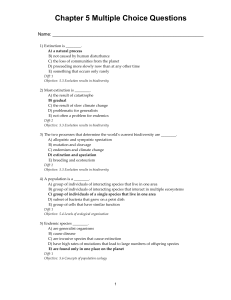
Chapter 5 Multiple Choice Questions (Answers) - science-b
... A) because restoration ecology can restore ecosystems B) because humans can find and make their own resources C) because zoos and gardens contain most important species and breeding technologies are improving D) because our understanding of genetics allows us to restore populations E) incorrect; the ...
... A) because restoration ecology can restore ecosystems B) because humans can find and make their own resources C) because zoos and gardens contain most important species and breeding technologies are improving D) because our understanding of genetics allows us to restore populations E) incorrect; the ...

2.1 Page 1 - csfcbiology
... The word ‘evolution’ is used widely, but in Biology we specifically mean ‘the process that has transformed life on Earth from its earliest beginnings to the diversity of forms we know about today. Species that have lived on Earth were and are formed by a process of continuous change – evolution. Thi ...
... The word ‘evolution’ is used widely, but in Biology we specifically mean ‘the process that has transformed life on Earth from its earliest beginnings to the diversity of forms we know about today. Species that have lived on Earth were and are formed by a process of continuous change – evolution. Thi ...

Misconceptions about Evolution and the Mechanisms of Evolution
... •Misconceptions are unfortunately very common. •Most of these misunderstandings have to do with assumptions that evolution proceeds in a particular direction or that individual living things can choose to adapt. ...
... •Misconceptions are unfortunately very common. •Most of these misunderstandings have to do with assumptions that evolution proceeds in a particular direction or that individual living things can choose to adapt. ...


Final Exam objectives
... Predict the possible offspring of a genetic cross by using a Punnett square. Analyze how meiosis maintains a constant number of chromosomes within a species. Infer how meiosis leads to variation in a species. Relate Mendel’s laws of heredity to the events of meiosis. Chapter 14 The Human Gen ...
... Predict the possible offspring of a genetic cross by using a Punnett square. Analyze how meiosis maintains a constant number of chromosomes within a species. Infer how meiosis leads to variation in a species. Relate Mendel’s laws of heredity to the events of meiosis. Chapter 14 The Human Gen ...

Darwin Synthetic Interview Webquests
... Some individuals that are better adapted, or more fit, for this particular environment (maybe they lose less water to perspiration). These more-fit organisms are able to out-compete the others and create more offspring. Over time, these favorable traits accumulate and the species changes so all orga ...
... Some individuals that are better adapted, or more fit, for this particular environment (maybe they lose less water to perspiration). These more-fit organisms are able to out-compete the others and create more offspring. Over time, these favorable traits accumulate and the species changes so all orga ...

NATURAL SELECTION
... This male red winged blackbird illustrates the colorful shoulder feathers, which are displayed during courtship and territorial defense. ...
... This male red winged blackbird illustrates the colorful shoulder feathers, which are displayed during courtship and territorial defense. ...
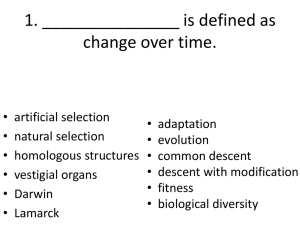
(natural selection).
... 5. An _______________ is any inherited characteristic that increases an organism’s chance of survival. ...
... 5. An _______________ is any inherited characteristic that increases an organism’s chance of survival. ...

Biology 218, Evolution
... evolution is one of the most revolutionary ideas in Western thought. When Darwin put forth his theory of evolution in 1859 it profoundly challenged the prevailing view that the world was static and perfectly created. According to Darwin’s theory, evolution is defined as descent with modification. To ...
... evolution is one of the most revolutionary ideas in Western thought. When Darwin put forth his theory of evolution in 1859 it profoundly challenged the prevailing view that the world was static and perfectly created. According to Darwin’s theory, evolution is defined as descent with modification. To ...

Chapter 22 Reading Guide
... published it in 1859 after learning Wallace had the same idea. Evidence: ...
... published it in 1859 after learning Wallace had the same idea. Evidence: ...

15-3 Darwin Presents His Case
... Individuals that are better suited to their environment survive and reproduce most successfully. Darwin called this process ____________________. ...
... Individuals that are better suited to their environment survive and reproduce most successfully. Darwin called this process ____________________. ...


modeling nat selection beaks
... Medium ground finches on the Galapagos Islands typically feed on small, soft seeds and fruits. The birds prefer soft seeds because they are easier to crack. However, during drought periods, food becomes scarce and birds are forced to eat larger, harder seeds that are difficult to break open. Scienti ...
... Medium ground finches on the Galapagos Islands typically feed on small, soft seeds and fruits. The birds prefer soft seeds because they are easier to crack. However, during drought periods, food becomes scarce and birds are forced to eat larger, harder seeds that are difficult to break open. Scienti ...
Genetic Algorithm
... How is a population with increasing fitness generated? Let us consider a population of rabbits. Some rabbits are faster than others, and we may say that these rabbits possess superior fitness, because they have a greater chance of avoiding foxes, surviving and then breeding. If two parents have sup ...
... How is a population with increasing fitness generated? Let us consider a population of rabbits. Some rabbits are faster than others, and we may say that these rabbits possess superior fitness, because they have a greater chance of avoiding foxes, surviving and then breeding. If two parents have sup ...

`Hybridization of Darwin`s finches on Isla Daphne Major, Galapagos`
... than strongly marked varieties, so that, just as one variety may admittedly give rise to another, so may any species arise by the transformation of an ancestor through a series of intermediate stages. At some point in this process, two lineages descending from a common ancestor become sufficiently d ...
... than strongly marked varieties, so that, just as one variety may admittedly give rise to another, so may any species arise by the transformation of an ancestor through a series of intermediate stages. At some point in this process, two lineages descending from a common ancestor become sufficiently d ...
Darwin`s bridge between microevolution and
... required to replace themselves in the next generation; third, that limited resources create a “struggle for existence” that regulates population size, such that most offspring die without reproducing; and fourth, that the individuals that survive and reproduce are, on average, by virtue of their ind ...
... required to replace themselves in the next generation; third, that limited resources create a “struggle for existence” that regulates population size, such that most offspring die without reproducing; and fourth, that the individuals that survive and reproduce are, on average, by virtue of their ind ...

Evolution
... vestigial structures. A vestigial strucutre is a body part that no longer has a function. How is a vestigial body part evidence of evolution? Most of these body parts do have jobs in other animals. For example, in many mammals the appendix helps digest food. Rabbits are examples of animals with an a ...
... vestigial structures. A vestigial strucutre is a body part that no longer has a function. How is a vestigial body part evidence of evolution? Most of these body parts do have jobs in other animals. For example, in many mammals the appendix helps digest food. Rabbits are examples of animals with an a ...
Characteristics of Life 1.01
... Homeostasis - living organisms maintain a consistent internal environment Heredity - living things pass traits to offspring Responsiveness - all living things respond and adjust to the environment Growth and development - all living things grow and ...
... Homeostasis - living organisms maintain a consistent internal environment Heredity - living things pass traits to offspring Responsiveness - all living things respond and adjust to the environment Growth and development - all living things grow and ...
