
These animals will interbreed with one another
... P. radiata sheds its pollen February and P. muricana shed its pollen in April. ...
... P. radiata sheds its pollen February and P. muricana shed its pollen in April. ...
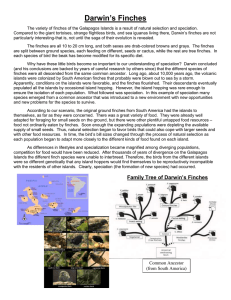
Darwin`s Finches
... The variety of finches of the Galapagos Islands is a result of natural selection and speciation. Compared to the giant tortoises, strange flightless birds, and sea iguanas living there, Darwin’s finches are not particularly interesting-that is, not until the saga of their evolution is revealed. The ...
... The variety of finches of the Galapagos Islands is a result of natural selection and speciation. Compared to the giant tortoises, strange flightless birds, and sea iguanas living there, Darwin’s finches are not particularly interesting-that is, not until the saga of their evolution is revealed. The ...

Evolution - Weber State University
... Wrote On theOrigin of Species In this book, Darwin did did two things: (1) established that species have changed over time (descent with modification) (2) proposed a mechanism for how that process took place (natural selection) Darwin did not arrive at the theory of natural selection out of the blue ...
... Wrote On theOrigin of Species In this book, Darwin did did two things: (1) established that species have changed over time (descent with modification) (2) proposed a mechanism for how that process took place (natural selection) Darwin did not arrive at the theory of natural selection out of the blue ...

Darwin, Victorian England, Eugenics, and a new evolution
... now is called social Darwinism was part of the very essence of biological Darwinism, and not (as commonly supposed today) some kind of addon or misunderstanding of Darwinian evolution. Bennett considers Darwin an atheistic eugenicist and identifies the agenda behind his Origin: “Darwin’s goal was to ...
... now is called social Darwinism was part of the very essence of biological Darwinism, and not (as commonly supposed today) some kind of addon or misunderstanding of Darwinian evolution. Bennett considers Darwin an atheistic eugenicist and identifies the agenda behind his Origin: “Darwin’s goal was to ...

Natural History, Field Ecology, Conservation Biology and Wildlife
... (Pianka 2002). It is among the most demanding tasks mentally and physically. Studies in nature often appear ‘messy’ because there are many confounding environmental factors. Still, many of these complex questions require field-based approaches and demand our best minds to unravel their mysteries. It ...
... (Pianka 2002). It is among the most demanding tasks mentally and physically. Studies in nature often appear ‘messy’ because there are many confounding environmental factors. Still, many of these complex questions require field-based approaches and demand our best minds to unravel their mysteries. It ...
to go to any of the pages listed below, click on its
... ____________________ 1. Many scientists believe that new species develop from older species as a result of adaptation. ____________________ 2. A change in a gene is called a mutation. ____________________ 3. A trait of an organism that helps it survive in its environment is called an evolution. ____ ...
... ____________________ 1. Many scientists believe that new species develop from older species as a result of adaptation. ____________________ 2. A change in a gene is called a mutation. ____________________ 3. A trait of an organism that helps it survive in its environment is called an evolution. ____ ...

AP Biology 2006-2007 Evolution by Natural Selection AP Biology
... AP Biology Life’s Natural History is a record of Successions & Extinctions ...
... AP Biology Life’s Natural History is a record of Successions & Extinctions ...

013368718X_CH17_267
... new population, geographic isolation, changes in the new population’s gene pool, behavioral isolation, and ecological competition. Use the phrases in the box to complete the chart. insects that live inside dead wood ...
... new population, geographic isolation, changes in the new population’s gene pool, behavioral isolation, and ecological competition. Use the phrases in the box to complete the chart. insects that live inside dead wood ...

Ch. 4 Populations and communities
... • Various organisms have evolved different traits • To accomplish the same function (e.g., avoid predation) ...
... • Various organisms have evolved different traits • To accomplish the same function (e.g., avoid predation) ...
Descent with Modification: A Darwinian View of Life
... with favorable inherited traits are more likely to survive and reproduce • In June 1858, Darwin received a manuscript from Alfred Russell Wallace, who had developed a theory of natural selection similar to Darwin’s • Darwin quickly finished The Origin of Species and published it the next year © 2011 ...
... with favorable inherited traits are more likely to survive and reproduce • In June 1858, Darwin received a manuscript from Alfred Russell Wallace, who had developed a theory of natural selection similar to Darwin’s • Darwin quickly finished The Origin of Species and published it the next year © 2011 ...


The Rock Pocket Mouse - Corner Canyon AP Biology
... sandy color. Naturalists in the 1930’s observed that mice found on the lava rocks were typically melanic, while those on the surrounding sand-colored granite rocks were usually light-colored. This color-matching between fur color and habitat background appears to be an adaptation against predators, ...
... sandy color. Naturalists in the 1930’s observed that mice found on the lava rocks were typically melanic, while those on the surrounding sand-colored granite rocks were usually light-colored. This color-matching between fur color and habitat background appears to be an adaptation against predators, ...

Evolution! - Bloom High School
... Perfection with Use & Need the constant use of an organ leads that organ to increase in size — like the muscles of a blacksmith or the large ears of a night-flying bat ...
... Perfection with Use & Need the constant use of an organ leads that organ to increase in size — like the muscles of a blacksmith or the large ears of a night-flying bat ...
The Origin of Species
... • As a boy and into adulthood, Charles Darwin had a consuming interest in nature • Darwin first studied medicine (unsuccessfully), and then theology at Cambridge University • After graduating, he took an unpaid position as naturalist and companion to Captain Robert FitzRoy for a 5-year around the wo ...
... • As a boy and into adulthood, Charles Darwin had a consuming interest in nature • Darwin first studied medicine (unsuccessfully), and then theology at Cambridge University • After graduating, he took an unpaid position as naturalist and companion to Captain Robert FitzRoy for a 5-year around the wo ...
lESSON 19.2 - Union City High School
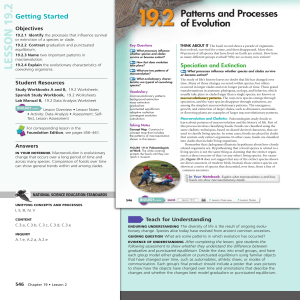
... Rapid Evolution After Equilibrium There are several reasons why evolution may proceed at different rates for different organisms at different times. Rapid evolution may occur after a small population becomes isolated from the main population. This small population can evolve faster than the larger o ...
... Rapid Evolution After Equilibrium There are several reasons why evolution may proceed at different rates for different organisms at different times. Rapid evolution may occur after a small population becomes isolated from the main population. This small population can evolve faster than the larger o ...

Phenotypic and genetic changes in life history traits in experimental
... three different fishing regimes: 1) positive size-selective harvest, where individuals larger than a minimum size (16 mm) were killed, mimicking a commercial fishery; 2) negative size-selective harvest consisted of removing individuals smaller than 16 mm; and 3) in size-independent harvest both larg ...
... three different fishing regimes: 1) positive size-selective harvest, where individuals larger than a minimum size (16 mm) were killed, mimicking a commercial fishery; 2) negative size-selective harvest consisted of removing individuals smaller than 16 mm; and 3) in size-independent harvest both larg ...

Jeopardy Powerpoint Review Game
... • Gazelles on the African plains are often hunted by the top predators. Over time, the gazelles have evolved to have very large eyes on either side of their head and very large ...
... • Gazelles on the African plains are often hunted by the top predators. Over time, the gazelles have evolved to have very large eyes on either side of their head and very large ...

6-15 CRW edit, JS intro, chp 1 and 2 copy
... existence and therefore would be selected naturally, and some would not. In this way the frequency of specific variations within populations would change over time, populations would evolve. This is indeed how population geneticists today see evolution. In tracing their views to Darwin, they make a ...
... existence and therefore would be selected naturally, and some would not. In this way the frequency of specific variations within populations would change over time, populations would evolve. This is indeed how population geneticists today see evolution. In tracing their views to Darwin, they make a ...
Some Biological Problems With The Natural Selection Theory
... the major support pillar for macroevolution is problematic. In. the first chapter of The Origin, Darwin discusses extensively artificial selection and extrapolates far beyond what his data warrants (Gale, 1982). The two major problems with this analogy between artificial and natural selection includ ...
... the major support pillar for macroevolution is problematic. In. the first chapter of The Origin, Darwin discusses extensively artificial selection and extrapolates far beyond what his data warrants (Gale, 1982). The two major problems with this analogy between artificial and natural selection includ ...

The Evidence for Evolution
... can weigh more than a half ton. Examination of the fossil record reveals that horses changed little in size for their first 30 million years, but since then, a number of different lineages exhibited rapid and substantial increases. However, trends toward decreased size were also exhibited among some ...
... can weigh more than a half ton. Examination of the fossil record reveals that horses changed little in size for their first 30 million years, but since then, a number of different lineages exhibited rapid and substantial increases. However, trends toward decreased size were also exhibited among some ...

Lecture 3 The Darwinian Revolution
... • changes were then transmitted to subsequent generations. • now called the “inheritance of acquired ...
... • changes were then transmitted to subsequent generations. • now called the “inheritance of acquired ...

Station #1 – Insect Insanity
... 2. There is an island not far from the Galapagos chain that currently has NO finches living on it. A fire recently struck this remote island killing many of the trees and plants. All that is left is the bare soil with some worms, ants, and other bugs crawling around. Three types of finches have flow ...
... 2. There is an island not far from the Galapagos chain that currently has NO finches living on it. A fire recently struck this remote island killing many of the trees and plants. All that is left is the bare soil with some worms, ants, and other bugs crawling around. Three types of finches have flow ...

Darwin`s finches highlight the unity of all life
... Nature. In this latest research, the entire genomes at the power of genomics tools such as those used of 120 individual birds from all Galapagos species in generating the results described in this paper. He plus two closely related species from other genera would also be delighted to see such strong ...
... Nature. In this latest research, the entire genomes at the power of genomics tools such as those used of 120 individual birds from all Galapagos species in generating the results described in this paper. He plus two closely related species from other genera would also be delighted to see such strong ...

Genetic Variation PDF
... remaining 5 coins have children and boost the population back up to 10, but keep the ratio of heads to tails the same. For example, if you had 2 heads and 3 tails then after reproduction you should have 4 heads and 6 tails. Repeat this process a few times and before you know it all your coins will b ...
... remaining 5 coins have children and boost the population back up to 10, but keep the ratio of heads to tails the same. For example, if you had 2 heads and 3 tails then after reproduction you should have 4 heads and 6 tails. Repeat this process a few times and before you know it all your coins will b ...

AP Biology Syllabus - Mr. Multhaupt`s Biology Page
... Do not feel overwhelmed. Yes there is a lot of information that we will be covered, but I have had numerous students tell me that they felt very prepared for the AP exam. I have also been told by most of the students that despite the amount of work the class entails, they very much enjoyed the cours ...
... Do not feel overwhelmed. Yes there is a lot of information that we will be covered, but I have had numerous students tell me that they felt very prepared for the AP exam. I have also been told by most of the students that despite the amount of work the class entails, they very much enjoyed the cours ...