
Natural Selection and Adaptations - pams
... 1.What did the experiment show about how prey are selected by predators? 2. What moth coloration is the best adaptation for a dark (newspaper) background? How do you know? 3. What would you expect the next generation of moths to look like after trial 1? What about the next generation after trial 3? ...
... 1.What did the experiment show about how prey are selected by predators? 2. What moth coloration is the best adaptation for a dark (newspaper) background? How do you know? 3. What would you expect the next generation of moths to look like after trial 1? What about the next generation after trial 3? ...

presenter notes: evolution
... Presenter notes: To give rise to a new species, Microevolution needs to go on for more much longer than humans have been breeding dogs. For example, if a species was to become divided into two isolated populations for tens of thousands of years, then natural selection would eventually change the fre ...
... Presenter notes: To give rise to a new species, Microevolution needs to go on for more much longer than humans have been breeding dogs. For example, if a species was to become divided into two isolated populations for tens of thousands of years, then natural selection would eventually change the fre ...
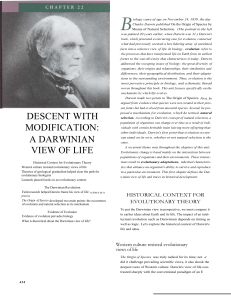
Darwin Chap.
... and he thought that species could move up the ladders toward greater complexity. On the lowest rungs were the microscopic organisms, which Lamarck believed were continually generated spontaneously from nonliving material. At the top of the evolutionary ladders were the most complex plants and animal ...
... and he thought that species could move up the ladders toward greater complexity. On the lowest rungs were the microscopic organisms, which Lamarck believed were continually generated spontaneously from nonliving material. At the top of the evolutionary ladders were the most complex plants and animal ...

File
... 4. Organisms with best adaptations are most likely to survive to reproduce 5. They will pass their genes to next generation 6. Over time, there will be more organisms with best adaptations for the environment ...
... 4. Organisms with best adaptations are most likely to survive to reproduce 5. They will pass their genes to next generation 6. Over time, there will be more organisms with best adaptations for the environment ...

AP Biology – Chapter 22
... Observation 2 – Traits are inherited from parents to offspring Observation 3 – All species are capable of producing more offspring than their environment can support (all species have the reproduction potential to increase their population size exponentially if all individuals born reproduce) Observ ...
... Observation 2 – Traits are inherited from parents to offspring Observation 3 – All species are capable of producing more offspring than their environment can support (all species have the reproduction potential to increase their population size exponentially if all individuals born reproduce) Observ ...

Darwin`s Theory of Evolution
... Darwin’s Epic Journey Darwin developed a scientific theory to explain how evolution, or change over time, occurs in living things. Darwin’s theory explains how modern organisms have evolved over long periods of time through descent from common ancestors. Observations Aboard the Beagle During his fiv ...
... Darwin’s Epic Journey Darwin developed a scientific theory to explain how evolution, or change over time, occurs in living things. Darwin’s theory explains how modern organisms have evolved over long periods of time through descent from common ancestors. Observations Aboard the Beagle During his fiv ...

1 The Transformations of Darwinism
... a struggle for existence. By using these laws, it is possible to formulate Darwin’s theory in a very general and abstract way, without referring to our own world or to the types of reproduction, inheritance, variation, and competition with which we are familiar. For example, in British evolutionary ...
... a struggle for existence. By using these laws, it is possible to formulate Darwin’s theory in a very general and abstract way, without referring to our own world or to the types of reproduction, inheritance, variation, and competition with which we are familiar. For example, in British evolutionary ...

Introduction to Evolutionary Computation
... • Locus = location of a gene • Genome = the complete collection of genetic material (all chromosomes together) • Genotype = the particular set of genes contained in a genome • Phenotype = the manifested characteristics of the individual; determined by the genotype • Haploid set: a single complement ...
... • Locus = location of a gene • Genome = the complete collection of genetic material (all chromosomes together) • Genotype = the particular set of genes contained in a genome • Phenotype = the manifested characteristics of the individual; determined by the genotype • Haploid set: a single complement ...
as a PDF
... modification is the theory of natural selection. In his proposed model for evolution Darwin again draws from gradualism to explain his mechanism of evolution, citing gradual change as the origin of evolution by natural selection. To succinctly state Darwin’s theory of evolution through natural selec ...
... modification is the theory of natural selection. In his proposed model for evolution Darwin again draws from gradualism to explain his mechanism of evolution, citing gradual change as the origin of evolution by natural selection. To succinctly state Darwin’s theory of evolution through natural selec ...

Unit 5 Qualifier - Mrs. Wolodkowicz`s Biological Realm
... 7. Define the Hardy-Weinberg Law & why do scientists believe this is an excellent source of proof for evolution._____________________________________ ____________________________________________________________ ____________________________________________________________ ____________________________ ...
... 7. Define the Hardy-Weinberg Law & why do scientists believe this is an excellent source of proof for evolution._____________________________________ ____________________________________________________________ ____________________________________________________________ ____________________________ ...

- Philsci-Archive
... empirical anomalies, to suggest novel tests, ideally tests that force choices among competitors, to account for evidence formerly not thought of as evidence for that theory at all, and so on. I would argue that, while this is not the only ‘environmental’ factor shaping theory construction and revisi ...
... empirical anomalies, to suggest novel tests, ideally tests that force choices among competitors, to account for evidence formerly not thought of as evidence for that theory at all, and so on. I would argue that, while this is not the only ‘environmental’ factor shaping theory construction and revisi ...

1.2 Unifying Themes of Biology
... you have a complete set of car parts, you might not have a functioning car. Only when all of the parts that make up a car are put together in the correct way do you have a working car. A car is a system. A system is an organized group of related parts that interact to form a whole. Like any other sy ...
... you have a complete set of car parts, you might not have a functioning car. Only when all of the parts that make up a car are put together in the correct way do you have a working car. A car is a system. A system is an organized group of related parts that interact to form a whole. Like any other sy ...

Kliknij tutaj aby pobrać plik
... descendants does not of itself suggest that the biologically fittest will be in any other sense the best. There need not be any definite direction in the process of natural selection, except in so far as organisms survive because they are suited to their particular ecological niche. Evolving organis ...
... descendants does not of itself suggest that the biologically fittest will be in any other sense the best. There need not be any definite direction in the process of natural selection, except in so far as organisms survive because they are suited to their particular ecological niche. Evolving organis ...


مواصفات مقرر الأصول الفلسفية للتربية
... The gene poll The factors that change gene frequencies: Genetic drift Gene flow (migration) Mutation Natural selection. Adaptive evolution. Co adapted gene complexes. Selection - Stabilizing selection - Directional selection. o Disruptive selection The evolutionary history of life: ...
... The gene poll The factors that change gene frequencies: Genetic drift Gene flow (migration) Mutation Natural selection. Adaptive evolution. Co adapted gene complexes. Selection - Stabilizing selection - Directional selection. o Disruptive selection The evolutionary history of life: ...

File
... 6. proposed the theory of evolution by natural selection 7. formation of new species 8. change over time 11. required for new species to form 14. preserved remains of ancient organisms 15. had different shaped beaks depending on the island they were from 16. the study of the earth 19. structures tha ...
... 6. proposed the theory of evolution by natural selection 7. formation of new species 8. change over time 11. required for new species to form 14. preserved remains of ancient organisms 15. had different shaped beaks depending on the island they were from 16. the study of the earth 19. structures tha ...
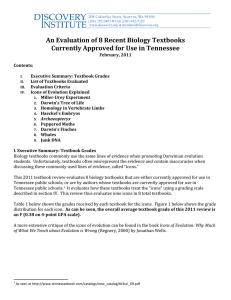
An evaluation of 8 recent biology textbooks currently approved for
... B = explains that the status of Archaeopteryx as a transitional link between reptiles and birds is controversial; points out that modern birds are probably not descended from it; mentions the controversy over whether birds evolved from dinosaurs or from a more primitive group; but fails to point ...
... B = explains that the status of Archaeopteryx as a transitional link between reptiles and birds is controversial; points out that modern birds are probably not descended from it; mentions the controversy over whether birds evolved from dinosaurs or from a more primitive group; but fails to point ...

I. Misconceptions about evolutionary theory and processes
... medical treatments, agricultural practices, and economic structures that significantly alter the challenges to reproduction and survival faced by modern humans. So, for example, because we can now treat diabetes with insulin, the gene versions that contribute to juvenile diabetes are no longer stron ...
... medical treatments, agricultural practices, and economic structures that significantly alter the challenges to reproduction and survival faced by modern humans. So, for example, because we can now treat diabetes with insulin, the gene versions that contribute to juvenile diabetes are no longer stron ...

biology - Auburn School District
... • Please do not talk with each other… quietly think about what you are ...
... • Please do not talk with each other… quietly think about what you are ...


charles darwin and the origin of species
... SPECIES • Charles Darwin published On the Origin of Species by Means of Natural Selection, November 24, 1859. ...
... SPECIES • Charles Darwin published On the Origin of Species by Means of Natural Selection, November 24, 1859. ...


Biology booklet 2
... DNA Evidence for Evolution Deoxyribonucleic acid (DNA) codes for proteins that your body needs to live. Two of those proteins are the alpha and beta hemoglobin proteins that occur in your blood. These proteins carry oxygen and carbon dioxide as they circulate in your bloodstream. Other animals’ bloo ...
... DNA Evidence for Evolution Deoxyribonucleic acid (DNA) codes for proteins that your body needs to live. Two of those proteins are the alpha and beta hemoglobin proteins that occur in your blood. These proteins carry oxygen and carbon dioxide as they circulate in your bloodstream. Other animals’ bloo ...
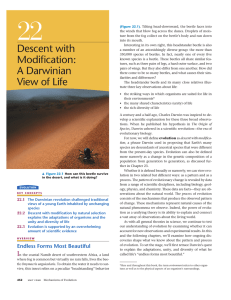
Descent with Modification-A Darwinian View of Life
... stretching its neck to reach leaves on high branches. The second principle, inheritance of acquired characteristics, stated that an organism could pass these modifications to its offspring. Lamarck reasoned that the long, muscular neck of the living giraffe had evolved over many generations as giraf ...
... stretching its neck to reach leaves on high branches. The second principle, inheritance of acquired characteristics, stated that an organism could pass these modifications to its offspring. Lamarck reasoned that the long, muscular neck of the living giraffe had evolved over many generations as giraf ...