Darwin`s Theory of Evolution
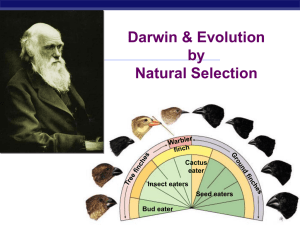
... Darwin observed that the characteristics of many animals and plants varied noticeably among the different Galapagos islands Among the tortoises, the shape of the shell corresponds to different habitats The Hood Island tortoise (right) has a long neck and a shell that is curved and open around the ne ...
... Darwin observed that the characteristics of many animals and plants varied noticeably among the different Galapagos islands Among the tortoises, the shape of the shell corresponds to different habitats The Hood Island tortoise (right) has a long neck and a shell that is curved and open around the ne ...
Exam IV Evolution Notes
... 1. Individuals in a population differ. 2. Some of this variation is heritable. 3. Since more babies are born than an area can support, many die before reaching reproductive age. (Thanks to Malthus.) 4. Individuals with heritable variations that increase their chance of reproductive success will make ...
... 1. Individuals in a population differ. 2. Some of this variation is heritable. 3. Since more babies are born than an area can support, many die before reaching reproductive age. (Thanks to Malthus.) 4. Individuals with heritable variations that increase their chance of reproductive success will make ...

Modular Evolution How Natural Selection Produces Biological
... This book deals with a classic problem in macroevolution: how do we reconcile the Darwinian ‘tree of life’, which implies that every single branch or living species is historically and adaptively unique, with apparent differences in levels of complexity between organisms such as bacteria and humans? ...
... This book deals with a classic problem in macroevolution: how do we reconcile the Darwinian ‘tree of life’, which implies that every single branch or living species is historically and adaptively unique, with apparent differences in levels of complexity between organisms such as bacteria and humans? ...

Hardy-Weinberg Theorem Charles Darwin`s unique contribution to
... Charles Darwin’s unique contribution to biology was not that he “discovered evolution”, but rather, that he proposed a mechanism for evolutionary change ….natural selection, the differential survival and reproduction of the individuals in a population. In On the Origin of Species, published in 1859, ...
... Charles Darwin’s unique contribution to biology was not that he “discovered evolution”, but rather, that he proposed a mechanism for evolutionary change ….natural selection, the differential survival and reproduction of the individuals in a population. In On the Origin of Species, published in 1859, ...

Evolution - Dr. Field`s Notes
... Darwin inferred that if humans could change species by artificial selection, then perhaps the same process could work in nature. ...
... Darwin inferred that if humans could change species by artificial selection, then perhaps the same process could work in nature. ...

GAME PLAN Origin of Species Erasmus Darwin
... 1842 Writes essay on “Origin of Species” distributes it only to few close friends 1858 Wallace proposes an identical theory to Darwin’s 1858 Wallace and Darwin’s papers are presented back to back at a scientific conference 1859 Publishes 600 page “abstract” of detailing and defending his theory 1872 ...
... 1842 Writes essay on “Origin of Species” distributes it only to few close friends 1858 Wallace proposes an identical theory to Darwin’s 1858 Wallace and Darwin’s papers are presented back to back at a scientific conference 1859 Publishes 600 page “abstract” of detailing and defending his theory 1872 ...

the emergence of darwinism - Oxford Academic
... natural history in general-Tropical Nature and The Malay Archipelago. He was the first t o make a comprehensive analysis of cryptic adaptations, he contributed materially to the study of mimicry, and originated the theory of warning coloration. He made many original contributions t o the species pro ...
... natural history in general-Tropical Nature and The Malay Archipelago. He was the first t o make a comprehensive analysis of cryptic adaptations, he contributed materially to the study of mimicry, and originated the theory of warning coloration. He made many original contributions t o the species pro ...

Questions - Vanier College
... something very interesting after the El Niño rains of 1983: a great deal of hybridization began to occur. On some islands which supported several finch species, researchers began identifying numerous individuals that were clearly hybrids of two closely related species. This was particularly the case ...
... something very interesting after the El Niño rains of 1983: a great deal of hybridization began to occur. On some islands which supported several finch species, researchers began identifying numerous individuals that were clearly hybrids of two closely related species. This was particularly the case ...

To foster student understanding of this concept, instructors can
... insights into the history of life on Earth. [See SP 3.1] LO 1.15 The student is able to describe specific examples of conserved core biological processes and features shared by all domains or within one domain of life, and how these shared, conserved core processes and features support the concept o ...
... insights into the history of life on Earth. [See SP 3.1] LO 1.15 The student is able to describe specific examples of conserved core biological processes and features shared by all domains or within one domain of life, and how these shared, conserved core processes and features support the concept o ...

Evolution Big Idea Powerpoint
... insights into the history of life on Earth. [See SP 3.1] LO 1.15 The student is able to describe specific examples of conserved core biological processes and features shared by all domains or within one domain of life, and how these shared, conserved core processes and features support the concept o ...
... insights into the history of life on Earth. [See SP 3.1] LO 1.15 The student is able to describe specific examples of conserved core biological processes and features shared by all domains or within one domain of life, and how these shared, conserved core processes and features support the concept o ...

From lecture:
... Know what proteins are made of, what codes for them, and the role they play in organisms. Know how and where Protein synthesis occurs. Know what transcription and translation refer to. ...
... Know what proteins are made of, what codes for them, and the role they play in organisms. Know how and where Protein synthesis occurs. Know what transcription and translation refer to. ...

Evolution - NIU Department of Biological Sciences
... Both spent years traveling to exotic locations and examining the plants and animals there. Darwin went first, but he spent years slowly thinking and writing. He was only prodded to publish when Wallace showed him his manuscript. ...
... Both spent years traveling to exotic locations and examining the plants and animals there. Darwin went first, but he spent years slowly thinking and writing. He was only prodded to publish when Wallace showed him his manuscript. ...
The Origin of Species
... • As a boy and into adulthood, Charles Darwin had a consuming interest in nature • Darwin first studied medicine (unsuccessfully), and then theology at Cambridge University • After graduating, he took an unpaid position as naturalist and companion to Captain Robert FitzRoy for a 5-year around the wo ...
... • As a boy and into adulthood, Charles Darwin had a consuming interest in nature • Darwin first studied medicine (unsuccessfully), and then theology at Cambridge University • After graduating, he took an unpaid position as naturalist and companion to Captain Robert FitzRoy for a 5-year around the wo ...

Summary of lesson - TI Education
... give a selective advantage. They also might predict that other mutations give no selective advantage in this condition. In this case, they should be clear what that would look like. Students will test this predication, and can amend this prediction in future simulations. Q12. When wolves are perform ...
... give a selective advantage. They also might predict that other mutations give no selective advantage in this condition. In this case, they should be clear what that would look like. Students will test this predication, and can amend this prediction in future simulations. Q12. When wolves are perform ...

Show me the Evidence - Mrs Murphy 7th grade science
... instructions are stored in the organism’s chromosomes. Heredity is the passage of these instructions from one generation to another. LS 8-Recognize that hereditary information is contained in genes located in the chromosomes of each cell. A human cell contains about 30,000 different genes on 23 diff ...
... instructions are stored in the organism’s chromosomes. Heredity is the passage of these instructions from one generation to another. LS 8-Recognize that hereditary information is contained in genes located in the chromosomes of each cell. A human cell contains about 30,000 different genes on 23 diff ...

Week 1 - Speyside High School
... Natural selection is the survival of the fittest (those organisms best suited to their environment): o Many more young are produced than can possible survive o In a population there is variation caused by meiosis, sexual reproduction and mutation o Organisms poorly adapted to their environment die ...
... Natural selection is the survival of the fittest (those organisms best suited to their environment): o Many more young are produced than can possible survive o In a population there is variation caused by meiosis, sexual reproduction and mutation o Organisms poorly adapted to their environment die ...

How Does Evolution Explain Blindness in Cavefish?
... Mendelian traits, inheritance of eye structures and eyesight is polygenic, that is, determined not by a single gene but by many (e.g., genes related to eye structure, the lens, the retina, pigments, etc.) This is particularly easy to understand in the case of eye pigments, which are formed by a seri ...
... Mendelian traits, inheritance of eye structures and eyesight is polygenic, that is, determined not by a single gene but by many (e.g., genes related to eye structure, the lens, the retina, pigments, etc.) This is particularly easy to understand in the case of eye pigments, which are formed by a seri ...

A Study of Genetic Drift in Callosobruchus maculatus
... know that on average, the chances of obtaining ‘heads’ is 50%. We also know the chances of obtaining ‘tails’ is 50%. Yet if we flip a coin only 10 times, we are quite likely to obtain a result of 7 ‘heads’ (70%) and 3 ‘tails’ (30%). Clearly, that’s not a 50/50 result. We are much more likely to obta ...
... know that on average, the chances of obtaining ‘heads’ is 50%. We also know the chances of obtaining ‘tails’ is 50%. Yet if we flip a coin only 10 times, we are quite likely to obtain a result of 7 ‘heads’ (70%) and 3 ‘tails’ (30%). Clearly, that’s not a 50/50 result. We are much more likely to obta ...
Adaptive Radiation
... area where diverse geographic or ecological conditions are available for colonization. • Variants of the ancestral species diverge as populations specialize for each set of conditions • Common during incidences of founder effect because there is many niches available to be filled • Also common after ...
... area where diverse geographic or ecological conditions are available for colonization. • Variants of the ancestral species diverge as populations specialize for each set of conditions • Common during incidences of founder effect because there is many niches available to be filled • Also common after ...

The Organism as the Subject and Object of Evolution
... external forces block the unrolling, the system may become permanently fixed at an early stage, and it is this premature fixation that explains any observed variation from individual to individual. In Freudian theory the personality may become fixed at an anal or oral erotic stage or at the stage of ...
... external forces block the unrolling, the system may become permanently fixed at an early stage, and it is this premature fixation that explains any observed variation from individual to individual. In Freudian theory the personality may become fixed at an anal or oral erotic stage or at the stage of ...

Taxonomy - Ross Koning
... Turn back to the tree of life shown in Figure 1.5. Note that Bacteria and Archaea are prokaryotes, while Eukarya are eukaryotes. On the simplified tree below, draw an arrow that points to the branch where the structure called the nucleus originated. Explain your reasoning. ...
... Turn back to the tree of life shown in Figure 1.5. Note that Bacteria and Archaea are prokaryotes, while Eukarya are eukaryotes. On the simplified tree below, draw an arrow that points to the branch where the structure called the nucleus originated. Explain your reasoning. ...

Variability and Natural Selection in Populations of Wood Lice
... But despite our tendency to think about average organisms, for some traits there remains considerable variation among individuals in a population and this variation is biologically very important. For example, the coats of some tigers are spottier than others and coats of some leopards are more stri ...
... But despite our tendency to think about average organisms, for some traits there remains considerable variation among individuals in a population and this variation is biologically very important. For example, the coats of some tigers are spottier than others and coats of some leopards are more stri ...

AP Biology - Cloudfront.net
... A karyotype is a standardized arrangement of all the chromosomes of a cell Homologous chromosomes are paired up, then they are put in order from the LARGEST chromosome pair to the smallest. ...
... A karyotype is a standardized arrangement of all the chromosomes of a cell Homologous chromosomes are paired up, then they are put in order from the LARGEST chromosome pair to the smallest. ...

Analysis and critique of the concept of Natural Selection (and of the
... (4) Its social function in the anticipation and control of Nature has, until recently, been vestigial. Nevertheless the theory grew like topsy in the Twentieth Century. (a) Let us ask why. And then (b) let us try to see what its social function has (or might) become. (a) There is reason to believe t ...
... (4) Its social function in the anticipation and control of Nature has, until recently, been vestigial. Nevertheless the theory grew like topsy in the Twentieth Century. (a) Let us ask why. And then (b) let us try to see what its social function has (or might) become. (a) There is reason to believe t ...