
Unit Overview - Faraday Schools
... (1) Creationists claim that the features of the earth were formed in one week of seven days. On the first day the earth’s core was rendered ready for the introduction of life and on the second the troposphere (the Biblical firmament) was put in place. The third day saw the birth of some of the mount ...
... (1) Creationists claim that the features of the earth were formed in one week of seven days. On the first day the earth’s core was rendered ready for the introduction of life and on the second the troposphere (the Biblical firmament) was put in place. The third day saw the birth of some of the mount ...

BIOLOGY 30 – REVISED JUNE 2016
... The four learning contexts (Scientific Inquiry, Technological Problem Solving, Cultural Perspectives, and STSE Decision Making) represent different processes for engaging students in achieving curricular outcomes; they are the “how” of the curriculum. Outcomes are coded SI, TPS, CP and DM to represe ...
... The four learning contexts (Scientific Inquiry, Technological Problem Solving, Cultural Perspectives, and STSE Decision Making) represent different processes for engaging students in achieving curricular outcomes; they are the “how” of the curriculum. Outcomes are coded SI, TPS, CP and DM to represe ...

The evolution of different species with similar structures or functions
... Mendelian traits, inheritance of eye structures and eyesight is polygenic, that is, determined not by a single gene but by many (e.g., genes related to eye structure, the lens, the retina, pigments, etc.) This is particularly easy to understand in the case of eye pigments, which are formed by a seri ...
... Mendelian traits, inheritance of eye structures and eyesight is polygenic, that is, determined not by a single gene but by many (e.g., genes related to eye structure, the lens, the retina, pigments, etc.) This is particularly easy to understand in the case of eye pigments, which are formed by a seri ...

Cladistics - Integrative Biology
... ancestor of those taxa. The members of a polyphyletic group are grouped by false synapomorphies - i.e., their similarities are analogous rather than homologous. If we grouped dolphins and sharks based on their physical similarity of a streamlined body adapted for speed in a marine environment, we wo ...
... ancestor of those taxa. The members of a polyphyletic group are grouped by false synapomorphies - i.e., their similarities are analogous rather than homologous. If we grouped dolphins and sharks based on their physical similarity of a streamlined body adapted for speed in a marine environment, we wo ...
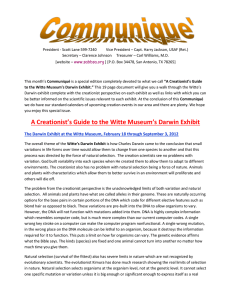
March 2012 Issue - Creationist`s Guide to The Witte
... The overall theme of the Witte’s Darwin Exhibit is how Charles Darwin came to the conclusion that small variations in life forms over time would allow them to change from one species to another and that this process was directed by the force of natural selection. The creation scientists see no probl ...
... The overall theme of the Witte’s Darwin Exhibit is how Charles Darwin came to the conclusion that small variations in life forms over time would allow them to change from one species to another and that this process was directed by the force of natural selection. The creation scientists see no probl ...

Evolutionary explanation
... evolutionary contexts, and concerns organisms or traits. An individual organism has abilities to physiologically adapt to its environment, for example by changing the values of some parameters of its metabolism (pulse, body temperature, etc.). Its being adapted is the result of such physiological pr ...
... evolutionary contexts, and concerns organisms or traits. An individual organism has abilities to physiologically adapt to its environment, for example by changing the values of some parameters of its metabolism (pulse, body temperature, etc.). Its being adapted is the result of such physiological pr ...

THE CASE AGAINST INTELLIGENT DESIGN. The Faith That Dare
... back through the branches to the node where they meet. (Extinction, of course, has pruned some branches--pterodactyls, for example--which represent groups that died off without descendants.) We are more closely related to chimpanzees than to orangutans because our common ancestor with these primates ...
... back through the branches to the node where they meet. (Extinction, of course, has pruned some branches--pterodactyls, for example--which represent groups that died off without descendants.) We are more closely related to chimpanzees than to orangutans because our common ancestor with these primates ...

Evidence of Evolution
... basic genetic machinery of RNA and DNA and the genetic code is essentially universal. – Evidently, the language of the genetic code has been passed along through all the branches of the tree of live eve since the code’s inception in an early life-form. Copyright © 2002 Pearson Education, Inc., publi ...
... basic genetic machinery of RNA and DNA and the genetic code is essentially universal. – Evidently, the language of the genetic code has been passed along through all the branches of the tree of live eve since the code’s inception in an early life-form. Copyright © 2002 Pearson Education, Inc., publi ...

Activities
... observed among the diverse species of living organisms. Changes in DNA (mutations) occur spontaneously at low rates. Some of these changes make no difference to the organism, whereas others can change cells and organisms. Only mutations in germ cells have the potential to create the variation that c ...
... observed among the diverse species of living organisms. Changes in DNA (mutations) occur spontaneously at low rates. Some of these changes make no difference to the organism, whereas others can change cells and organisms. Only mutations in germ cells have the potential to create the variation that c ...

File - Lincoln High School AP Biology
... Speciation and Reproductive Isolation Species: members in a population who have the potential to interbreed in nature and produce viable, fertile offspring Reproductive isolation: one group of genes becomes isolated from one another to begin a separate evolutionary history Speciation: anything ...
... Speciation and Reproductive Isolation Species: members in a population who have the potential to interbreed in nature and produce viable, fertile offspring Reproductive isolation: one group of genes becomes isolated from one another to begin a separate evolutionary history Speciation: anything ...

Evolution Jeopardy
... Darwin’s Theory of Natural Selection 500 - Answer Natural selection is one way of how evolution works. Evolution is how species change over time (generally due to natural selection). Game Board ...
... Darwin’s Theory of Natural Selection 500 - Answer Natural selection is one way of how evolution works. Evolution is how species change over time (generally due to natural selection). Game Board ...

The power of natural selection
... Adaptation by natural selection is the centrepiece of biology. Yet evolutionary biologists may be deluding themselves if they think they have a good handle on the typical strength of selection in nature. he one constant in our world is change — change often wrought by our own devices. In consequence ...
... Adaptation by natural selection is the centrepiece of biology. Yet evolutionary biologists may be deluding themselves if they think they have a good handle on the typical strength of selection in nature. he one constant in our world is change — change often wrought by our own devices. In consequence ...

Biological Aging Theories - A One-Page Summary
... overcome by the evolution process. Because it fits with Darwin’s theory as generally understood, this idea is still popular with the science-oriented general public. In the 1950s theorists led by P. Medawar and G. Williams suggested that the evolution process was neutral regarding aging. In effect, ...
... overcome by the evolution process. Because it fits with Darwin’s theory as generally understood, this idea is still popular with the science-oriented general public. In the 1950s theorists led by P. Medawar and G. Williams suggested that the evolution process was neutral regarding aging. In effect, ...

Changes Over Time
... Natural selection is the process by which individuals who are better adapted to their environment are more likely to survive and reproduce than other members of the same species. ...
... Natural selection is the process by which individuals who are better adapted to their environment are more likely to survive and reproduce than other members of the same species. ...

Coming to terms with biological evolution: a critique of the terms and
... evolution: (1) a teleological or need-driven idea of the adaptive process; (2) variation of traits within a population and subsequent differences in reproductive success were not recognised; and (3) a gradual variation of traits was perceived to occur in all members of the population at the same tim ...
... evolution: (1) a teleological or need-driven idea of the adaptive process; (2) variation of traits within a population and subsequent differences in reproductive success were not recognised; and (3) a gradual variation of traits was perceived to occur in all members of the population at the same tim ...

Jeopardy Powerpoint Review Game
... Question: A little child catches a fly and pulls its wings off. The fly actually lives a better life, but does not pass its lack of wings on to its offspring because the loss of wings is an _________ _______. ...
... Question: A little child catches a fly and pulls its wings off. The fly actually lives a better life, but does not pass its lack of wings on to its offspring because the loss of wings is an _________ _______. ...

Lesson Overview
... sketch shows Darwin’s explanation for how descent with modification could produce the diversity of life. A single “tree of life” links all living ...
... sketch shows Darwin’s explanation for how descent with modification could produce the diversity of life. A single “tree of life” links all living ...
Evolution and Natural Selection (Lecture 2)
... Charles Darwin (1802-1882) “I have called this principle, by which each slight variation, if useful, is preserved, by the term Natural Selection.” (The Origin of Species) http://www.interaktv.com/Darwin/Darwin.html ...
... Charles Darwin (1802-1882) “I have called this principle, by which each slight variation, if useful, is preserved, by the term Natural Selection.” (The Origin of Species) http://www.interaktv.com/Darwin/Darwin.html ...
Paving the way for Darwin Georges Cuvier (1769
... “I have called this principle, by which each slight variation, if useful, is preserved, by the term Natural Selection.” (The Origin of Species) http://www. interaktv .com/Darwin/Darwin.html ...
... “I have called this principle, by which each slight variation, if useful, is preserved, by the term Natural Selection.” (The Origin of Species) http://www. interaktv .com/Darwin/Darwin.html ...

here
... (baseml) protein coding sequences and amino acid sequences (codeml) and to simulate sequences evolution. The input file needs to be in phylip format. By default it assumes a sequential format (e.g. here). If the sequences are interleaved, you need to add an “I” to the first line, as in these ...
... (baseml) protein coding sequences and amino acid sequences (codeml) and to simulate sequences evolution. The input file needs to be in phylip format. By default it assumes a sequential format (e.g. here). If the sequences are interleaved, you need to add an “I” to the first line, as in these ...
IB Biology Evolution
... Copyright © 2002 Pearson Education, Inc., publishing as Benjamin Cummings ...
... Copyright © 2002 Pearson Education, Inc., publishing as Benjamin Cummings ...

making evolution relevant and exciting to biology students
... vitro evolution, this topic is rarely even mentioned in most introductory biology textbooks. 7. Integrate evolution throughout the book. The coverage of evolution should not be limited to one section of an introductory biology book. Every chapter should discuss how evolution is critical for making c ...
... vitro evolution, this topic is rarely even mentioned in most introductory biology textbooks. 7. Integrate evolution throughout the book. The coverage of evolution should not be limited to one section of an introductory biology book. Every chapter should discuss how evolution is critical for making c ...

OCR GCSE 21st Century Science Physics Module P2
... 3. Know, and recognise when given relevant data, examples of how different organisms are adapted to their environment, and explain how the adaptations increase the organism’s chance of surviving to successfully reproduce. 4. Know and understand that living organisms are dependent on the environment ...
... 3. Know, and recognise when given relevant data, examples of how different organisms are adapted to their environment, and explain how the adaptations increase the organism’s chance of surviving to successfully reproduce. 4. Know and understand that living organisms are dependent on the environment ...
THE COLLAPSE OF THE EVOLUTION THEORY
... event A, therefore A must have caused B! There was an oil spill and a car accident therefore the spill must have caused the accident. Is it not possible that they are ...
... event A, therefore A must have caused B! There was an oil spill and a car accident therefore the spill must have caused the accident. Is it not possible that they are ...
