
Download
... an evolutionary perspective. Perspectives in Biology and Medicine, 43(3), 406448. Cordain, L., Gotshall, R., Eaton, S., & Eaton, S. I. (1998). Physical activity, energy expenditure and fitness: an evolutionary perspective. International Journal of Sports Medicine, 19(5), 328-335. Curtis, V., & Biran ...
... an evolutionary perspective. Perspectives in Biology and Medicine, 43(3), 406448. Cordain, L., Gotshall, R., Eaton, S., & Eaton, S. I. (1998). Physical activity, energy expenditure and fitness: an evolutionary perspective. International Journal of Sports Medicine, 19(5), 328-335. Curtis, V., & Biran ...
Descent with Modification: A Darwinian View of Life
... • As a boy and into adulthood, Charles Darwin had a consuming interest in nature • Darwin first studied medicine (unsuccessfully), and then theology at Cambridge University • After graduating, he took an unpaid position as naturalist and companion to Captain Robert FitzRoy for a 5-year around the wo ...
... • As a boy and into adulthood, Charles Darwin had a consuming interest in nature • Darwin first studied medicine (unsuccessfully), and then theology at Cambridge University • After graduating, he took an unpaid position as naturalist and companion to Captain Robert FitzRoy for a 5-year around the wo ...

ch 10 Jeopardy Review Evolution
... • The study of fossils or extinct organisms that continues to provide new information and support current hypotheses about how evolution occurs. ...
... • The study of fossils or extinct organisms that continues to provide new information and support current hypotheses about how evolution occurs. ...
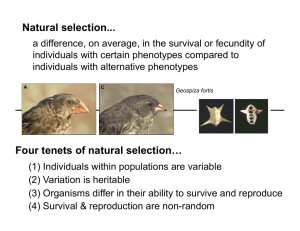
Four tenets of natural selection… Natural selection
... Probability of survival before and during the reproductive period ...
... Probability of survival before and during the reproductive period ...

16.3 Darwin Presents His Case
... Darwin wrote up a complete draft of his ideas about natural selection, but he put the work aside and didn’t publish it for another 20 years. Darwin knew that his own theory was just as radical as Lamarck’s, so he wanted to gather as much evidence as he could to support his ideas before he made them ...
... Darwin wrote up a complete draft of his ideas about natural selection, but he put the work aside and didn’t publish it for another 20 years. Darwin knew that his own theory was just as radical as Lamarck’s, so he wanted to gather as much evidence as he could to support his ideas before he made them ...

15-3 Darwin Presents His Case
... been evolving on Earth for millions of years. Evidence includes: fossil record, homologous structures, and similarities in embryology. Slide 10 of 41 Copyright Pearson Prentice Hall ...
... been evolving on Earth for millions of years. Evidence includes: fossil record, homologous structures, and similarities in embryology. Slide 10 of 41 Copyright Pearson Prentice Hall ...

Chpt 15.3 – Theory of Evolution
... been evolving on Earth for millions of years. Evidence includes: fossil record, homologous structures, and similarities in embryology. Slide 10 of 41 Copyright Pearson Prentice Hall ...
... been evolving on Earth for millions of years. Evidence includes: fossil record, homologous structures, and similarities in embryology. Slide 10 of 41 Copyright Pearson Prentice Hall ...

Darwin - HCC Learning Web
... species and noted patterns of similarities and differences. • In the early 1800s, French naturalist Jean Baptiste Lamarck suggested that life evolves, and explained this evolution as the refinement of traits that equip organisms to perform successfully in their environment. ...
... species and noted patterns of similarities and differences. • In the early 1800s, French naturalist Jean Baptiste Lamarck suggested that life evolves, and explained this evolution as the refinement of traits that equip organisms to perform successfully in their environment. ...

Teaching and Learning about Evolution and Natural Selection
... students in the arts or commerce streams, who do not study evolution after Class X). In some cases evolution is mentioned as early as Class VII. Some of the students' problems in understanding evolution stem from the way they are taught, which is almost exclusively listening to lectures, reading tex ...
... students in the arts or commerce streams, who do not study evolution after Class X). In some cases evolution is mentioned as early as Class VII. Some of the students' problems in understanding evolution stem from the way they are taught, which is almost exclusively listening to lectures, reading tex ...
Document
... • As a boy and into adulthood, Charles Darwin had a consuming interest in nature • Darwin first studied medicine (unsuccessfully), and then theology at Cambridge University • After graduating, he took an unpaid position as naturalist and companion to Captain Robert FitzRoy for a 5-year around the wo ...
... • As a boy and into adulthood, Charles Darwin had a consuming interest in nature • Darwin first studied medicine (unsuccessfully), and then theology at Cambridge University • After graduating, he took an unpaid position as naturalist and companion to Captain Robert FitzRoy for a 5-year around the wo ...
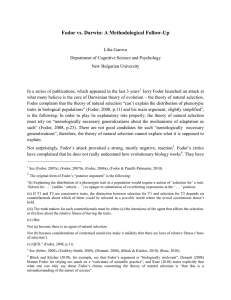
Fodor vs Darwin_ pe_10_6 - Philsci
... evolutionary biology (Edwards, 1998). This is so not only because it successfully explains the observed 1:1 sex ratio in most species but also because it implies the empirically confirmed prediction that if in a given population rearing sons is more ‘expensive’ than rearing daughters, there will be ...
... evolutionary biology (Edwards, 1998). This is so not only because it successfully explains the observed 1:1 sex ratio in most species but also because it implies the empirically confirmed prediction that if in a given population rearing sons is more ‘expensive’ than rearing daughters, there will be ...

bYTEBoss PPT_2.7.12.evolution2
... ________ as a result of good genes ________ and ________. A. habitat; dominate and survive B. environment; adapt and camouflage C. environment; survive and reproduce D. habitat; adapt and change ...
... ________ as a result of good genes ________ and ________. A. habitat; dominate and survive B. environment; adapt and camouflage C. environment; survive and reproduce D. habitat; adapt and change ...

ch 10 Jeopardy Review Evolution
... • The study of fossils or extinct organisms that continues to provide new information and support current hypotheses about how evolution occurs. ...
... • The study of fossils or extinct organisms that continues to provide new information and support current hypotheses about how evolution occurs. ...

influência de fertilizantes foliares, na eficácia do herbicida glyphosate
... essentially evolute when the population adapts to a given environment, which is accompanied by a reduction in genetic variation within the population while fixing those genes most favorable to that particular environment. Reporting back to the last universal ancestor (LUA), that represents the origi ...
... essentially evolute when the population adapts to a given environment, which is accompanied by a reduction in genetic variation within the population while fixing those genes most favorable to that particular environment. Reporting back to the last universal ancestor (LUA), that represents the origi ...

Exam I Bio101Spr08vA
... 18. Which of the following is NOT a major part of Darwin's Theory of Natural Selection? a. in every population, there are more offspring born than will survive to reproduce b. characteristics that help an individual survive will tend to become more common in a population c. some individuals will rep ...
... 18. Which of the following is NOT a major part of Darwin's Theory of Natural Selection? a. in every population, there are more offspring born than will survive to reproduce b. characteristics that help an individual survive will tend to become more common in a population c. some individuals will rep ...

Chapter 8: Evolution Lesson 8.3: Microevolution and the Genetics of
... One common misconception about evolution is the idea that individuals can evolve. Individuals do not evolve. Their genes do not change over time. Individuals can only accumulate adaptations that help them survive in the environment. Evolution takes a long time, spanning several generations, to happe ...
... One common misconception about evolution is the idea that individuals can evolve. Individuals do not evolve. Their genes do not change over time. Individuals can only accumulate adaptations that help them survive in the environment. Evolution takes a long time, spanning several generations, to happe ...
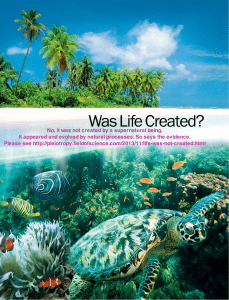
Was Life Created? - Michigan State University
... Space is a dangerous place where lethal radiation is common and meteoroids are an ever-present danger. Yet, our blue planet seems to fly through this galactic “shooting gallery” with relative impunity. Why? Because earth is protected by amazing armor—a powerful magnetic field and a custom-made atmos ...
... Space is a dangerous place where lethal radiation is common and meteoroids are an ever-present danger. Yet, our blue planet seems to fly through this galactic “shooting gallery” with relative impunity. Why? Because earth is protected by amazing armor—a powerful magnetic field and a custom-made atmos ...

evolution-for-beginners3
... ape for a grandfather or a man highly endowed by nature and possessed of great means and influence and yet who employs these faculties and that influence for the mere purpose of introducing ridicule into a grave scientific discussion I unhesitatingly affirm my preference for the ape.” ...
... ape for a grandfather or a man highly endowed by nature and possessed of great means and influence and yet who employs these faculties and that influence for the mere purpose of introducing ridicule into a grave scientific discussion I unhesitatingly affirm my preference for the ape.” ...
Descent with Modification: A Darwinian View of Life
... • As a boy and into adulthood, Charles Darwin had a consuming interest in nature • Darwin first studied medicine (unsuccessfully), and then theology at Cambridge University • After graduating, he took an unpaid position as naturalist and companion to Captain Robert FitzRoy for a 5-year around the wo ...
... • As a boy and into adulthood, Charles Darwin had a consuming interest in nature • Darwin first studied medicine (unsuccessfully), and then theology at Cambridge University • After graduating, he took an unpaid position as naturalist and companion to Captain Robert FitzRoy for a 5-year around the wo ...


CHAPTER 12 Adaptations Over Time
... Darwin's theory of natural selection emphasizes the differences among individuals of a species. These differences are called variations. A variation is an inherited trait that makes an individual different from other members of its species. Variations result from permanent changes, or mutations, in ...
... Darwin's theory of natural selection emphasizes the differences among individuals of a species. These differences are called variations. A variation is an inherited trait that makes an individual different from other members of its species. Variations result from permanent changes, or mutations, in ...

Evolution
... Darwin’s role on the ship was as naturalist and companion to the captain. His job was to collect biological and geological specimens during the ship’s travel. ...
... Darwin’s role on the ship was as naturalist and companion to the captain. His job was to collect biological and geological specimens during the ship’s travel. ...

Introduction to Biology
... concepts – is supported by much experimental evidence and scientific reasoning – expresses ideas of which we are most certain ...
... concepts – is supported by much experimental evidence and scientific reasoning – expresses ideas of which we are most certain ...

Ch_22 Evolution Evidence
... Earth’s geologic features — profound change formed as product of slow but continuous & cumulative processes ...
... Earth’s geologic features — profound change formed as product of slow but continuous & cumulative processes ...

Ch_22 Evolution Evidence
... Earth’s geologic features — profound change formed as product of slow but continuous & cumulative processes ...
... Earth’s geologic features — profound change formed as product of slow but continuous & cumulative processes ...