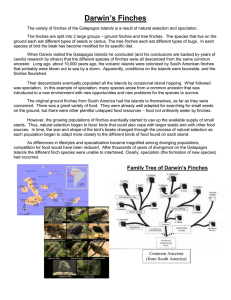
Darwin`s Finches
... ancestor. Long ago, about 10,000 years ago, the volcanic islands were colonized by South American finches that probably were blown out to sea by a storm. Apparently, conditions on the islands were favorable, and the finches flourished. Their descendants eventually populated all the islands by occasi ...
... ancestor. Long ago, about 10,000 years ago, the volcanic islands were colonized by South American finches that probably were blown out to sea by a storm. Apparently, conditions on the islands were favorable, and the finches flourished. Their descendants eventually populated all the islands by occasi ...

modularity and mereology - Birkbeck, University of London
... classification require discrete characters. So, systematists need to find a way to divide the range of continuous variation into a number of relatively distinct states. Also, the processes of morphological change are only just becoming understood. How can we classify when we know so little about the ...
... classification require discrete characters. So, systematists need to find a way to divide the range of continuous variation into a number of relatively distinct states. Also, the processes of morphological change are only just becoming understood. How can we classify when we know so little about the ...


Course Name: Anatomy and Physiology Level: H Points: 5
... Genetically Modified Organisms Chapter 13: How Populations Evolve Darwin’s Theory of Evolution Population Genetics and the Modern Synthesis Variation and Natural Selection Chapter 14: The Origin of Species Concepts of Species Mechanisms of Speciation Macroevolution rd ...
... Genetically Modified Organisms Chapter 13: How Populations Evolve Darwin’s Theory of Evolution Population Genetics and the Modern Synthesis Variation and Natural Selection Chapter 14: The Origin of Species Concepts of Species Mechanisms of Speciation Macroevolution rd ...

Why evolution need not be true - Creation Ministries International
... exist in the chain. Owing to the fact that reconstruction After expounding on the known Birds to reptiles: of evolutionary pathways among fossil fossils, Coyne comments: “Despite the not quite so rosy organisms is an ongoing post hoc unknowns, we can make some guesses process, evolutionists can alwa ...
... exist in the chain. Owing to the fact that reconstruction After expounding on the known Birds to reptiles: of evolutionary pathways among fossil fossils, Coyne comments: “Despite the not quite so rosy organisms is an ongoing post hoc unknowns, we can make some guesses process, evolutionists can alwa ...

2015“`外研社杯`全国英语阅读大赛”样题 一、2015 年“`外研社杯`全国
... of the 1920s, which combined the genetic work of Gregor Mendel with Darwin’s ideas about natural selection, and Theodosius Dobzhansky’s “Modern Synthesis” of the 1930s, which built upon Fisher’s work with genetics within a species by focusing on how genetic variation could cause the origin of a new ...
... of the 1920s, which combined the genetic work of Gregor Mendel with Darwin’s ideas about natural selection, and Theodosius Dobzhansky’s “Modern Synthesis” of the 1930s, which built upon Fisher’s work with genetics within a species by focusing on how genetic variation could cause the origin of a new ...

How to test an evolutionary hypothesis about disease
... f. Evolutionary explanations are not alternatives to proximate explanations for how a mechanism works and why it goes awry in some people. Such proximate explanations are also needed, but they are not a substitute for an evolutionary explanation for why the body is the way it is. Evidence about prox ...
... f. Evolutionary explanations are not alternatives to proximate explanations for how a mechanism works and why it goes awry in some people. Such proximate explanations are also needed, but they are not a substitute for an evolutionary explanation for why the body is the way it is. Evidence about prox ...

File
... • Lyell stressed that scientists must explain past events in terms of processes that they can actually observe. • The processes that shaped the Earth millions of years earlier continue in the present. ...
... • Lyell stressed that scientists must explain past events in terms of processes that they can actually observe. • The processes that shaped the Earth millions of years earlier continue in the present. ...

02Ch22EvolutionDarwi..
... AP Biology Life’s Natural History is a record of Successions & Extinctions ...
... AP Biology Life’s Natural History is a record of Successions & Extinctions ...
The Extended Evolutionary Synthesis and the role of soft inheritance
... Evolutionary biology today has to incorporate soft inheritance, saltational changes due to systemic mutations, and various types of genetic exchange and cooperation. These all challenge the assumptions of the Modern Synthesis. We believe that rather than trying to continue to work within the framewo ...
... Evolutionary biology today has to incorporate soft inheritance, saltational changes due to systemic mutations, and various types of genetic exchange and cooperation. These all challenge the assumptions of the Modern Synthesis. We believe that rather than trying to continue to work within the framewo ...

Chapter 13 Genetic Variation in Populations
... – Evolution is a population phenomenon – Evolution is a change in gene (now allele) frequencies in a population because of various natural forces such as mutation, selection, migration, or genetic drift – These changes in allele frequencies lead to differences among populations, species, and higher ...
... – Evolution is a population phenomenon – Evolution is a change in gene (now allele) frequencies in a population because of various natural forces such as mutation, selection, migration, or genetic drift – These changes in allele frequencies lead to differences among populations, species, and higher ...

A Stochastic Modelling of Mutations in Bacteria
... possible (in part, at least) by changes in DNA, the genetic material. These mutations are considered by many to be mostly harmful, but still the most important source of change in evolution.12 Recently, the importance of mutations in evolutionary processes has been questioned by Gould and others,3,4 ...
... possible (in part, at least) by changes in DNA, the genetic material. These mutations are considered by many to be mostly harmful, but still the most important source of change in evolution.12 Recently, the importance of mutations in evolutionary processes has been questioned by Gould and others,3,4 ...

Using Evolution as the Framework for Teaching Biology
... analysis presented by Ernst Mayr in his book The Growth of Biological Thought (1982, 505). Mayr concludes that Darwin had five separate theories, each addressing a different aspect of evolution. My presentation of biochemistry and genetics is traditional. The emphasis is on how the molecular nature ...
... analysis presented by Ernst Mayr in his book The Growth of Biological Thought (1982, 505). Mayr concludes that Darwin had five separate theories, each addressing a different aspect of evolution. My presentation of biochemistry and genetics is traditional. The emphasis is on how the molecular nature ...

Document
... – Focus on: characteristics of life, themes of biology, hypotheses • Activator:..entangled bank.. – React to the following quote from Charles Darwin’s book On the Origin of Species. What are your views on the evolution of life? • Key terms: evolution, adaptation ...
... – Focus on: characteristics of life, themes of biology, hypotheses • Activator:..entangled bank.. – React to the following quote from Charles Darwin’s book On the Origin of Species. What are your views on the evolution of life? • Key terms: evolution, adaptation ...

Ch 14 Evolution
... • Early Biological Thought Did Not Include the Concept of Evolution • Exploration of New Lands: Staggering Diversity of Life ...
... • Early Biological Thought Did Not Include the Concept of Evolution • Exploration of New Lands: Staggering Diversity of Life ...

Chapter 8 Developing a Theory of Evolution
... his ideas about changes in species over time. By comparing current species of animals with fossil forms, Lamarck observed what he interpreted as a “line of descent,” or progression, in which a series of fossils (from older to more recent) led to a modern species. He thought that species increased in ...
... his ideas about changes in species over time. By comparing current species of animals with fossil forms, Lamarck observed what he interpreted as a “line of descent,” or progression, in which a series of fossils (from older to more recent) led to a modern species. He thought that species increased in ...

Selection and Evolution with a Deck of Cards
... predicted using the simple equation R=h2s. Using our beak size example above, we would predict that the average beak size in the next generation of birds should be 2.4 centimeters larger than the parental generation. Thinking about evolution by natural selection in this manner illustrates how charac ...
... predicted using the simple equation R=h2s. Using our beak size example above, we would predict that the average beak size in the next generation of birds should be 2.4 centimeters larger than the parental generation. Thinking about evolution by natural selection in this manner illustrates how charac ...

EVOLUTION
... The seamless blending of all knowledge In the 18th and 19th centuries, the world was widely believed to have been created in 4004 B.C. This date was first proposed in 1650, by James Ussher, Archbishop of Armagh, in his book Annals of the World. To construct this timeline he used many documents, incl ...
... The seamless blending of all knowledge In the 18th and 19th centuries, the world was widely believed to have been created in 4004 B.C. This date was first proposed in 1650, by James Ussher, Archbishop of Armagh, in his book Annals of the World. To construct this timeline he used many documents, incl ...
Perspectives
... the present to the past.’’ The stochastic nature of the molecular clock was well recognized and described by a Poisson process for the first time. It was also pointed out that, for a molecular clock to exist, amino acid changes ...
... the present to the past.’’ The stochastic nature of the molecular clock was well recognized and described by a Poisson process for the first time. It was also pointed out that, for a molecular clock to exist, amino acid changes ...
1. Evolution, fitness and adaptations The ability of humans to
... in a titanic competitive struggle to leave copies of themselves behind to the next generation.13 ...whereas Eldredge argues that Natural selection is basically a filter. Organisms [not genes] compete for resources. As a side effect of such competition, those who make out better have a somewhat great ...
... in a titanic competitive struggle to leave copies of themselves behind to the next generation.13 ...whereas Eldredge argues that Natural selection is basically a filter. Organisms [not genes] compete for resources. As a side effect of such competition, those who make out better have a somewhat great ...
UNIT II – PLANT DIVERSITY
... offspring, becomes more common in the population. If this process continues, eventually, all individuals in the population will be brown. If you have variation, differential reproduction, and heredity, you will have evolution by natural selection as an outcome. It is as simple as that. ...
... offspring, becomes more common in the population. If this process continues, eventually, all individuals in the population will be brown. If you have variation, differential reproduction, and heredity, you will have evolution by natural selection as an outcome. It is as simple as that. ...

EVOLUTION STUDY GUIDE QUESTIONS
... Biodiversity is a variety of life in a particular area , habitat, ecosystem or in the world ...
... Biodiversity is a variety of life in a particular area , habitat, ecosystem or in the world ...

printer-friendly version
... Natural selection is considered a mechanism of evolution. Charles Darwin gathered evidence on many different organisms during voyages in the 1800’s. Careful study and characterization of his data led Darwin to his theory of evolution through natural selection. His theory was based on four premises: ...
... Natural selection is considered a mechanism of evolution. Charles Darwin gathered evidence on many different organisms during voyages in the 1800’s. Careful study and characterization of his data led Darwin to his theory of evolution through natural selection. His theory was based on four premises: ...
Darwin and Feminism: Preliminary Investigations for
... bifurcation, and becoming that characterise all forms of life. His work develops an anti-humanist, ‘algorithmic’, that is, mechanical or fundamentally mindless, analysis of biological dynamics which refuses to assume that the temporal movement forward can be equated with development or progress. His ...
... bifurcation, and becoming that characterise all forms of life. His work develops an anti-humanist, ‘algorithmic’, that is, mechanical or fundamentally mindless, analysis of biological dynamics which refuses to assume that the temporal movement forward can be equated with development or progress. His ...

Final PP Presentation
... Previous research hasn’t paid much attention to variation in traits because they believed, due to natural selection, important traits would not have much variation. Tooby and Cosmides (1992), Buss (1991), and Buss and Greiling (1999) suggest, however, that there may be some heritable variations that ...
... Previous research hasn’t paid much attention to variation in traits because they believed, due to natural selection, important traits would not have much variation. Tooby and Cosmides (1992), Buss (1991), and Buss and Greiling (1999) suggest, however, that there may be some heritable variations that ...