
Chapter 26 - TeacherWeb
... • They can diverge within the clade that carries them and often evolve new functions. ...
... • They can diverge within the clade that carries them and often evolve new functions. ...

8.CHP:Corel VENTURA - UM Personal World Wide Web Server
... four generations of scientists. As we will describe, the fundamental issues were identified from the beginning, in the American Anthropologist (AA), and have changed very little since then. Some conceptual problems have been persistent: Because of its timescale and scope, modern human origins resear ...
... four generations of scientists. As we will describe, the fundamental issues were identified from the beginning, in the American Anthropologist (AA), and have changed very little since then. Some conceptual problems have been persistent: Because of its timescale and scope, modern human origins resear ...

Exploring the Evolution of Horses in Response to Climate Change
... In this performance assessment task, students individually respond to a fictional letter from a paleontologist requesting their help in the construction of a phylogenetic tree of horses for a museum exhibit. In order to develop an appropriate and accurate representation they will apply their underst ...
... In this performance assessment task, students individually respond to a fictional letter from a paleontologist requesting their help in the construction of a phylogenetic tree of horses for a museum exhibit. In order to develop an appropriate and accurate representation they will apply their underst ...
Mechanisms of Evolution
... Amish-a religious minority, which is essentially an isolated population, established from a relatively small number of individuals. ...
... Amish-a religious minority, which is essentially an isolated population, established from a relatively small number of individuals. ...

The probability of the improbable. Society
... Variation occurs not only under domestication but also in nature. There is a strong hereditary principle. More individuals are born than can possibly survive and procreate. From these observations he concludes that those individual organisms which carried favourable variations would have a higher ch ...
... Variation occurs not only under domestication but also in nature. There is a strong hereditary principle. More individuals are born than can possibly survive and procreate. From these observations he concludes that those individual organisms which carried favourable variations would have a higher ch ...
video slide - Course
... • The use of drugs to combat HIV selects for viruses resistant to these drugs. • HIV uses the enzyme reverse transcriptase to make a DNA version of its own RNA genome. • The drug 3TC is designed to interfere and cause errors in the manufacture of DNA from the virus. • Some individual HIV viruses hav ...
... • The use of drugs to combat HIV selects for viruses resistant to these drugs. • HIV uses the enzyme reverse transcriptase to make a DNA version of its own RNA genome. • The drug 3TC is designed to interfere and cause errors in the manufacture of DNA from the virus. • Some individual HIV viruses hav ...

The Genomic Drive Hypothesis and Punctuated Evolutionary
... possible modes of evolution. Current orthodox evolutionary thought is dominated by an assumption that biological lineages evolve by the slow and gradual accumulation of adaptive mutations, that is, by gradualism, and that macroevolution (the origin of higher taxa) can be explained by an extrapolatio ...
... possible modes of evolution. Current orthodox evolutionary thought is dominated by an assumption that biological lineages evolve by the slow and gradual accumulation of adaptive mutations, that is, by gradualism, and that macroevolution (the origin of higher taxa) can be explained by an extrapolatio ...
II. Hardy-Weinberg Principle, cont
... III. A HISTORY OF EVOLUTIONARY THEORY, cont • Darwin, cont o Observed many examples of adaptations Inherited characteristics that enhance organisms’ survival and reproduction o Based on principles of natural selection Populations of organisms can change over the generations if individuals having ...
... III. A HISTORY OF EVOLUTIONARY THEORY, cont • Darwin, cont o Observed many examples of adaptations Inherited characteristics that enhance organisms’ survival and reproduction o Based on principles of natural selection Populations of organisms can change over the generations if individuals having ...

BIO 301M Ecology, Evolution and Society TEXTBOOK
... The DISCUSSION SECTION grade (25%) and 3 SEMESTER EXAM grades (75%, ie. 25% each) comprise the semester grade. A comprehensive FINAL EXAM is optional, but the FINAL EXAM grade, if higher, may be substituted for a lower grade on one semester exam. In the rare case of a missed exam for documented medi ...
... The DISCUSSION SECTION grade (25%) and 3 SEMESTER EXAM grades (75%, ie. 25% each) comprise the semester grade. A comprehensive FINAL EXAM is optional, but the FINAL EXAM grade, if higher, may be substituted for a lower grade on one semester exam. In the rare case of a missed exam for documented medi ...
Darwin`s Theory of Natural Selection and Its Moral Purpose
... heritable traits from each other; more individuals are produced than the resources of the environment can sustain; those that by chance have traits that better fit them than others of their kind to circumstances will more likely survive to pass on those traits to offspring; consequently, the structu ...
... heritable traits from each other; more individuals are produced than the resources of the environment can sustain; those that by chance have traits that better fit them than others of their kind to circumstances will more likely survive to pass on those traits to offspring; consequently, the structu ...
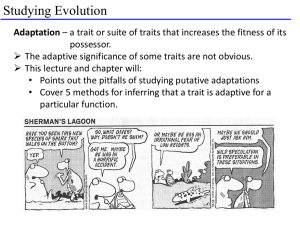
Document
... Studying Evolution- Observational Methods Not all hypothesis can be tested under controlled conditions, nor can all organisms be manipulated like flies. However, some observations do not necessarily lead to cause and effect. That we always find iguana’s with body temperatures that are always near t ...
... Studying Evolution- Observational Methods Not all hypothesis can be tested under controlled conditions, nor can all organisms be manipulated like flies. However, some observations do not necessarily lead to cause and effect. That we always find iguana’s with body temperatures that are always near t ...
Chapter 22
... • In 1844, Darwin wrote an essay on natural selection as the mechanism of descent with modification, but did not introduce his theory publicly • Natural selection is a process in which individuals with favorable inherited traits are more likely to survive and reproduce • In June 1858, Darwin receiv ...
... • In 1844, Darwin wrote an essay on natural selection as the mechanism of descent with modification, but did not introduce his theory publicly • Natural selection is a process in which individuals with favorable inherited traits are more likely to survive and reproduce • In June 1858, Darwin receiv ...

Reproductive systems and evolution in vascular plants
... plants are too few to allow us to assess this prediction directly. It is, however, a botanical commonplace that selfing species are often derivatives of outcrossing progenitors (see the discussion of selfers in Arenaria and Linanthus below, for example). Because derivatives must be younger than thei ...
... plants are too few to allow us to assess this prediction directly. It is, however, a botanical commonplace that selfing species are often derivatives of outcrossing progenitors (see the discussion of selfers in Arenaria and Linanthus below, for example). Because derivatives must be younger than thei ...

Chapter 14 Notes
... 14.6 Sympatric speciation takes place without geographic isolation • Sympatric speciation occurs when a new species arises within the same geographic area as its parent species. • How can reproductive isolation develop when members of sympatric populations remain in contact with each other? • Gene ...
... 14.6 Sympatric speciation takes place without geographic isolation • Sympatric speciation occurs when a new species arises within the same geographic area as its parent species. • How can reproductive isolation develop when members of sympatric populations remain in contact with each other? • Gene ...

Chapter_13_HB_How_Populations_Evolve
... Lyell's Principles of Geology led him to realize that still-operating natural forces gradually change Earth ...
... Lyell's Principles of Geology led him to realize that still-operating natural forces gradually change Earth ...

Document
... given the available raw material and the constraints of genetics. And finally, although the malaria parasite has been unable to counter-evolve resistance to heterozygotes for the sickle-cell gene, it has evolved, through mutation, resistance to various anti-malarial drugs devised by humans. This res ...
... given the available raw material and the constraints of genetics. And finally, although the malaria parasite has been unable to counter-evolve resistance to heterozygotes for the sickle-cell gene, it has evolved, through mutation, resistance to various anti-malarial drugs devised by humans. This res ...

ap biology exam essay (free response) questions
... a. Explain how the reduction and rearrangement are accomplished in meiosis. b. Several human disorders occur as a result of defects in the meiotic process. Identify ONE such chromosomal abnormality ; what effects does it have on the phenotype of people with the disorder? Describe how this abnormalit ...
... a. Explain how the reduction and rearrangement are accomplished in meiosis. b. Several human disorders occur as a result of defects in the meiotic process. Identify ONE such chromosomal abnormality ; what effects does it have on the phenotype of people with the disorder? Describe how this abnormalit ...
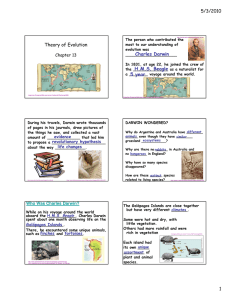
Theory of Evolution Charles Darwin H.M.S. Beagle 5 year
... After Darwin returned to England in 1836 he filled notebooks with his ideas species diversity and the process about _____________ evolution that he would later call _______. He did not rush to publish his ideas disagreed with the because they ________ beliefs of his fundamental scientific ______ day ...
... After Darwin returned to England in 1836 he filled notebooks with his ideas species diversity and the process about _____________ evolution that he would later call _______. He did not rush to publish his ideas disagreed with the because they ________ beliefs of his fundamental scientific ______ day ...
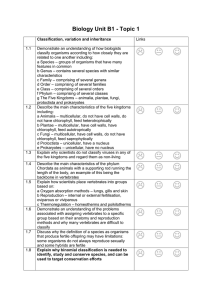
LKJ - physicsinfo.co.uk
... 1.10 Construct and use keys to show how species can be identified 1.11 Explain how organisms are adapted to their environment and how some organisms have characteristics that enable them to survive in extreme environments, including deep-sea hydrothermal vents and polar regions 1.12 Demonstrate an u ...
... 1.10 Construct and use keys to show how species can be identified 1.11 Explain how organisms are adapted to their environment and how some organisms have characteristics that enable them to survive in extreme environments, including deep-sea hydrothermal vents and polar regions 1.12 Demonstrate an u ...

Unity from Division
... Born in Baltimore, Maryland, U. S. A., in 1941. After receiving a doctorate in mathematics from University of Maryland, Simon Asher Levin held positions such as Professor of Ecology, Director of Ecosystems Research Center and of Center for Environmental Research at Cornell University; Professor of B ...
... Born in Baltimore, Maryland, U. S. A., in 1941. After receiving a doctorate in mathematics from University of Maryland, Simon Asher Levin held positions such as Professor of Ecology, Director of Ecosystems Research Center and of Center for Environmental Research at Cornell University; Professor of B ...

nature book - Chapin Library
... des animaux sans vertèbres (1815-22), Lamarck argued that changes in an environment alter in turn the needs of its resident organisms, who then purposefully change their behavior. In this way, organs or other living structures are used more or less, and may develop or regress accordingly. Thus all o ...
... des animaux sans vertèbres (1815-22), Lamarck argued that changes in an environment alter in turn the needs of its resident organisms, who then purposefully change their behavior. In this way, organs or other living structures are used more or less, and may develop or regress accordingly. Thus all o ...

Harnessing Evolution: The Interaction Between Sexual
... However, even in these carefully controlled laboratory settings, observing each individual is impossible, the timescales required are still on the order of years for individual experiments, and the applicability for understanding the evolution of intelligence is distant. Digital evolution is an alte ...
... However, even in these carefully controlled laboratory settings, observing each individual is impossible, the timescales required are still on the order of years for individual experiments, and the applicability for understanding the evolution of intelligence is distant. Digital evolution is an alte ...

How many Beany Beetles?
... Investigating evolution by adaptation and natural selection Ask the pupils what they think evolution means. As new groups of animals and plants are born or develop, they may be a little different from their parents. This change over time and the natural processes that caused it, is called evolution. ...
... Investigating evolution by adaptation and natural selection Ask the pupils what they think evolution means. As new groups of animals and plants are born or develop, they may be a little different from their parents. This change over time and the natural processes that caused it, is called evolution. ...


Analyzing Adaptations: Living of Land
... occurred by inheritance of “acquired traits” Not determined by genes Individuals acquire characteristics during their lifetime & pass them on to their offspring Example: giraffes acquire long necks by stretching them to reach leaves ...
... occurred by inheritance of “acquired traits” Not determined by genes Individuals acquire characteristics during their lifetime & pass them on to their offspring Example: giraffes acquire long necks by stretching them to reach leaves ...