
Newman - AMP @ georgetown
... to the theory’s early acceptance. It also established an intellectual habit of avoiding the role of development in evolution because if the only relevant changes in an object’s form are gradual, then how the object originated, its degrees of freedom, and the limits of its possible deformations can b ...
... to the theory’s early acceptance. It also established an intellectual habit of avoiding the role of development in evolution because if the only relevant changes in an object’s form are gradual, then how the object originated, its degrees of freedom, and the limits of its possible deformations can b ...

Unit 7 (Evolution) Study Guide SPRING 2014 (Student
... 6. Who proposed the hypothesis of ‘inheritance of acquired characteristics’ as an explanation for how evolution occurs? Explain what this idea means. Answer: _____________________________________________________________________________ ...
... 6. Who proposed the hypothesis of ‘inheritance of acquired characteristics’ as an explanation for how evolution occurs? Explain what this idea means. Answer: _____________________________________________________________________________ ...

video slide - Wild about Bio
... Biogeography The geographic distribution of species Islands have many endemic (native) species that are often closely related to species on the nearest mainland or island Earth’s continents were formerly united in a single large continent called Pangaea, but have since separated by continental ...
... Biogeography The geographic distribution of species Islands have many endemic (native) species that are often closely related to species on the nearest mainland or island Earth’s continents were formerly united in a single large continent called Pangaea, but have since separated by continental ...

Social Evolution
... that can be found side-by-side in Darwin. Although Darwin was always generally cautious in his pronouncements, especially when they involved the application of his theory to human society, his views tended toward the competitive side of the debate. It is important to stress in this regard that Darwi ...
... that can be found side-by-side in Darwin. Although Darwin was always generally cautious in his pronouncements, especially when they involved the application of his theory to human society, his views tended toward the competitive side of the debate. It is important to stress in this regard that Darwi ...

Chapter 10 The Theory of Evolution
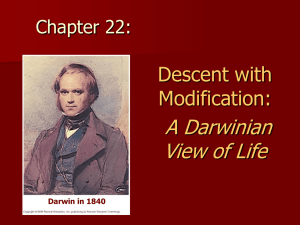
... Darwin’s theory of evolution actually contains two major ideas: 1. One idea is that evolution occurs. In other words, organisms change over time. Life on Earth has changed as descendants diverged from common ancestors in the past. 2. The other idea is that evolution occurs by natural selection. Natu ...
... Darwin’s theory of evolution actually contains two major ideas: 1. One idea is that evolution occurs. In other words, organisms change over time. Life on Earth has changed as descendants diverged from common ancestors in the past. 2. The other idea is that evolution occurs by natural selection. Natu ...

What Evolution Is - Wesley Grove Chapel
... fossilized because they were too small or because they were soft-bodied Molecular comparisons among living organisms point to a hypothetical common ancestor hundreds of millions of years before the Cambrian ...
... fossilized because they were too small or because they were soft-bodied Molecular comparisons among living organisms point to a hypothetical common ancestor hundreds of millions of years before the Cambrian ...
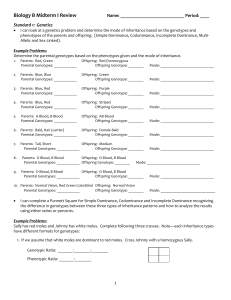
Biology B Midterm I Review Name: Period: ____ Standard 1
... Scenario Practice #2 There are 13 types of Galapagos finches, also known as Darwin's Finches, and they share the same habits and characteristics except for one, and they all have different beaks. The differences in their beaks might be the most important aspect of their survival. In 1977, a large dr ...
... Scenario Practice #2 There are 13 types of Galapagos finches, also known as Darwin's Finches, and they share the same habits and characteristics except for one, and they all have different beaks. The differences in their beaks might be the most important aspect of their survival. In 1977, a large dr ...

13.4 Homologies provide strong evidence for evolution
... populations, which successfully introduced new alleles. • This strategy worked. New alleles entered the population, and the egg-hatching rate improved to more than 90%. ...
... populations, which successfully introduced new alleles. • This strategy worked. New alleles entered the population, and the egg-hatching rate improved to more than 90%. ...


Jeopardy - Scarsdale Schools
... Organisms that are better adapted to their environment are “selected” to be able to survive and reproduce, passing on their favorable traits to their ...
... Organisms that are better adapted to their environment are “selected” to be able to survive and reproduce, passing on their favorable traits to their ...
Lesson Overview
... animals, yet many of their genes, and therefore the proteins coded by those genes, are similar to those of animals. Such profound biochemical similarities are best explained by Darwin’s conclusion: Living organisms evolved through descent with modification from a common ancestor. ...
... animals, yet many of their genes, and therefore the proteins coded by those genes, are similar to those of animals. Such profound biochemical similarities are best explained by Darwin’s conclusion: Living organisms evolved through descent with modification from a common ancestor. ...
Darwinism in Minds, Bodies and Brains
... logic, propagate itself more widely through the population than any trait that will inhibit the capacity for survival or success of reproduction. Standing opposite to the widely believed creationist argument of its context, this concept has been revolutionary in science and history. Owing to the ele ...
... logic, propagate itself more widely through the population than any trait that will inhibit the capacity for survival or success of reproduction. Standing opposite to the widely believed creationist argument of its context, this concept has been revolutionary in science and history. Owing to the ele ...

14_self_test_qanda.doc
... all of their descendants still retain those genes c. genes that modify the developmental pathways in vertebrates arose later in evolution d. all of the above Answer: d Hint: Please review section 14.3 of your text. Feedback: a. Incorrect. This is true, because similar developmental structures are re ...
... all of their descendants still retain those genes c. genes that modify the developmental pathways in vertebrates arose later in evolution d. all of the above Answer: d Hint: Please review section 14.3 of your text. Feedback: a. Incorrect. This is true, because similar developmental structures are re ...

Convergence, Adaptation, and Constraint The Harvard community
... evolution, with many studies finding that convergent phenotypes have been produced through similar changes at the genetic level, but others discovering convergent phenotypes resulting from different genetic changes. These studies speak to the adaptationist and constraint perspectives on convergent e ...
... evolution, with many studies finding that convergent phenotypes have been produced through similar changes at the genetic level, but others discovering convergent phenotypes resulting from different genetic changes. These studies speak to the adaptationist and constraint perspectives on convergent e ...
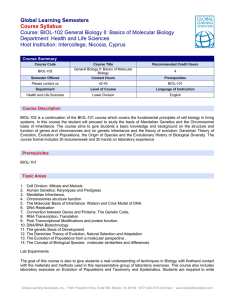
Global Learning Semesters
... systems. In this course the student will proceed to study the basis of Mendelian Genetics and the Chromosomal basis of Inheritance. The course aims to give students a basic knowledge and background on the structure and function of genes and chromosomes and on genetic inheritance and the theory of ev ...
... systems. In this course the student will proceed to study the basis of Mendelian Genetics and the Chromosomal basis of Inheritance. The course aims to give students a basic knowledge and background on the structure and function of genes and chromosomes and on genetic inheritance and the theory of ev ...

Cumulative selection 49.00KB 2007-06
... evolutionary history. Today, horses are quite diverse as certain characteristics have been selected by both natural and artificial selection. 4. Adaptive radiation occurs as one species evolves into 2 or more species. For example, mammals with hoofs have evolved into different species (horses, camel ...
... evolutionary history. Today, horses are quite diverse as certain characteristics have been selected by both natural and artificial selection. 4. Adaptive radiation occurs as one species evolves into 2 or more species. For example, mammals with hoofs have evolved into different species (horses, camel ...

Cumulative Change and Natural Selection Student Material
... evolutionary history. Today, horses are quite diverse as certain characteristics have been selected by both natural and artificial selection. 4. Adaptive radiation occurs as one species evolves into 2 or more species. For example, mammals with hoofs have evolved into different species (horses, camel ...
... evolutionary history. Today, horses are quite diverse as certain characteristics have been selected by both natural and artificial selection. 4. Adaptive radiation occurs as one species evolves into 2 or more species. For example, mammals with hoofs have evolved into different species (horses, camel ...

Good Morning 9/28/15
... See me with questions. I can not answer questions now until I have given out all sheets. ...
... See me with questions. I can not answer questions now until I have given out all sheets. ...

The altered evolutionary trajectories of gene duplicates
... studies involving whole-genome sequence analysis have revealed the cumulative changes in proteins encoded by the members of surviving gene pairs, but so far these descriptive analyses have generated more questions than they have answered. In this article, we review the contributions and limitations ...
... studies involving whole-genome sequence analysis have revealed the cumulative changes in proteins encoded by the members of surviving gene pairs, but so far these descriptive analyses have generated more questions than they have answered. In this article, we review the contributions and limitations ...
Regents Biology
... Darwin concluded that when the original South American finches reached the islands, they adapted to available food in different environments ...
... Darwin concluded that when the original South American finches reached the islands, they adapted to available food in different environments ...
Regents Biology
... Darwin concluded that when the original South American finches reached the islands, they adapted to available food in different environments ...
... Darwin concluded that when the original South American finches reached the islands, they adapted to available food in different environments ...

unit b1 – influences on life checklist
... advantageous characteristics to their offspring f gradual change – over a period of time the proportion of individuals with the advantageous characteristics in the population will increase compared with the proportion of individuals with poorly adapted characteristics, and the poorly adapted charact ...
... advantageous characteristics to their offspring f gradual change – over a period of time the proportion of individuals with the advantageous characteristics in the population will increase compared with the proportion of individuals with poorly adapted characteristics, and the poorly adapted charact ...

26LecturePresentation
... genome, providing more opportunities for evolutionary changes • Like homologous genes, duplicated genes can be traced to a common ancestor • Orthologous genes - found in a single copy in the genome and are homologous between species ...
... genome, providing more opportunities for evolutionary changes • Like homologous genes, duplicated genes can be traced to a common ancestor • Orthologous genes - found in a single copy in the genome and are homologous between species ...

Honors Biology - Octorara Area School District
... B. Compare the functions of the two types of endoplasmic reticulum. B. Name the two major components of the cytoskeleton and discuss their importance. C. Discuss the process of diffusion and ...
... B. Compare the functions of the two types of endoplasmic reticulum. B. Name the two major components of the cytoskeleton and discuss their importance. C. Discuss the process of diffusion and ...