
Misunderstandings - Department of Neurobiology and Behavior
... this enduring image and likely have some version of it burned into our brains. Unfortunately, this widespread image is a horribly inaccurate characterization of the evolutionary process, and it has undoubtedly reinforced the ideas that evolution proceeds in a linear fashion, from simple to advanced, ...
... this enduring image and likely have some version of it burned into our brains. Unfortunately, this widespread image is a horribly inaccurate characterization of the evolutionary process, and it has undoubtedly reinforced the ideas that evolution proceeds in a linear fashion, from simple to advanced, ...
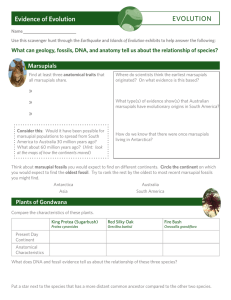
Evidence of Evolution - California Academy of Sciences
... and Australia long after other Gondwanan continents split off. DNA shows that Australian marsupials are related to those in the Americas. According to the DNA data, the South American monito del monte shares a common ancestor with the marsupials that now live in Australia. Fossil evidence of teeth f ...
... and Australia long after other Gondwanan continents split off. DNA shows that Australian marsupials are related to those in the Americas. According to the DNA data, the South American monito del monte shares a common ancestor with the marsupials that now live in Australia. Fossil evidence of teeth f ...

Darwin`s Theory of Evolution The Puzzle of Life`s Diversity Chapter
... ANSWER: A collection of ______________, Scientific facts observations and ___________ hypotheses __________, known as ________________________ EVOLUTIONARY THEORY ...
... ANSWER: A collection of ______________, Scientific facts observations and ___________ hypotheses __________, known as ________________________ EVOLUTIONARY THEORY ...


Challenges to the Theory of Evolution
... Quote From West [Evolutionist] “Contrary to what most scientists write, the fossil record does not support the Darwinian theory of evolution because it is this theory (there are several) which we use to interpret the fossil record. By doing so, we are guilty of circular reasoning if we then say the ...
... Quote From West [Evolutionist] “Contrary to what most scientists write, the fossil record does not support the Darwinian theory of evolution because it is this theory (there are several) which we use to interpret the fossil record. By doing so, we are guilty of circular reasoning if we then say the ...

Evolution5Challenges.ppt - Heinz Lycklama`s Website
... Quote From West [Evolutionist] “Contrary to what most scientists write, the fossil record does not support the Darwinian theory of evolution because it is this theory (there are several) which we use to interpret the fossil record. By doing so, we are guilty of circular reasoning if we then say the ...
... Quote From West [Evolutionist] “Contrary to what most scientists write, the fossil record does not support the Darwinian theory of evolution because it is this theory (there are several) which we use to interpret the fossil record. By doing so, we are guilty of circular reasoning if we then say the ...

Chapter 23. MACROEVOLUTION: MICROEVOLUTIONARY
... In evolutionary biology and in anthropology, these often take the form of functional explanations, in which only knowledge of present circumstances and general physical laws (e.g. the principles of mechanics) are necessary to explain present behavior (Mitchell and Valone 1990). For example, long fa ...
... In evolutionary biology and in anthropology, these often take the form of functional explanations, in which only knowledge of present circumstances and general physical laws (e.g. the principles of mechanics) are necessary to explain present behavior (Mitchell and Valone 1990). For example, long fa ...

Notes to Instructors Answers
... Campbell Biology, 9th edition, defines natural selection as “differential success in the reproduction of different phenotypes resulting from the interaction of organisms with their environment.” The text goes on to state that “evolution occurs when natural selection causes changes in relative freque ...
... Campbell Biology, 9th edition, defines natural selection as “differential success in the reproduction of different phenotypes resulting from the interaction of organisms with their environment.” The text goes on to state that “evolution occurs when natural selection causes changes in relative freque ...

File - LFHS AP Biology
... – 6. In the Action Settings window, make sure the Hyperlink button (to the left of “Hyperlink”) is selected, and in the select box underneath choose “Slide…” – 7. In the Hyperlink to Slide window, scroll down to the appropriate question slide (the original slide number of the question). NOTE: Using ...
... – 6. In the Action Settings window, make sure the Hyperlink button (to the left of “Hyperlink”) is selected, and in the select box underneath choose “Slide…” – 7. In the Hyperlink to Slide window, scroll down to the appropriate question slide (the original slide number of the question). NOTE: Using ...
Darwinian Evolution (ch 22) Campbell PPT
... the origin of new species as closely related processes – From studies made years after Darwin’s voyage, biologists have concluded that this is what happened to the Galápagos finches ...
... the origin of new species as closely related processes – From studies made years after Darwin’s voyage, biologists have concluded that this is what happened to the Galápagos finches ...

Impact of teaching style on student learning of evolution
... In order to determine if my students fully understand a particular scientific topic, a researchbased assessment must be used. When studying the effectiveness of hands-on inquiry lessons in Physics, the Force Concept Inventory can be used. This assessment focuses on identifying student misconception ...
... In order to determine if my students fully understand a particular scientific topic, a researchbased assessment must be used. When studying the effectiveness of hands-on inquiry lessons in Physics, the Force Concept Inventory can be used. This assessment focuses on identifying student misconception ...
AP Biology Chapter 22 Darwin Guided Notes
... • As a boy and into adulthood, Charles Darwin had a consuming interest in __________ • Darwin first studied ________(unsuccessfully), and then __________ at Cambridge University • After graduating, he took an unpaid position as ______________ and companion to Captain Robert FitzRoy for a 5-year arou ...
... • As a boy and into adulthood, Charles Darwin had a consuming interest in __________ • Darwin first studied ________(unsuccessfully), and then __________ at Cambridge University • After graduating, he took an unpaid position as ______________ and companion to Captain Robert FitzRoy for a 5-year arou ...

It tells an evolutionary story of common ancestors
... 4. Artificial selection How do we know natural selection can change a population? we can recreate a similar process “evolution by human selection” “descendants” of wild mustard ...
... 4. Artificial selection How do we know natural selection can change a population? we can recreate a similar process “evolution by human selection” “descendants” of wild mustard ...

Species and Speciation
... subdivided into smaller groups because of a geographic barrier (Allopatric speciation). These subdivided groups tend to undergo different changes, and may become dissimilar enough to be considered separate species. Speciation can also occur within a population by polyploidy (addition or multiplicati ...
... subdivided into smaller groups because of a geographic barrier (Allopatric speciation). These subdivided groups tend to undergo different changes, and may become dissimilar enough to be considered separate species. Speciation can also occur within a population by polyploidy (addition or multiplicati ...


Introduction to Evolution
... aspects/implications/applications of evolutionary biology? What do you consider some of the more important common misunderstandings people have of evolutionary biology? What are key issues/topics in evolutionary biology you feel it is important to understand to be able to critically assess/interpret ...
... aspects/implications/applications of evolutionary biology? What do you consider some of the more important common misunderstandings people have of evolutionary biology? What are key issues/topics in evolutionary biology you feel it is important to understand to be able to critically assess/interpret ...
Evolution without Lamarck`s Theory and its Use in the Darwinian
... (ii) Moreover, Muslim and Jewish boys have been circumcised for thousands of years, but this has not resulted in a tendency toward the reduction of the prepuce in them. (iii) Additionally, it was the custom in China to bind the feet by iron shoes of their baby girls in order to keep them small and d ...
... (ii) Moreover, Muslim and Jewish boys have been circumcised for thousands of years, but this has not resulted in a tendency toward the reduction of the prepuce in them. (iii) Additionally, it was the custom in China to bind the feet by iron shoes of their baby girls in order to keep them small and d ...

HS Life Science Alignment
... HS-LS2-6 Evaluate the claims, evidence, and reasoning that the complex interactions in ecosystems maintain relatively consistent numbers and types of organisms in stable conditions, but changing conditions may result in a new ecosystem. ...
... HS-LS2-6 Evaluate the claims, evidence, and reasoning that the complex interactions in ecosystems maintain relatively consistent numbers and types of organisms in stable conditions, but changing conditions may result in a new ecosystem. ...
Darwin`s Ancestors - New York University
... secreted into the female is excited into development by response to environmental conditions. Erasmus Darwin is concerned to support his hypothesis that the embryon, the sole vital element of propagation, “is produced solely by the male.” However, ontogenesis occurs only when the embryon comes into ...
... secreted into the female is excited into development by response to environmental conditions. Erasmus Darwin is concerned to support his hypothesis that the embryon, the sole vital element of propagation, “is produced solely by the male.” However, ontogenesis occurs only when the embryon comes into ...
darwin`s orchids: their variation, plasticity, and natural selection
... Over time, we have come to know Darwin’s theory of natural selection quite well and have been able to enrich it with accumulated knowledge of biology, especially with a better understanding of genetics. Natural selection is now viewed as a process with three conditions. First, a population must ha ...
... Over time, we have come to know Darwin’s theory of natural selection quite well and have been able to enrich it with accumulated knowledge of biology, especially with a better understanding of genetics. Natural selection is now viewed as a process with three conditions. First, a population must ha ...

New Scientist Evolution Special
... same – so they will not be selected for, but they could nevertheless spread by genetic drift. Use your mutations In this way, a species can go from having one gene with two functions to two genes that each carry out one function. This increase in complexity occurs not because of selection but despit ...
... same – so they will not be selected for, but they could nevertheless spread by genetic drift. Use your mutations In this way, a species can go from having one gene with two functions to two genes that each carry out one function. This increase in complexity occurs not because of selection but despit ...

Darwin` Finches
... considered. For that reason, studies in speciation often focus on groups of species that are closely related and living in relatively contained, isolated habitats, such as islands. The Grants’ studies of speciation have focused on the finches living on the Galápagos Islands. These islands sit on the ...
... considered. For that reason, studies in speciation often focus on groups of species that are closely related and living in relatively contained, isolated habitats, such as islands. The Grants’ studies of speciation have focused on the finches living on the Galápagos Islands. These islands sit on the ...

Social Evolution
... be found side-by-side in Darwin. Although Darwin was always generally cautious in his pronouncements, especially when they involved the application of his theory to human society, his views tended toward the competitive side of the debate. It is important to stress in this regard that Darwin’s key i ...
... be found side-by-side in Darwin. Although Darwin was always generally cautious in his pronouncements, especially when they involved the application of his theory to human society, his views tended toward the competitive side of the debate. It is important to stress in this regard that Darwin’s key i ...

Blenheim Primary School and Children`s Centre – Science Plan for
... How do you Introduce evolution on powerpoint. Big questions. Has anybody got any other questions think it about plants or animals? happened Given chn AfL sheet called Amazing Adaptations to assess current understanding and so that…(e.g. can show progression throughout unit. Will need to read and ...
... How do you Introduce evolution on powerpoint. Big questions. Has anybody got any other questions think it about plants or animals? happened Given chn AfL sheet called Amazing Adaptations to assess current understanding and so that…(e.g. can show progression throughout unit. Will need to read and ...

17-2
... One example of the founder effect is the evolution of several hundred species of fruit flies on different Hawaiian islands. All those species descended from the same mainland fruit fly population. However, species on different islands have allele frequencies that are different from those of the origin ...
... One example of the founder effect is the evolution of several hundred species of fruit flies on different Hawaiian islands. All those species descended from the same mainland fruit fly population. However, species on different islands have allele frequencies that are different from those of the origin ...