
Biosc 41 Announcements 12/3
... a. Variation existed in the finch population. Those that naturally had longer, narrower beaks could reach their food more easily, allowing finches with these features to survive and reproduce more often than those that did not. b. Every day, finches who needed to eat insects would squeeze their be ...
... a. Variation existed in the finch population. Those that naturally had longer, narrower beaks could reach their food more easily, allowing finches with these features to survive and reproduce more often than those that did not. b. Every day, finches who needed to eat insects would squeeze their be ...

FREE Sample Here
... 44. Natural selection helps the individual adapt to changes in its environment. True False ...
... 44. Natural selection helps the individual adapt to changes in its environment. True False ...

PPT File
... organisms evolved through the inheritance of acquired characteristics – Lamarck theorized that organisms are modified during their lifetime through use or disuse of different parts – These modifications are passed to offspring – The idea of inheritance of acquired characteristics was not rejected un ...
... organisms evolved through the inheritance of acquired characteristics – Lamarck theorized that organisms are modified during their lifetime through use or disuse of different parts – These modifications are passed to offspring – The idea of inheritance of acquired characteristics was not rejected un ...

Modern application of evolutionary theory to psychology: Key
... evolutionary scientists include the two concepts under the label natural selection. Sexual selection includes the two components of intrasexual competition (competition between members of the same sex for sexual access to members of the other sex) and intersexual selection (differential mate choice ...
... evolutionary scientists include the two concepts under the label natural selection. Sexual selection includes the two components of intrasexual competition (competition between members of the same sex for sexual access to members of the other sex) and intersexual selection (differential mate choice ...
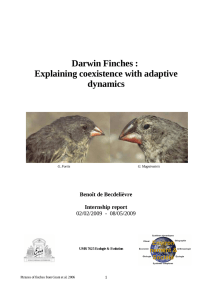
Darwin Finches : Explaining coexistence with adaptive
... The specimens of finches (Geospizinae) that he found on the Galapagos Islands provided a spectacular illustration of the theory : they form a group of 13 species found nowhere else on earth, but closely allied to those found on the South Continent, despite different environmental conditions, thus su ...
... The specimens of finches (Geospizinae) that he found on the Galapagos Islands provided a spectacular illustration of the theory : they form a group of 13 species found nowhere else on earth, but closely allied to those found on the South Continent, despite different environmental conditions, thus su ...

Vestigial Structures: Evolution`s Fallacies Jake Drahos Many people
... While vestigial structures are, by definition, useless, at least to the organism on which they exist. However, they do have a use. Vestigial structures can help determine the evolutionary relationships between organisms. Two organisms may share a vestigial structure. This likely means they shared a ...
... While vestigial structures are, by definition, useless, at least to the organism on which they exist. However, they do have a use. Vestigial structures can help determine the evolutionary relationships between organisms. Two organisms may share a vestigial structure. This likely means they shared a ...
- Philsci
... pursue it through the development of genetics and the Modern Synthesis, we find that while the explanation for what plays this structural role changes almost beyond recognition, the structural element nonetheless remains. What we have here, then – in line with McMullin’s appeal to the longterm prese ...
... pursue it through the development of genetics and the Modern Synthesis, we find that while the explanation for what plays this structural role changes almost beyond recognition, the structural element nonetheless remains. What we have here, then – in line with McMullin’s appeal to the longterm prese ...

Chapter 7 Changes Over Time
... Apply It! In the sentences below, identify which meaning of the word theory was used—the everyday meaning or the scientific meaning. ...
... Apply It! In the sentences below, identify which meaning of the word theory was used—the everyday meaning or the scientific meaning. ...
Evolutionary computing
... • Adaptation: the state of being and process of becoming suitable w.r.t. the environment • Natural selection: reproductive advantage by adaptation to an environment (survival of the fittest) • Phenotypic variability: small, random, apparently undirected deviation of offspring from parents Note: fitn ...
... • Adaptation: the state of being and process of becoming suitable w.r.t. the environment • Natural selection: reproductive advantage by adaptation to an environment (survival of the fittest) • Phenotypic variability: small, random, apparently undirected deviation of offspring from parents Note: fitn ...
Ch 19 Clicker Questions
... A. Variation existed in the finch population. Those that naturally had longer, narrower beaks could reach their food more easily, allowing finches with these features to survive and reproduce more often than those that did not. B. Every day, finches who needed to eat insects would squeeze their beak ...
... A. Variation existed in the finch population. Those that naturally had longer, narrower beaks could reach their food more easily, allowing finches with these features to survive and reproduce more often than those that did not. B. Every day, finches who needed to eat insects would squeeze their beak ...

how mechanistic biology can inform molecular ecology
... region of the protein and because this site was correlated with low temperature adaptation in Antarctic nototheniod fishes (Fields & Somero 1998). They tested this prediction using site-directed mutagenesis followed by in vitro expression and biochemical tests of protein function. As predicted, all ...
... region of the protein and because this site was correlated with low temperature adaptation in Antarctic nototheniod fishes (Fields & Somero 1998). They tested this prediction using site-directed mutagenesis followed by in vitro expression and biochemical tests of protein function. As predicted, all ...

8-2.1 - S2TEM Centers SC
... Natural selection arises from three well-established observations: (1) There is variation in traits within every species of organism, (2) some of these traits give some individuals advantage over others in survival and reproduction, and (3) those individuals that survive to adulthood be more likely ...
... Natural selection arises from three well-established observations: (1) There is variation in traits within every species of organism, (2) some of these traits give some individuals advantage over others in survival and reproduction, and (3) those individuals that survive to adulthood be more likely ...

Introduction
... Haven’t we explained that a species is defined by reproductive isolation only to have students point out exceptions such as the dog and the wolf, or the recent hybrid Grizzly/Polar bear? This unit is designed to address the vexing issue of the species concept by using these common student questions ...
... Haven’t we explained that a species is defined by reproductive isolation only to have students point out exceptions such as the dog and the wolf, or the recent hybrid Grizzly/Polar bear? This unit is designed to address the vexing issue of the species concept by using these common student questions ...

(2009) Trends in Microbiology. - Why Microbial Evolutionary
... birth, microbiologists interested in the application of Darwin’s ideas to the microscopic world have a lot to celebrate: an emerging picture of the (mostly microbial) Tree of Life at ever-increasing resolution, an understanding of horizontal gene transfer as a driving force in the evolution of micro ...
... birth, microbiologists interested in the application of Darwin’s ideas to the microscopic world have a lot to celebrate: an emerging picture of the (mostly microbial) Tree of Life at ever-increasing resolution, an understanding of horizontal gene transfer as a driving force in the evolution of micro ...
EvoDevo and niche construction: building bridges
... it still need not follow that development be regarded as evolutionarily inconsequential. In many cases the ‘‘controlling genes’’ may themselves have been selected as a result of development-induced changes in the selective environment (Laland and Sterelny, 2006). For example, it is often assumed tha ...
... it still need not follow that development be regarded as evolutionarily inconsequential. In many cases the ‘‘controlling genes’’ may themselves have been selected as a result of development-induced changes in the selective environment (Laland and Sterelny, 2006). For example, it is often assumed tha ...
Species range expansion by beneficial mutations
... species ranges that result from locally advantageous mutations. We begin our analysis by finding the survival probability of a mutation that occurs at a given location and with a given phenotypic effect. Those results form a foundation that we then use to study three basic questions about range expa ...
... species ranges that result from locally advantageous mutations. We begin our analysis by finding the survival probability of a mutation that occurs at a given location and with a given phenotypic effect. Those results form a foundation that we then use to study three basic questions about range expa ...

Biology Honors - Southern Regional School District
... DNA molecules. Genes are regions in the DNA that ● How do organisms detect, process, and use contain the instructions that code for the formation of information about the environment? proteins, which carry out most of the work of cells. ● Multi cellular organisms have a hierarchical structural organ ...
... DNA molecules. Genes are regions in the DNA that ● How do organisms detect, process, and use contain the instructions that code for the formation of information about the environment? proteins, which carry out most of the work of cells. ● Multi cellular organisms have a hierarchical structural organ ...

Evolutionary Biology, Quantitative Genetics, and (maybe) Biophysics
... Variation in Cell Division Traits Between Isolates Prediction of quantitative genetics theory of mutation-selection balance: ...
... Variation in Cell Division Traits Between Isolates Prediction of quantitative genetics theory of mutation-selection balance: ...
PBS 505 GENETIC METHODS IN PLANT BREEDING 2 Units Three
... common in a population as a function of differential reproduction of their bearers. It is a key mechanism of evolution. The genetic variation within a population of organisms may cause some individuals to survive and reproduce more successfully than others. Factors which affect reproductive success ...
... common in a population as a function of differential reproduction of their bearers. It is a key mechanism of evolution. The genetic variation within a population of organisms may cause some individuals to survive and reproduce more successfully than others. Factors which affect reproductive success ...
Biology, 8e (Campbell) Chapter 22 Descent with Modification: A
... 21) A biologist studied a population of squirrels for 15 years. During that time, the population was never fewer than 30 squirrels and never more than 45. Her data showed that over half of the squirrels born did not survive to reproduce, because of competition for food and predation. In a single gen ...
... 21) A biologist studied a population of squirrels for 15 years. During that time, the population was never fewer than 30 squirrels and never more than 45. Her data showed that over half of the squirrels born did not survive to reproduce, because of competition for food and predation. In a single gen ...
A review of The Structure of Evolutionary Theory
... processes advancing in definite directions”), 19 pp (396-415) on William Bateson’s search for the causes of discontinuous variation, 38 pp (413-451) on Hugo De Vries’s “mutation theory,” as well as 15 pp (451-466) on Goldschmidt’s now discredited “systemic mutations” and “hopeful monsters.” Of such ...
... processes advancing in definite directions”), 19 pp (396-415) on William Bateson’s search for the causes of discontinuous variation, 38 pp (413-451) on Hugo De Vries’s “mutation theory,” as well as 15 pp (451-466) on Goldschmidt’s now discredited “systemic mutations” and “hopeful monsters.” Of such ...
Selection and Adaptation
... Natural selection, which over generations leads to adaptations, is one important process through which species change over time in response to changes in environmental conditions. ...
... Natural selection, which over generations leads to adaptations, is one important process through which species change over time in response to changes in environmental conditions. ...

Biological Aging: Active and Passive Mechanisms Compared
... Subsequently, most efforts to develop evolutionary aging theories were limited by the need to demonstrate compensating individual benefit. However, by ~1960, even semi-plausible conforming compensating benefits for the majority of the semelparous animal observations had still not been discovered. In ...
... Subsequently, most efforts to develop evolutionary aging theories were limited by the need to demonstrate compensating individual benefit. However, by ~1960, even semi-plausible conforming compensating benefits for the majority of the semelparous animal observations had still not been discovered. In ...
Environment, Development, and Evolution
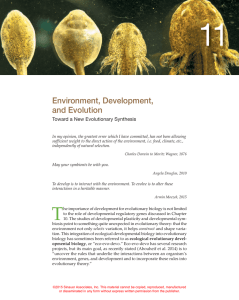
... a nutritional resource. But once fully integrated into such mutually obligate symbiosis, the aphid became dependent upon this symbiont for its development. ...
... a nutritional resource. But once fully integrated into such mutually obligate symbiosis, the aphid became dependent upon this symbiont for its development. ...
Perspective Evolution Is an Experiment
... are, in fact, selected in parallel across different domestication events. If genes are selected in parallel, it implies that the number of genetic solutions to the challenge of domestication is constrained. However, I find no evidence for parallel selection events either between species (maize vs. r ...
... are, in fact, selected in parallel across different domestication events. If genes are selected in parallel, it implies that the number of genetic solutions to the challenge of domestication is constrained. However, I find no evidence for parallel selection events either between species (maize vs. r ...