FREE Sample Here - We can offer most test bank and
... steps are: (1) observation; (2) question or problem; (3) hypothesis/null hypothesis; (4) gathering data/methodology; and (5) formation of a conclusion. Stress the equal importance of honest and effective methodology and conclusion formation. Describe the process of theory formation, a hypothesis sup ...
... steps are: (1) observation; (2) question or problem; (3) hypothesis/null hypothesis; (4) gathering data/methodology; and (5) formation of a conclusion. Stress the equal importance of honest and effective methodology and conclusion formation. Describe the process of theory formation, a hypothesis sup ...

P. syringae One metabolism - Department of Statistics Oxford
... evolutionary time and have just the reactions changing ? • Can we explore the role of niche-specific conditions in network evolution by defining core “available” metabolites ? • Can we develop theories about how and why selection has acted on networks by modulating selected variables (e.g. nitrogen ...
... evolutionary time and have just the reactions changing ? • Can we explore the role of niche-specific conditions in network evolution by defining core “available” metabolites ? • Can we develop theories about how and why selection has acted on networks by modulating selected variables (e.g. nitrogen ...

Lab 13- Evolution and Natural Selection
... Put Darwin’s observations together and you get natural selection, a process favoring survival and reproduction of the most fit individuals in a population. Natural selection can be viewed as differential reproduction. Individuals with favorable characteristics have a competitive advantage and are mo ...
... Put Darwin’s observations together and you get natural selection, a process favoring survival and reproduction of the most fit individuals in a population. Natural selection can be viewed as differential reproduction. Individuals with favorable characteristics have a competitive advantage and are mo ...

Beginnings - McGraw Hill Higher Education
... others, 2002). Over the course of many generations, organisms with the characteristics needed for survival would comprise a larger percentage of the population. Over many, many generations, this could produce a gradual modification of the whole population. If environmental conditions change, however ...
... others, 2002). Over the course of many generations, organisms with the characteristics needed for survival would comprise a larger percentage of the population. Over many, many generations, this could produce a gradual modification of the whole population. If environmental conditions change, however ...

Reprint - Queen`s University Department of Mathematics and Statistics.
... purports to have implications for theories of speciation by using an assumption of asexuality, but my goal here is to explore how population structure affects the form of selection that results from competition for resources rather than to explore speciation itself. An assumption of asexuality is we ...
... purports to have implications for theories of speciation by using an assumption of asexuality, but my goal here is to explore how population structure affects the form of selection that results from competition for resources rather than to explore speciation itself. An assumption of asexuality is we ...
Mar27-31
... 2. Square root of 1/2500 = 1/50 caucasians is heterozygous, i.e., carries one defective allele and one normal allele. ...
... 2. Square root of 1/2500 = 1/50 caucasians is heterozygous, i.e., carries one defective allele and one normal allele. ...

Evolutionary Biology (Life Sciences 3500) Fall 2014
... think-pieces will provide material for discussion in our class meetings. Think-pieces should address the key concepts associated with the topic, as well as highlight the most important findings or other aspects of the reading, including any questions you have. 4.1.2 Examples from the literature Fiv ...
... think-pieces will provide material for discussion in our class meetings. Think-pieces should address the key concepts associated with the topic, as well as highlight the most important findings or other aspects of the reading, including any questions you have. 4.1.2 Examples from the literature Fiv ...

12. Evolutionary Theory
... perspective during his five years on the Beagle; many contributed to his thinking after the voyage. Not until 23 years after he returned to England did Darwin crystallize his thoughts and evidence sufficiently to publish his theory. Before Darwin, most people believed that all species were created a ...
... perspective during his five years on the Beagle; many contributed to his thinking after the voyage. Not until 23 years after he returned to England did Darwin crystallize his thoughts and evidence sufficiently to publish his theory. Before Darwin, most people believed that all species were created a ...
Natural Selection or the Non-survival of the Non-fit
... 'survival of the fittest', many ecological concepts supposed to be connected with selection resulting in 'survival of the fittest' within a few generations, such as the dominant role of competition, the critical level of the costs of reproduction, the need of optimization and of optimal life-history ...
... 'survival of the fittest', many ecological concepts supposed to be connected with selection resulting in 'survival of the fittest' within a few generations, such as the dominant role of competition, the critical level of the costs of reproduction, the need of optimization and of optimal life-history ...

Unit 2: Change and Diversity of Life
... inherited characteristic that increases an organism’s chance of ...
... inherited characteristic that increases an organism’s chance of ...

Natural Selection Teacher Handout
... Since resources are limited, this leads to a "struggle for existence." Darwin applied this principal to the observations he made of nature, and realized that survival wouldn’t just depend on random chance. Organisms with beneficial traits would have a better chance of surviving the struggle for exis ...
... Since resources are limited, this leads to a "struggle for existence." Darwin applied this principal to the observations he made of nature, and realized that survival wouldn’t just depend on random chance. Organisms with beneficial traits would have a better chance of surviving the struggle for exis ...
Natural_Selection_TeacherHandout
... Since resources are limited, this leads to a "struggle for existence." Darwin applied this principal to the observations he made of nature, and realized that survival wouldn’t just depend on random chance. Organisms with beneficial traits would have a better chance of surviving the struggle for exis ...
... Since resources are limited, this leads to a "struggle for existence." Darwin applied this principal to the observations he made of nature, and realized that survival wouldn’t just depend on random chance. Organisms with beneficial traits would have a better chance of surviving the struggle for exis ...
Natural Selection Teacher Handout Module Overview
... Since resources are limited, this leads to a "struggle for existence." Darwin applied this principal to the observations he made of nature, and realized that survival wouldn’t just depend on random chance. Organisms with beneficial traits would have a better chance of surviving the struggle for exis ...
... Since resources are limited, this leads to a "struggle for existence." Darwin applied this principal to the observations he made of nature, and realized that survival wouldn’t just depend on random chance. Organisms with beneficial traits would have a better chance of surviving the struggle for exis ...
The Postulated Resemblance of Natural to Artificial Selection
... Such historic livestock improvers as Bakewell and Cruickshank are known to have hired out bulls to their neighbours, bringing them back into their own herds again if they proved themselves by their progeny. The underlying principles of the progeny test are sound genetically. It is the aim of the sci ...
... Such historic livestock improvers as Bakewell and Cruickshank are known to have hired out bulls to their neighbours, bringing them back into their own herds again if they proved themselves by their progeny. The underlying principles of the progeny test are sound genetically. It is the aim of the sci ...
LEVELS OF SELECTION ARE ARTEFACTS OF DIFFERENT
... to form collectives of type A and similarly members of type B form collectives of type B. Suppose that once these two types of collectives are put together in E, they beget new collectives of their type, but collectives A are more fecund than collectives B. It seems here that collectives A are fitte ...
... to form collectives of type A and similarly members of type B form collectives of type B. Suppose that once these two types of collectives are put together in E, they beget new collectives of their type, but collectives A are more fecund than collectives B. It seems here that collectives A are fitte ...
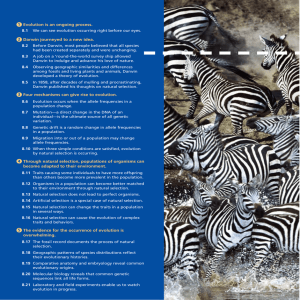
Evolution and Natural Selection Chapter Notes Article
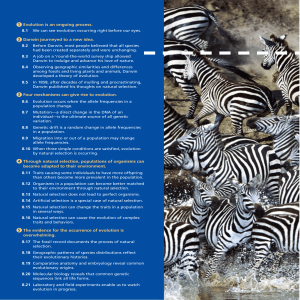
... average fly in the new generation can live for about 23 hours without food. And again, some of the new flies survive for more than 23 hours, some for less. The surviving flies tend to be those that pack on the fat when the food is available. The new starvation-resistance curve for this second genera ...
... average fly in the new generation can live for about 23 hours without food. And again, some of the new flies survive for more than 23 hours, some for less. The surviving flies tend to be those that pack on the fat when the food is available. The new starvation-resistance curve for this second genera ...
Evolution and Natural Selection Chapter Notes Article
... average fly in the new generation can live for about 23 hours without food. And again, some of the new flies survive for more than 23 hours, some for less. The surviving flies tend to be those that pack on the fat when the food is available. The new starvation-resistance curve for this second genera ...
... average fly in the new generation can live for about 23 hours without food. And again, some of the new flies survive for more than 23 hours, some for less. The surviving flies tend to be those that pack on the fat when the food is available. The new starvation-resistance curve for this second genera ...
advanced biology - Lakewood City Schools
... mechanism for evolution; undirected variation in inherited characteristics exist within every species. These characteristics may give individuals an advantage or disadvantage compared to others in surviving and reproducing. The advantaged offspring are more likely to survive and reproduce. Therefore ...
... mechanism for evolution; undirected variation in inherited characteristics exist within every species. These characteristics may give individuals an advantage or disadvantage compared to others in surviving and reproducing. The advantaged offspring are more likely to survive and reproduce. Therefore ...
Estimation of the upper limit of the mutation rate and mean
... of U and Uhs with the method of Deng et al. (2006). In brief, mutations are assumed to be strictly deleterious for the fitness trait studied, and a variable proportion of them are assumed to have a pleiotropic advantageous effect on another fitness trait, generating overdominance on global fitness. Usin ...
... of U and Uhs with the method of Deng et al. (2006). In brief, mutations are assumed to be strictly deleterious for the fitness trait studied, and a variable proportion of them are assumed to have a pleiotropic advantageous effect on another fitness trait, generating overdominance on global fitness. Usin ...
EVOLUTION TOWARD A NEW ADAPTIVE OPTIMUM
... from the sample at 8000 years, in which the pronounced evolutionary decrease begins (Fig. 1). Because the microevolutionary processes take place on generational time scales, we converted the ages in years to organismal generations, assuming a generation time of two years for these sticklebacks (Bell ...
... from the sample at 8000 years, in which the pronounced evolutionary decrease begins (Fig. 1). Because the microevolutionary processes take place on generational time scales, we converted the ages in years to organismal generations, assuming a generation time of two years for these sticklebacks (Bell ...
15-3 Darwin Presents His Case
... Scientific advances in many fields of biology, geology, and physics have confirmed and expanded most of Darwin’s hypotheses. Evolutionary theory continues to change as new data are gathered and new ways of thinking arise. ...
... Scientific advances in many fields of biology, geology, and physics have confirmed and expanded most of Darwin’s hypotheses. Evolutionary theory continues to change as new data are gathered and new ways of thinking arise. ...

video slide - Cloudfront.net
... • Mutations: a mutation in a gene may substitute one nucleotide for another, but the change will be harmless if it does not affect the function of the protein the DNA encodes. • Sexual recombination: plants and animals depend on sexual recombination for the genetic variation that makes adaption poss ...
... • Mutations: a mutation in a gene may substitute one nucleotide for another, but the change will be harmless if it does not affect the function of the protein the DNA encodes. • Sexual recombination: plants and animals depend on sexual recombination for the genetic variation that makes adaption poss ...

Compromising Theories - Northwest Creation Network
... fossilized because they were too small or because they were soft-bodied Molecular comparisons among living organisms point to a hypothetical common ancestor hundreds of millions of years before the Cambrian ...
... fossilized because they were too small or because they were soft-bodied Molecular comparisons among living organisms point to a hypothetical common ancestor hundreds of millions of years before the Cambrian ...
descent with modification
... Copyright © 2002 Pearson Education, Inc., publishing as Benjamin Cummings ...
... Copyright © 2002 Pearson Education, Inc., publishing as Benjamin Cummings ...

Atomism, epigenesis, preformation and preexistence: a clarification
... published in 1651, have been analysed by several authors in great detail (e.g. Adelmann, 1966; Pagel, 1967; Gaskin, 1967; Roger, 1971) which is why only the most important points pertinent to the understanding of his theory of epigenesis will be mentioned here. Harvey closely followed Aristotle, as ...
... published in 1651, have been analysed by several authors in great detail (e.g. Adelmann, 1966; Pagel, 1967; Gaskin, 1967; Roger, 1971) which is why only the most important points pertinent to the understanding of his theory of epigenesis will be mentioned here. Harvey closely followed Aristotle, as ...