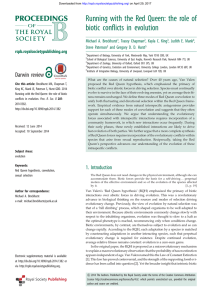
Running with the Red Queen: the role of biotic conflicts in evolution
... The standard model of RQ interactions focuses on the ability of evolution to be sustained in pairwise interactions that themselves persist indefinitely. However, each pair of antagonistic species are probably only co-travellers for a finite period of time. The ‘end’ of interactions may be associated ...
... The standard model of RQ interactions focuses on the ability of evolution to be sustained in pairwise interactions that themselves persist indefinitely. However, each pair of antagonistic species are probably only co-travellers for a finite period of time. The ‘end’ of interactions may be associated ...

4 Levels of Selection: An Alternative to Individualism in Biology and
... averaged across all groups, we have said nothing at all. Since this definition includes both within- and between-group selection, it makes ‘‘individual selection’’ synonymous with ‘‘whatever evolves,’’ including either S-types or A-types. It does not identify any set of traits that conceivably could ...
... averaged across all groups, we have said nothing at all. Since this definition includes both within- and between-group selection, it makes ‘‘individual selection’’ synonymous with ‘‘whatever evolves,’’ including either S-types or A-types. It does not identify any set of traits that conceivably could ...
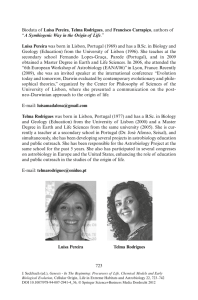
J. Seckbach (ed.), Genesis - In The Beginning: Precursors of Life
... biological organization. This author argues that the functional effects produced, for instance, by an independent set of genomes, as symbionts or coevolving species, with the contingencies of survival and reproduction constitute the directive aspect of natural selection. The notion of “competition v ...
... biological organization. This author argues that the functional effects produced, for instance, by an independent set of genomes, as symbionts or coevolving species, with the contingencies of survival and reproduction constitute the directive aspect of natural selection. The notion of “competition v ...

Here - Fred Hutchinson Cancer Research Center
... 1Z4, Canada. Fax: 604 822 2416; E-mail: [email protected] © 2006 Blackwell Publishing Ltd ...
... 1Z4, Canada. Fax: 604 822 2416; E-mail: [email protected] © 2006 Blackwell Publishing Ltd ...
life sciences examination guidelines senior certificate
... Define meiosis. State where meiosis takes place in plants and in animals. State that interphase takes place before meiosis and that although meiosis is a continuous process, the events are divided into different phases for convenience. ...
... Define meiosis. State where meiosis takes place in plants and in animals. State that interphase takes place before meiosis and that although meiosis is a continuous process, the events are divided into different phases for convenience. ...

Vestiges of the natural history of development: historical holdovers
... wings in the sun), neither of which is needed for its survival. All of the examples cited in the previous paragraphs— whether anatomical, physiological, or behavioral—have one thing in common: they are vestiges of evolution, artifacts of the progressive change that occurred over generations via natu ...
... wings in the sun), neither of which is needed for its survival. All of the examples cited in the previous paragraphs— whether anatomical, physiological, or behavioral—have one thing in common: they are vestiges of evolution, artifacts of the progressive change that occurred over generations via natu ...
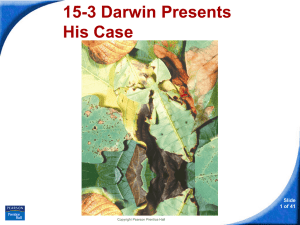
Chapter15_Section03_edit
... Because more organisms are produced than can survive, they compete for limited resources. Slide 28 of 41 Copyright Pearson Prentice Hall ...
... Because more organisms are produced than can survive, they compete for limited resources. Slide 28 of 41 Copyright Pearson Prentice Hall ...

Theory of Evolution
... can survive and reproduce and are said to have high fitness. • Individuals with characteristics that are not well-suited to their environment either die without reproducing or leave few offspring and are said to have low fitness. • This difference in rates of survival and reproduction is called surv ...
... can survive and reproduce and are said to have high fitness. • Individuals with characteristics that are not well-suited to their environment either die without reproducing or leave few offspring and are said to have low fitness. • This difference in rates of survival and reproduction is called surv ...
sample - Create Training
... remembered his father kicking from the path as a means of keeping count of the number of circuits he’d completed. The forest is now tall and venerable, and as I strolled I found myself pondering the thoughts that might possess a man as he walked repeatedly—almost compulsively—on a course as regular ...
... remembered his father kicking from the path as a means of keeping count of the number of circuits he’d completed. The forest is now tall and venerable, and as I strolled I found myself pondering the thoughts that might possess a man as he walked repeatedly—almost compulsively—on a course as regular ...
Natural Selection as a Cause: Probability, Chance, and Selective
... What does the coin-tossing example demonstrate? That when a type of outcome depends on chance, different outcomes may have the same probabilistic cause (here, it’s the relevant physical set-up). This is the distinctive mark of a probabilistic cause. Let us make clear what "probabilistic cause" mean ...
... What does the coin-tossing example demonstrate? That when a type of outcome depends on chance, different outcomes may have the same probabilistic cause (here, it’s the relevant physical set-up). This is the distinctive mark of a probabilistic cause. Let us make clear what "probabilistic cause" mean ...
Natural Selection - Plain Local Schools
... B. Darwin noticed the animals and plants he observed were uniquely South American C. Darwin was especially intrigued by the Galapagos Islands because of their diversity ...
... B. Darwin noticed the animals and plants he observed were uniquely South American C. Darwin was especially intrigued by the Galapagos Islands because of their diversity ...

Did Darwin Write the Origin Backwards? Philosophical Essays on
... some trait evolved by group or individual selection? Or was he a sort of pre-Mendelian conventionalist who thought group selection was useful, but the one true explanation was individual selection? Sober does not say, but it would have been helpful, given that the book is nominally about Darwin, if ...
... some trait evolved by group or individual selection? Or was he a sort of pre-Mendelian conventionalist who thought group selection was useful, but the one true explanation was individual selection? Sober does not say, but it would have been helpful, given that the book is nominally about Darwin, if ...

Week/Stahlke #2 - Washington State University
... Populations that undergo a process of rapid evolution present excellent opportunities to investigate the mechanisms driving or restraining adaptive divergence. The genetic variance–covariance matrix (G) is often considered to constrain adaptation but little is known about its potential to evolve dur ...
... Populations that undergo a process of rapid evolution present excellent opportunities to investigate the mechanisms driving or restraining adaptive divergence. The genetic variance–covariance matrix (G) is often considered to constrain adaptation but little is known about its potential to evolve dur ...
PDF
... frequently in an evolutionary process that often leads to macroevolutionary trends and in which organisms are said to be optimally/almost optimally “designed” for the habitats they inhabit. Organic Nonoptimal Constrained Evolution (ONCE), a new perspective on biological evolution that is proposed he ...
... frequently in an evolutionary process that often leads to macroevolutionary trends and in which organisms are said to be optimally/almost optimally “designed” for the habitats they inhabit. Organic Nonoptimal Constrained Evolution (ONCE), a new perspective on biological evolution that is proposed he ...

Chapter 13 Notes - Anderson County Schools
... evolution possible • Just a few years after the publication of The Origin of Species, Gregor Mendel wrote a groundbreaking paper on inheritance in pea plants. • Although the significance of Mendel’s work was not recognized during his or Darwin’s lifetime, its rediscovery in 1900 set the stage for un ...
... evolution possible • Just a few years after the publication of The Origin of Species, Gregor Mendel wrote a groundbreaking paper on inheritance in pea plants. • Although the significance of Mendel’s work was not recognized during his or Darwin’s lifetime, its rediscovery in 1900 set the stage for un ...
AP & Regents Biology - Whitman
... Biology is an ever expanding body of knowledge… too much to memorize it all need to generalize create a framework upon which to organize new knowledge themes are fundamental in understanding the nature of living organisms ...
... Biology is an ever expanding body of knowledge… too much to memorize it all need to generalize create a framework upon which to organize new knowledge themes are fundamental in understanding the nature of living organisms ...

Pre-adaptation, exaptation and technology speciation: a comment
... for a task (Simon, 1996) whether that design occurs through variation–selection– retention processes (as in biological evolution) or Lemarkian processes (as in new product development, etc.). In biology, this led Williams (1966: 6)to define adaptation as occurring when we can, ‘‘attribute the origin ...
... for a task (Simon, 1996) whether that design occurs through variation–selection– retention processes (as in biological evolution) or Lemarkian processes (as in new product development, etc.). In biology, this led Williams (1966: 6)to define adaptation as occurring when we can, ‘‘attribute the origin ...

The Origin of Species
... In 1844, Darwin wrote an essay on natural selection as the mechanism of descent with modification but did not introduce his theory publicly Natural selection is a process in which individuals with favorable inherited traits are more likely to survive and reproduce In June 1858, Darwin receive ...
... In 1844, Darwin wrote an essay on natural selection as the mechanism of descent with modification but did not introduce his theory publicly Natural selection is a process in which individuals with favorable inherited traits are more likely to survive and reproduce In June 1858, Darwin receive ...
dos and don`ts of testing the geographic mosaic theory of coevolution
... This is mainly because when both species are present, it can be difficult to rule ...
... This is mainly because when both species are present, it can be difficult to rule ...

Untitled - Matrix Education
... However, this is not a very good working definition for purposes of Biology. ...
... However, this is not a very good working definition for purposes of Biology. ...

Natural selection-the Making of the Fittest
... d. Provide an explanation for these observations. Be sure to include the following key words in your answer: “selection” (or “selective”), “fitness” (or “fit”), and “survival” (or “survive”). Sample answer (key terms are in italics): “In New Mexico, there is a selective advantage to having dark-col ...
... d. Provide an explanation for these observations. Be sure to include the following key words in your answer: “selection” (or “selective”), “fitness” (or “fit”), and “survival” (or “survive”). Sample answer (key terms are in italics): “In New Mexico, there is a selective advantage to having dark-col ...
8, Tupper seminar, larval type and species selection
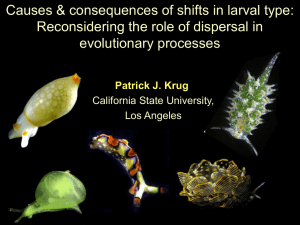
... BF >5 = strong support for model with change concentrated near tips larval type changes as species-specific adaptation, recently in history ...
... BF >5 = strong support for model with change concentrated near tips larval type changes as species-specific adaptation, recently in history ...


BSC1005 /Belk_Chapter 9
... Georgia Southern University Copyright © 2010 Pearson Education, Inc. ...
... Georgia Southern University Copyright © 2010 Pearson Education, Inc. ...