
A Review of the Evolutionary Psychology Debates
... evolutionary and psychological theories—has been most strongly advocated in a long essay by the anthropologist John Tooby and the psychologist Leda Cosmides, entitled “The Psychological Foundations of Culture” [4]. Tooby and Cosmides claim that evolutionary theory has, until now, been largely absent ...
... evolutionary and psychological theories—has been most strongly advocated in a long essay by the anthropologist John Tooby and the psychologist Leda Cosmides, entitled “The Psychological Foundations of Culture” [4]. Tooby and Cosmides claim that evolutionary theory has, until now, been largely absent ...
Microgeographic adaptation and the spatial scale of evolution
... Local adaptation has been a major focus of evolutionary ecologists working across diverse systems for decades. However, little of this research has explored variation at microgeographic scales because it has often been assumed that high rates of gene flow will prevent adaptive divergence at fine spa ...
... Local adaptation has been a major focus of evolutionary ecologists working across diverse systems for decades. However, little of this research has explored variation at microgeographic scales because it has often been assumed that high rates of gene flow will prevent adaptive divergence at fine spa ...
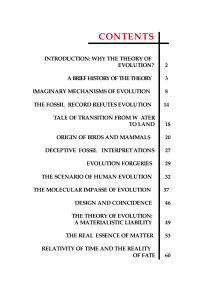
C O N T E N T S - Muslim Library
... selection and mutation are two complementary mechanisms. The origin of evolutionary modifications is random mutations that take place in the genetic structure of living things. The traits brought about by the mutations are selected by the mechanism of natural selection and therefore the living thing ...
... selection and mutation are two complementary mechanisms. The origin of evolutionary modifications is random mutations that take place in the genetic structure of living things. The traits brought about by the mutations are selected by the mechanism of natural selection and therefore the living thing ...

Using new tools to solve an old problem: the evolution of
... endothermy could have occurred. More recently, molecular biologists have developed powerful tools to infer past adaptive processes, and gene expression mechanisms that describe the organization of genomes into phenotypes. Here, we argue that the evolution of endothermy could now be elucidated based ...
... endothermy could have occurred. More recently, molecular biologists have developed powerful tools to infer past adaptive processes, and gene expression mechanisms that describe the organization of genomes into phenotypes. Here, we argue that the evolution of endothermy could now be elucidated based ...
15-3 Darwin Presents His Case
... Because of its similarities to artificial selection, Darwin referred to the survival of the fittest as natural selection. In natural selection, the traits being selected contribute to an organism's fitness in its ...
... Because of its similarities to artificial selection, Darwin referred to the survival of the fittest as natural selection. In natural selection, the traits being selected contribute to an organism's fitness in its ...

Drift, not selection, shapes toll-like receptor variation among oceanic
... Understanding the relative role of different evolutionary forces in shaping the level and distribution of functional genetic diversity among natural populations is a key issue in evolutionary and conservation biology. To do so accurately genetic data must be analysed in conjunction with an unambiguo ...
... Understanding the relative role of different evolutionary forces in shaping the level and distribution of functional genetic diversity among natural populations is a key issue in evolutionary and conservation biology. To do so accurately genetic data must be analysed in conjunction with an unambiguo ...

Darwin`s Theory of Evolution The Puzzle of Life`s Diversity Chapter
... Why grow a tail and then lose it? HUMAN EMBRYO _________________ has a tail at 4 weeks _________________ Tail disappears at _________________ about 8 weeks tail ...
... Why grow a tail and then lose it? HUMAN EMBRYO _________________ has a tail at 4 weeks _________________ Tail disappears at _________________ about 8 weeks tail ...

/K /d K d
... conclusions about lineage-specific modes of protein evolution using this metric. Background It has long been established that different lineages evolve at heterogeneous rates [1,2] and that differences in organismal life history are reflected by rates of molecular evolution. This is readily observed ...
... conclusions about lineage-specific modes of protein evolution using this metric. Background It has long been established that different lineages evolve at heterogeneous rates [1,2] and that differences in organismal life history are reflected by rates of molecular evolution. This is readily observed ...

Bottlenecks and Founder Effects
... Students should be familiar with the concept of random sampling and sample size. Students should understand how changes in alleles frequencies lead to changes in the gene pool of the population (they should also know what an allele is). Students should be familiar with the basic concepts of ev ...
... Students should be familiar with the concept of random sampling and sample size. Students should understand how changes in alleles frequencies lead to changes in the gene pool of the population (they should also know what an allele is). Students should be familiar with the basic concepts of ev ...
06 Life Histories 2009
... • Life histories balance trade-offs between current reproduction and future reproduction. • Great variation among organisms in resolving the fundamental tradeoff between fecundity and adult growth and survival. • Principle: limited time and resources are allocated among competing functions so as to ...
... • Life histories balance trade-offs between current reproduction and future reproduction. • Great variation among organisms in resolving the fundamental tradeoff between fecundity and adult growth and survival. • Principle: limited time and resources are allocated among competing functions so as to ...

Part-5B - UTK-EECS
... • But organisms and species must also channel energy toward the preservation and expansion of themselves as material ...
... • But organisms and species must also channel energy toward the preservation and expansion of themselves as material ...

15-3 PowerPoint
... Why grow a tail and then lose it? HUMAN EMBRYO _________________ has a tail at 4 weeks _________________ Tail disappears at _________________ about 8 weeks tail ...
... Why grow a tail and then lose it? HUMAN EMBRYO _________________ has a tail at 4 weeks _________________ Tail disappears at _________________ about 8 weeks tail ...

Chaetodon ocellata
... morphology, the structure and appearance of the organism – a species as defined this way will have a definable set of characteristics different from those of other species – weaknesses of typological definition • males may look different than females (sexual dimorphism) and juveniles than adults • t ...
... morphology, the structure and appearance of the organism – a species as defined this way will have a definable set of characteristics different from those of other species – weaknesses of typological definition • males may look different than females (sexual dimorphism) and juveniles than adults • t ...

The Bible, Science and Creation
... Small variation within prescribed limits of complexity e.g., finch beaks by mutation and natural selection ...
... Small variation within prescribed limits of complexity e.g., finch beaks by mutation and natural selection ...
Evolution_Ch7_transmittal_to_PE_Aug3
... (Figure 9). Each has a fascinating history that began in some part of the world where the original wild species lived. In this activity, you are to choose a domesticated species and investigate its past. [catch C07-P12-OB11USB; Size D; Research. Photo of wheat clearly showing an individual head of w ...
... (Figure 9). Each has a fascinating history that began in some part of the world where the original wild species lived. In this activity, you are to choose a domesticated species and investigate its past. [catch C07-P12-OB11USB; Size D; Research. Photo of wheat clearly showing an individual head of w ...

DarwinianPseudoScience
... Small variation within prescribed limits of complexity e.g., finch beaks by mutation and natural selection ...
... Small variation within prescribed limits of complexity e.g., finch beaks by mutation and natural selection ...

4. Define the following terms: transcription, translation, codon
... and realistic impression of science as a human activity. Fifty-five chapters discuss the chemistry of life, the cell, genetics, mechanisms of evolution, the evolutionary history of biological diversity, plant and animal form and function, and ecology. Illustrates in color and includes CD-ROM with120 ...
... and realistic impression of science as a human activity. Fifty-five chapters discuss the chemistry of life, the cell, genetics, mechanisms of evolution, the evolutionary history of biological diversity, plant and animal form and function, and ecology. Illustrates in color and includes CD-ROM with120 ...

Evolution - Bee-Man
... development also may increase the number of taste buds. Thus, mutations that happened to give the fish an advantage in tasting and smelling—a huge benefit in a dark environment— might also have inadvertently, and harmlessly, caused the degeneration of their eyes. ...
... development also may increase the number of taste buds. Thus, mutations that happened to give the fish an advantage in tasting and smelling—a huge benefit in a dark environment— might also have inadvertently, and harmlessly, caused the degeneration of their eyes. ...

Genome evolution - The Faculty of Mathematics and Computer
... samples for museums-gardens 1 paper in first 6 years as professor Controversial (geophysics, chemistry..) The “first” evolutionary theorist “Forming order” Complexification force ...
... samples for museums-gardens 1 paper in first 6 years as professor Controversial (geophysics, chemistry..) The “first” evolutionary theorist “Forming order” Complexification force ...

Hsp90 - Csulb.edu
... even when wildtype Hsp90 function is restored. Hsp90’s dual involvement in stress response and signal transduction raises the intriguing possibility that it serves to link the expression of genetic variation to environmental stress. Rutherford and Lindquist hypothesize that during stress Hsp90 becom ...
... even when wildtype Hsp90 function is restored. Hsp90’s dual involvement in stress response and signal transduction raises the intriguing possibility that it serves to link the expression of genetic variation to environmental stress. Rutherford and Lindquist hypothesize that during stress Hsp90 becom ...
Environmental Grain, Organism Fitness, and Type
... Natural selection is the result of differences in fitness, and fitness depends on organisms’ interactions with their environment. But environments vary in space and time, sometimes in extreme ways. Variation in what biologists call patches, habitats, environments, etc.—or what I’ll call subenvironments ...
... Natural selection is the result of differences in fitness, and fitness depends on organisms’ interactions with their environment. But environments vary in space and time, sometimes in extreme ways. Variation in what biologists call patches, habitats, environments, etc.—or what I’ll call subenvironments ...
Evolution of Phenotypes
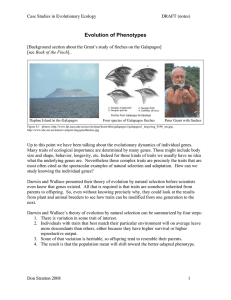
... parents to offspring. So, even without knowing precisely why, they could look at the results from plant and animal breeders to see how traits can be modified from one generation to the next. Darwin and Wallace’s theory of evolution by natural selection can be summarized by four steps: 1. There is va ...
... parents to offspring. So, even without knowing precisely why, they could look at the results from plant and animal breeders to see how traits can be modified from one generation to the next. Darwin and Wallace’s theory of evolution by natural selection can be summarized by four steps: 1. There is va ...
06 Life Histories 2010
... • Slow (often large organisms) • slow development • delayed maturity • low fecundity • high parental investment/offspring • low mortality • long life • Fast: opposite traits ...
... • Slow (often large organisms) • slow development • delayed maturity • low fecundity • high parental investment/offspring • low mortality • long life • Fast: opposite traits ...

Natural Selection Causes Evolution
... 1. Individuals within populations vary 2. Some of the variation within individuals can be passed on to their offspring 3. Populations of organisms produce more offspring than will survive 4. Survival and reproduction are not random ...
... 1. Individuals within populations vary 2. Some of the variation within individuals can be passed on to their offspring 3. Populations of organisms produce more offspring than will survive 4. Survival and reproduction are not random ...
What Darwin`s Finches Can Teach Us about the Evolutionary Origin
... of a new population. The large ground finch (Geospiza magnirostris) became a breeding member of the community in late 1982, when two females and three males began to breed. In preceding years we had observed immigrant members of this species on the island in the dry season, but when the rains began ...
... of a new population. The large ground finch (Geospiza magnirostris) became a breeding member of the community in late 1982, when two females and three males began to breed. In preceding years we had observed immigrant members of this species on the island in the dry season, but when the rains began ...