
Chapter 10: Natural Selection
... Natural selection does cause organisms to become a better fit to their environment Organisms are not necessarily “better”, just better fit to a particular situation Adaptation that is beneficial in one situation might be a liability in another Adaptations are trade-offs between better fit in ...
... Natural selection does cause organisms to become a better fit to their environment Organisms are not necessarily “better”, just better fit to a particular situation Adaptation that is beneficial in one situation might be a liability in another Adaptations are trade-offs between better fit in ...

Evolution and Systematics
... creation, in which the Creator established an unchanging ideal body form for each species. One belief was that growing organisms strive to match the ideal patterns, and they differ because the physical world is imperfect. The scholar's goal was to deduce the ideal pattern for each species by examini ...
... creation, in which the Creator established an unchanging ideal body form for each species. One belief was that growing organisms strive to match the ideal patterns, and they differ because the physical world is imperfect. The scholar's goal was to deduce the ideal pattern for each species by examini ...
Biology
... Because more organisms are produced than can survive, they compete for limited resources. Slide 30 of 41 Copyright Pearson Prentice Hall ...
... Because more organisms are produced than can survive, they compete for limited resources. Slide 30 of 41 Copyright Pearson Prentice Hall ...

Fisheries-induced evolution of maturation reaction norms
... consequences on the target species, but may also induce adaptive changes in their life history because fishing is by essence selective (Stokes et al. 1993, Palumbi 2001, Ashley et al. 2003 ). ∎ Adaptive changes can have two different origins (Rijnsdorp 1993, Law 2000): Phenotypic plasticity: most ...
... consequences on the target species, but may also induce adaptive changes in their life history because fishing is by essence selective (Stokes et al. 1993, Palumbi 2001, Ashley et al. 2003 ). ∎ Adaptive changes can have two different origins (Rijnsdorp 1993, Law 2000): Phenotypic plasticity: most ...
Natural selection
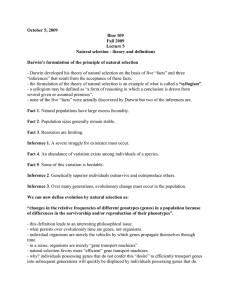
... Inference 1. A severe struggle for existence must occur. Fact 4. An abundance of variation exists among individuals of a species. Fact 5. Some of this variation is heritable. Inference 2. Genetically superior individuals outsurvive and outreproduce others. Inference 3. Over many generations, evoluti ...
... Inference 1. A severe struggle for existence must occur. Fact 4. An abundance of variation exists among individuals of a species. Fact 5. Some of this variation is heritable. Inference 2. Genetically superior individuals outsurvive and outreproduce others. Inference 3. Over many generations, evoluti ...

14. Natural Selection
... Charles Darwin observed many species of animals and plants in the Galapagos Islands that were unique to the islands, but still similar to species he had seen elsewhere. Darwin developed a theory called natural selection to explain how species change over time. He described natural selection as the p ...
... Charles Darwin observed many species of animals and plants in the Galapagos Islands that were unique to the islands, but still similar to species he had seen elsewhere. Darwin developed a theory called natural selection to explain how species change over time. He described natural selection as the p ...
14 - Darwin Presents His Case
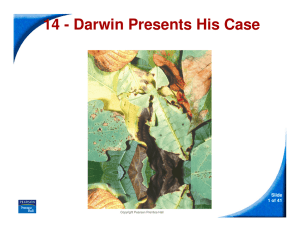
... Because more organisms are produced than can survive, they compete for limited resources. Slide 31 of 41 Copyright Pearson Prentice Hall ...
... Because more organisms are produced than can survive, they compete for limited resources. Slide 31 of 41 Copyright Pearson Prentice Hall ...
Natural selection
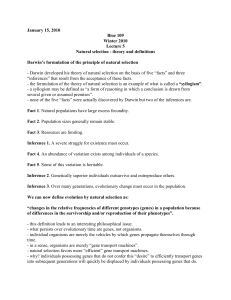
... Inference 1. A severe struggle for existence must occur. Fact 4. An abundance of variation exists among individuals of a species. Fact 5. Some of this variation is heritable. Inference 2. Genetically superior individuals outsurvive and outreproduce others. Inference 3. Over many generations, evoluti ...
... Inference 1. A severe struggle for existence must occur. Fact 4. An abundance of variation exists among individuals of a species. Fact 5. Some of this variation is heritable. Inference 2. Genetically superior individuals outsurvive and outreproduce others. Inference 3. Over many generations, evoluti ...
Neo-Darwinists and Neo-Aristotelians: how to talk about natural
... armory of both scientists and the popular audience. Yet this language still generates puzzles because of the directed character of the activities it describes. Ernst Mayr’s early 1961 paper was a classic attempt to delineate a sound theoretical and scientific basis for the teleological notions of pu ...
... armory of both scientists and the popular audience. Yet this language still generates puzzles because of the directed character of the activities it describes. Ernst Mayr’s early 1961 paper was a classic attempt to delineate a sound theoretical and scientific basis for the teleological notions of pu ...

File
... selection would favor traits adapted to the new conditions – Diversity within a population allows populations to adapt when the environment changes ...
... selection would favor traits adapted to the new conditions – Diversity within a population allows populations to adapt when the environment changes ...
Honey, I shrunk the organization: in search of
... competitive advantage. Being unique is associated to the ability to attract and convince customers, investors, and employees, thereby easing the process of collection of resources needed to operate, and augmenting the value of products, services, and opportunities provided. At the same time, being u ...
... competitive advantage. Being unique is associated to the ability to attract and convince customers, investors, and employees, thereby easing the process of collection of resources needed to operate, and augmenting the value of products, services, and opportunities provided. At the same time, being u ...
this PDF file - Reports of the National Center for Science
... Lamarckian perspective should be taken into account in biology in order to produce a new evolutionary synthesis that would describe and explain the biological world better than the classical theory of evolution (that is, the Modern Synthesis). As conveyed by the title, Lamarckism includes very diffe ...
... Lamarckian perspective should be taken into account in biology in order to produce a new evolutionary synthesis that would describe and explain the biological world better than the classical theory of evolution (that is, the Modern Synthesis). As conveyed by the title, Lamarckism includes very diffe ...

AP Biology - Falkavage-APBIO - home
... 1.A.1: Natural Selection is a major mechanism of evolution. 1.A.2: Natural Selection acts on phenotypic variations in populations. 1.A.3: Evolutionary change is also driven by a random process. 1.A.4: Biological evolution is supported by scientific evidence from many disciplines including mathematic ...
... 1.A.1: Natural Selection is a major mechanism of evolution. 1.A.2: Natural Selection acts on phenotypic variations in populations. 1.A.3: Evolutionary change is also driven by a random process. 1.A.4: Biological evolution is supported by scientific evidence from many disciplines including mathematic ...
16Insect Evolutionary
... In some circumstances niche choice may equate to mate choice. The classic case in which pleiotropic effects cause reproductive isolation in this manner is during host shifts among phytophagous insects (Bush, 1969). Clearly, given the great diversity of host-plant relationships found among the insect ...
... In some circumstances niche choice may equate to mate choice. The classic case in which pleiotropic effects cause reproductive isolation in this manner is during host shifts among phytophagous insects (Bush, 1969). Clearly, given the great diversity of host-plant relationships found among the insect ...

15.1 Conditions on early Earth made the origin of life possible
... An important step in cladistics is the comparison of the ingroup (the taxa whose phylogeny is being investigated) and the outgroup (a taxon that diverged before the lineage leading to the members of the ingroup) – The tree is constructed from a series of branch points, represented by the emergence ...
... An important step in cladistics is the comparison of the ingroup (the taxa whose phylogeny is being investigated) and the outgroup (a taxon that diverged before the lineage leading to the members of the ingroup) – The tree is constructed from a series of branch points, represented by the emergence ...
perspective:is human cultural evolution darwinian? evidence
... these against the rich variety of empirical data concerning human culture that have been garnered in a diversity of human sciences since The Origin was published. Accordingly, we shall briefly reprise the key elements of the case for biological evolution through natural selection that were presented ...
... these against the rich variety of empirical data concerning human culture that have been garnered in a diversity of human sciences since The Origin was published. Accordingly, we shall briefly reprise the key elements of the case for biological evolution through natural selection that were presented ...
Conceptual Barriers to Progress Within Evolutionary Biology
... The niche construction perspective differs from the conventional perspective in recognizing two major adaptive processes in evolution, natural selection and niche construction. The perspective also recognizes two general forms of inheritance in evolution, genetic and ecological inheritance. There ar ...
... The niche construction perspective differs from the conventional perspective in recognizing two major adaptive processes in evolution, natural selection and niche construction. The perspective also recognizes two general forms of inheritance in evolution, genetic and ecological inheritance. There ar ...

The Importance of Developmental Repatterning in the Evolution of
... Abstract Historically, in his On the Origin of Species, Charles Darwin is remembered for, among other things, remarking on how poor the fossil record was and being concerned that it would not support his view of modification by natural selection. He is much less well remembered, though, for arguing ...
... Abstract Historically, in his On the Origin of Species, Charles Darwin is remembered for, among other things, remarking on how poor the fossil record was and being concerned that it would not support his view of modification by natural selection. He is much less well remembered, though, for arguing ...
Preview Sample 2
... 3. Discuss the roles of natural selection and sexual selection in the evolution of species. Ans: ● Natural selection: variation gives some individuals a survival advantage; these are more likely to reproduce and hence pass on those advantages to their offspring. ● Sexual selection: individuals withi ...
... 3. Discuss the roles of natural selection and sexual selection in the evolution of species. Ans: ● Natural selection: variation gives some individuals a survival advantage; these are more likely to reproduce and hence pass on those advantages to their offspring. ● Sexual selection: individuals withi ...
in evolution - University of California, Berkeley
... common form of mutation-single nucleotide substitution-are highly unlikely to be present within a species at any point in time; (b) there is a simple and direct relationship between the mutation rate and the rate of evolutionary change on the molecular level; (c) specific mutations do not recur at r ...
... common form of mutation-single nucleotide substitution-are highly unlikely to be present within a species at any point in time; (b) there is a simple and direct relationship between the mutation rate and the rate of evolutionary change on the molecular level; (c) specific mutations do not recur at r ...

7th grade Honors Science Curriculum
... geology, fossils and comparative anatomy that provides the basis for the theory of evolution 4.1.7.D Explain how biological diversity relates to the ability of an ecosystem to adapt to change 4.1.7.E Identify factors that contribute to change in natural and human-made systems; explain the processes ...
... geology, fossils and comparative anatomy that provides the basis for the theory of evolution 4.1.7.D Explain how biological diversity relates to the ability of an ecosystem to adapt to change 4.1.7.E Identify factors that contribute to change in natural and human-made systems; explain the processes ...

Why language change is not (language) evolution
... ‘the linguistic species need not be a clone of any biological species, despite the fact that it shares several properties with the parasitic species’ (2001: 145) ‘there is no particular reason why every structural notion applicable to a biological species should be applicable to a linguistic species ...
... ‘the linguistic species need not be a clone of any biological species, despite the fact that it shares several properties with the parasitic species’ (2001: 145) ‘there is no particular reason why every structural notion applicable to a biological species should be applicable to a linguistic species ...


Distortion of symmetrical introgression in a hybrid zone
... mtDNA of one species and the homozygote of the other species (BB). The estimator D2 is of special interest because it estimates whether heterozygote (hybrid) individuals are more likely to have one species’ mtDNA than the other. A significant value implies fitness differences relative to genetic bac ...
... mtDNA of one species and the homozygote of the other species (BB). The estimator D2 is of special interest because it estimates whether heterozygote (hybrid) individuals are more likely to have one species’ mtDNA than the other. A significant value implies fitness differences relative to genetic bac ...
- Digital Commons @Brockport
... Minimization is maximization by another name; just as light minimizes its travel time 1, it maximizes the inverse of its travel time l /t. The light's trajectory can be discovered by finding how some quantity is minimized or maximized. One understands nature by thinking ofnature as going to extremes ...
... Minimization is maximization by another name; just as light minimizes its travel time 1, it maximizes the inverse of its travel time l /t. The light's trajectory can be discovered by finding how some quantity is minimized or maximized. One understands nature by thinking ofnature as going to extremes ...