
If They Can Mate, Did They Speciate?
... Haven’t we explained that a species is defined by reproductive isolation only to have students point out exceptions such as the dog and the wolf, or the recent hybrid Grizzly/Polar bear? This unit is designed to address the vexing issue of the species concept by using these common student questions ...
... Haven’t we explained that a species is defined by reproductive isolation only to have students point out exceptions such as the dog and the wolf, or the recent hybrid Grizzly/Polar bear? This unit is designed to address the vexing issue of the species concept by using these common student questions ...

A View of Life
... Hypothesized local catastrophes had occurred whenever a new strata showed a new mix of fossils. After each catastrophe, a region was repopulated by species from surrounding areas. Catastrophism Mader: Biology 8th Ed. ...
... Hypothesized local catastrophes had occurred whenever a new strata showed a new mix of fossils. After each catastrophe, a region was repopulated by species from surrounding areas. Catastrophism Mader: Biology 8th Ed. ...
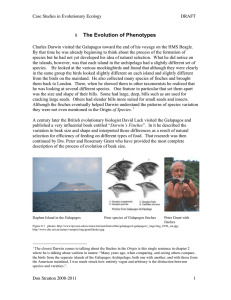
8 The Evolution of Phenotypes
... Their first big surprise came in 1977 when there was an especially severe drought on the islands. That year the rains did not arrive and there was a period of 20 months with almost no rain. Eventually the finches ate most of the seeds that were available. Different plants produce seeds of different ...
... Their first big surprise came in 1977 when there was an especially severe drought on the islands. That year the rains did not arrive and there was a period of 20 months with almost no rain. Eventually the finches ate most of the seeds that were available. Different plants produce seeds of different ...

Darwin`s Finches
... themselves. A few years ago, Dosch Luter and I tried to go a little bit further than just making that kind of matching correspondence. We asked, "Is it possible to be able to take information from what is available in the matter of food supply on each of the islands and so understand the way in whic ...
... themselves. A few years ago, Dosch Luter and I tried to go a little bit further than just making that kind of matching correspondence. We asked, "Is it possible to be able to take information from what is available in the matter of food supply on each of the islands and so understand the way in whic ...

Distinguished Lecture Series vol 10
... themselves. A few years ago, Dosch Luter and I tried to go a little bit further than just making that kind of matching correspondence. We asked, "Is it possible to be able to take information from what is available in the matter of food supply on each of the islands and so understand the way in whic ...
... themselves. A few years ago, Dosch Luter and I tried to go a little bit further than just making that kind of matching correspondence. We asked, "Is it possible to be able to take information from what is available in the matter of food supply on each of the islands and so understand the way in whic ...

Clarifying biotic homogenization
... seems to be that the modularity of things is, as the editors point out, a matter of degree. However, there is no formal theory of modularity and, in the absence of that, no consensus about how to measure it. The result is that we are invariably given the history of a case rather than a sense of its ...
... seems to be that the modularity of things is, as the editors point out, a matter of degree. However, there is no formal theory of modularity and, in the absence of that, no consensus about how to measure it. The result is that we are invariably given the history of a case rather than a sense of its ...

Evolution of Genetic Variance-Covariance Structure
... One of the features of organisms that makes the study of biology so compelling is their apparent complexity. Molecular, cellular, developmental, physiological, neurological, and behavioral systems are each fascinating in and of themselves, but it is their interaction that generates what we see as th ...
... One of the features of organisms that makes the study of biology so compelling is their apparent complexity. Molecular, cellular, developmental, physiological, neurological, and behavioral systems are each fascinating in and of themselves, but it is their interaction that generates what we see as th ...
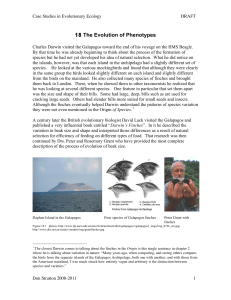
18 The Evolution of Phenotypes
... Their first big surprise came in 1977 when there was an especially severe drought on the islands. That year the rains did not arrive and there was a period of 20 months with almost no rain. Eventually the finches ate most of the seeds that were available. Different plants produce seeds of different ...
... Their first big surprise came in 1977 when there was an especially severe drought on the islands. That year the rains did not arrive and there was a period of 20 months with almost no rain. Eventually the finches ate most of the seeds that were available. Different plants produce seeds of different ...

HUMAN GENETIC VARIATION: THE MECHANISMS AND RESULTS
... study (26) found over 60 different alleles that cause OCA1 in a sample of only 102 patients. Most albino patients carried copies of two mutant alleles that differed at the DNA level. This finding suggests that mutation provides a constant supply of new deficiency alleles, but selection removes them ...
... study (26) found over 60 different alleles that cause OCA1 in a sample of only 102 patients. Most albino patients carried copies of two mutant alleles that differed at the DNA level. This finding suggests that mutation provides a constant supply of new deficiency alleles, but selection removes them ...

Part A - Board of Studies
... An organism has a genotype represented by Gg Tt. This organism can produce different types of gametes. The possible gametes would be represented by (A) G, g, T, t (B) Gg, gT, GT, gt (C) GG, gg, TT, tt (D) GT, Gt, gT, gt ...
... An organism has a genotype represented by Gg Tt. This organism can produce different types of gametes. The possible gametes would be represented by (A) G, g, T, t (B) Gg, gT, GT, gt (C) GG, gg, TT, tt (D) GT, Gt, gT, gt ...

13. How Populations Evolve
... • After his return, Darwin began to document his observations and his new theory of evolution ...
... • After his return, Darwin began to document his observations and his new theory of evolution ...

peppered moth survey
... Peppered Moth Graphing Activity Targets 3) Apply the concept of how environmental change influences natural selection leading to: diversity, speciation, loss of biodiversity, and extinction 6) Predict the survival of an animal in a specific environment given certain existing behavioral and physical ...
... Peppered Moth Graphing Activity Targets 3) Apply the concept of how environmental change influences natural selection leading to: diversity, speciation, loss of biodiversity, and extinction 6) Predict the survival of an animal in a specific environment given certain existing behavioral and physical ...

Generative design in an evolutionary procedure
... The schema of design model is developed into two evolutionary processes of design operations which include natural selections and the evolutionary mechanism. Natural selections provide the tournament for the distribution of designers’ weighting that calculates fitness of each population. Theories of ...
... The schema of design model is developed into two evolutionary processes of design operations which include natural selections and the evolutionary mechanism. Natural selections provide the tournament for the distribution of designers’ weighting that calculates fitness of each population. Theories of ...

Mechanisms of Evolution
... the past, list 2–3 things that could cause these changes. 4. Reinforce that biological evolution happens at the population level over many generations and not in individual organisms. ...
... the past, list 2–3 things that could cause these changes. 4. Reinforce that biological evolution happens at the population level over many generations and not in individual organisms. ...

The Evolutionary Legacies of the Quaternary Ice Ages
... British seas after being expelled from them by Glacial cold, when 2 million years had elapsed, and after such migration to milder seas? Be so good as to explain all this in your next letter.” Darwin did not reply directly to Lyell’s question or comment on it anywhere else. Lyell was clearly concerne ...
... British seas after being expelled from them by Glacial cold, when 2 million years had elapsed, and after such migration to milder seas? Be so good as to explain all this in your next letter.” Darwin did not reply directly to Lyell’s question or comment on it anywhere else. Lyell was clearly concerne ...
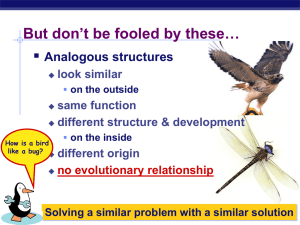
File - San Marin Science
... from a common ancestor on the mainland – they adapted to different local ...
... from a common ancestor on the mainland – they adapted to different local ...

Interesting Open Questions in Disease Ecology and Evolution*
... most parasites can infect multiple host species. However, while such multihost-multiparasite interactions are the norm in nature, they have received relatively little empirical study (Fenton and Pedersen 2005; Rigaud et al. 2010). In the most simplistic (and unrealistic) scenario, a system would be ...
... most parasites can infect multiple host species. However, while such multihost-multiparasite interactions are the norm in nature, they have received relatively little empirical study (Fenton and Pedersen 2005; Rigaud et al. 2010). In the most simplistic (and unrealistic) scenario, a system would be ...
2014 - UO Blogs - University of Oregon
... to pursue fundamental questions such as where did life (including us) come from, how are different life forms related to each other and what can a deep understanding of one life form tell us about ...
... to pursue fundamental questions such as where did life (including us) come from, how are different life forms related to each other and what can a deep understanding of one life form tell us about ...

Chapter 12 PowerPoint
... almost perfectly into its habitat. How could an organism like this arise? Each generation, the best camouflaged individuals survive to reproduce. The alleles conferring camouflage become more common in each generation. ...
... almost perfectly into its habitat. How could an organism like this arise? Each generation, the best camouflaged individuals survive to reproduce. The alleles conferring camouflage become more common in each generation. ...

Document
... almost perfectly into its habitat. How could an organism like this arise? Each generation, the best camouflaged individuals survive to reproduce. The alleles conferring camouflage become more common in each generation. ...
... almost perfectly into its habitat. How could an organism like this arise? Each generation, the best camouflaged individuals survive to reproduce. The alleles conferring camouflage become more common in each generation. ...

5 Points of Darwin`s Natural Selection
... Living things that are well adapted to their environment survive and reproduce. Those that are not well adapted don’t survive and reproduce. An adaptation is any characteristic that increases fitness, which is defined as the ability to survive and reproduce. Over many generations heritable adaptive ...
... Living things that are well adapted to their environment survive and reproduce. Those that are not well adapted don’t survive and reproduce. An adaptation is any characteristic that increases fitness, which is defined as the ability to survive and reproduce. Over many generations heritable adaptive ...
Chapter 7 The Evolution of Living Things-1n7p04n
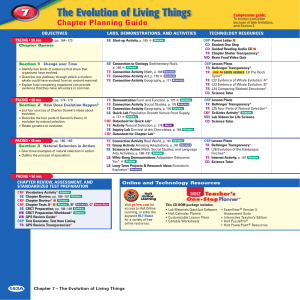
... method applies to the world of physical science and the role of physical science in the world. By the end of the chapter, students should demonstrate a clear understanding of the chapter’s main ideas and be able to discuss the following topics: 1. physical science as the study of energy and matter ( ...
... method applies to the world of physical science and the role of physical science in the world. By the end of the chapter, students should demonstrate a clear understanding of the chapter’s main ideas and be able to discuss the following topics: 1. physical science as the study of energy and matter ( ...
1 - DrMillsLMU
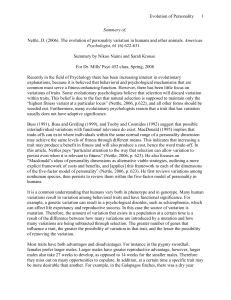
... exploration levels can be either a cost or a benefit. Nettle discusses another theory known as negative frequency-dependent selection. This process occurs when traits have increased fitness when they are rare, but their fitness decreases as they become more common. After discussing many examples in ...
... exploration levels can be either a cost or a benefit. Nettle discusses another theory known as negative frequency-dependent selection. This process occurs when traits have increased fitness when they are rare, but their fitness decreases as they become more common. After discussing many examples in ...

Natural Selection - Bakersfield College
... – Now believed to have arisen from single pair or pregnant female from So. American mainland • Rafted to islands by storm • Population size increased and resources decreased • Individuals capable of using other resources did so to survive • Natural selection gradually selected for those groups that ...
... – Now believed to have arisen from single pair or pregnant female from So. American mainland • Rafted to islands by storm • Population size increased and resources decreased • Individuals capable of using other resources did so to survive • Natural selection gradually selected for those groups that ...

What the scientists say about evolution
... imagination which could explain every irregularity in the solar system without explanation, leap the gaps in the atomic series without evidence [a gap required by the Big Bang theory], postulate the discovery of fossils which have never been discovered, and prophesy the success of breeding experimen ...
... imagination which could explain every irregularity in the solar system without explanation, leap the gaps in the atomic series without evidence [a gap required by the Big Bang theory], postulate the discovery of fossils which have never been discovered, and prophesy the success of breeding experimen ...