
Editorial Review
... is used in the scientific literature in many different ways and different contexts. This is not surprizing as one can have different perspectives on stress depending on the discipline (e.g. physiology, ecology and evolutionary biology), and biological level of interest (viz. molecular, physiological ...
... is used in the scientific literature in many different ways and different contexts. This is not surprizing as one can have different perspectives on stress depending on the discipline (e.g. physiology, ecology and evolutionary biology), and biological level of interest (viz. molecular, physiological ...

Evolution - Your Planet Earth
... • He figured out the basic principles of genetics. He showed that offspring received characteristics from both parents, but only the dominant characteristic trait was expressed. Mendel’s work only came to light in 1900, long after his death ...
... • He figured out the basic principles of genetics. He showed that offspring received characteristics from both parents, but only the dominant characteristic trait was expressed. Mendel’s work only came to light in 1900, long after his death ...
Understanding Evolution
... Evolutionary theory is the central theory of biology. It explains the unity of life by documenting how extant and extinct species share a common ancestry. It also explains the diversity of life by describing how species have evolved from ancestral ones through natural processes. Charles Darwin laid ...
... Evolutionary theory is the central theory of biology. It explains the unity of life by documenting how extant and extinct species share a common ancestry. It also explains the diversity of life by describing how species have evolved from ancestral ones through natural processes. Charles Darwin laid ...
Revision PowerPoint B1 Topic 1 Foundation
... environment. This means features that are affected by the surroundings. For example, height and weight are both genetic and affected by your diet / illness. ALL: State what is meant by variation, and (Grade E) conduct an investigation into variation. (SKILL) Describe variation as continuous or disco ...
... environment. This means features that are affected by the surroundings. For example, height and weight are both genetic and affected by your diet / illness. ALL: State what is meant by variation, and (Grade E) conduct an investigation into variation. (SKILL) Describe variation as continuous or disco ...
Taxonomy was the foundation of Darwin`s evolution
... taxonomic practice from boyhood, yet only rarely, during the Beagle’s voyage, gave a moment’s thought to why the Linnaean categories worked so well. He knew first hand how easy it was to overlook the wonderfulness of the shape of nature being recorded by taxonomists. It is essential to recognize tha ...
... taxonomic practice from boyhood, yet only rarely, during the Beagle’s voyage, gave a moment’s thought to why the Linnaean categories worked so well. He knew first hand how easy it was to overlook the wonderfulness of the shape of nature being recorded by taxonomists. It is essential to recognize tha ...

Processes of evolution – extra questions and answers
... Food supply could have been affected by the severe drought. This could have affected the finches since there would be less water available, fewer plants (due to lack of water or pollinators) producing fewer seeds. Any feature that increased a bird’s ability to obtain food would be selected for. Role ...
... Food supply could have been affected by the severe drought. This could have affected the finches since there would be less water available, fewer plants (due to lack of water or pollinators) producing fewer seeds. Any feature that increased a bird’s ability to obtain food would be selected for. Role ...

Lesson Overview - Mr. Pelton Science
... Survival of the Fittest • According to Darwin, differences in adaptations affect an individual’s fitness. • Fitness describes how well an organism can survive and reproduce in its environment. • Individuals with adaptations that are wellsuited to their environment can survive and reproduce and are s ...
... Survival of the Fittest • According to Darwin, differences in adaptations affect an individual’s fitness. • Fitness describes how well an organism can survive and reproduce in its environment. • Individuals with adaptations that are wellsuited to their environment can survive and reproduce and are s ...
variation in fitness - University of California, Berkeley
... of production of mutants that have a fitness above neutrality, is very low, being about 1/30 of 1/N. In this example, a few mutants do get fixed. Two were actually fixed during the first 10,000 generations (see Figure 1). A third mutant was not fixed because at the time its frequency was approaching ...
... of production of mutants that have a fitness above neutrality, is very low, being about 1/30 of 1/N. In this example, a few mutants do get fixed. Two were actually fixed during the first 10,000 generations (see Figure 1). A third mutant was not fixed because at the time its frequency was approaching ...
IS EVOLUTION A FACT? — A REBUTTAL TO AN EVOLUTIONIST`S
... proof” for evolution, and are fond of making statements such as these: “Bacteria experience far more mutations because there are so many more individuals and generations. This and the short reproductive cycle allow beneficial mutations to be exploited by natural selection rapidly” (Berra, 1990, p. 5 ...
... proof” for evolution, and are fond of making statements such as these: “Bacteria experience far more mutations because there are so many more individuals and generations. This and the short reproductive cycle allow beneficial mutations to be exploited by natural selection rapidly” (Berra, 1990, p. 5 ...
Lecture PPT - Carol Lee Lab - University of Wisconsin–Madison
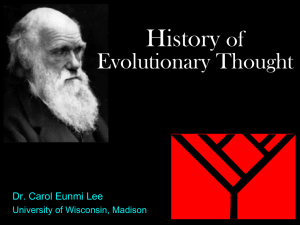
... independently They decided on a joint presentation at the Linnean Society in 1858, but it received little attention After which Darwin rushed to publish his book in 1859 ...
... independently They decided on a joint presentation at the Linnean Society in 1858, but it received little attention After which Darwin rushed to publish his book in 1859 ...

Standard(s) - Delaware Department of Education
... The diversity and changing of life forms over many generations is the result of natural selection, in which organisms with advantageous traits survive, reproduce, and pass those traits to offspring. a. All living things are related by descent with modification from common ancestors. b. The theory ...
... The diversity and changing of life forms over many generations is the result of natural selection, in which organisms with advantageous traits survive, reproduce, and pass those traits to offspring. a. All living things are related by descent with modification from common ancestors. b. The theory ...

Why Do Animals Survive or Die?
... In this activity, you and the members of your team will play the roles of paleontologists working in the field in Ohio, near the town of Canton. One clear crisp afternoon in October, you find four well-preserved and complete fossil bones. 1. Withdraw four fossil bones from your envelope. Make sure y ...
... In this activity, you and the members of your team will play the roles of paleontologists working in the field in Ohio, near the town of Canton. One clear crisp afternoon in October, you find four well-preserved and complete fossil bones. 1. Withdraw four fossil bones from your envelope. Make sure y ...

Natural selection and population dynamics
... Studies of the large metapopulation of the Glanville fritillary butterfly Melitaea cinxia in Åland, southwest Finland, have detected hard (between-deme) selection (Box 1) in relation to several components of fitness. In this butterfly metapopulation, which is characterised by high rates of local ex ...
... Studies of the large metapopulation of the Glanville fritillary butterfly Melitaea cinxia in Åland, southwest Finland, have detected hard (between-deme) selection (Box 1) in relation to several components of fitness. In this butterfly metapopulation, which is characterised by high rates of local ex ...

Phylogenetic Classification
... descent from a common ancestor. The more similar the sequences, the more recently two groups are assumed to have shared a common ancestor. Many base sequence comparisons have confirmed genetic relationships that were assumed on the basis of similarities in physical traits. For example, 96 percent of ...
... descent from a common ancestor. The more similar the sequences, the more recently two groups are assumed to have shared a common ancestor. Many base sequence comparisons have confirmed genetic relationships that were assumed on the basis of similarities in physical traits. For example, 96 percent of ...

S 7.3 Biological evolution accounts for the diversity of species
... observed many unusual life forms on these small islands, such as giant tortoises, or land turtles. Some of these tortoises could look him in the eye! After returning to England, Darwin thought about the organisms he had seen. He compared Galapagos organisms to organisms that lived elsewhere. He also ...
... observed many unusual life forms on these small islands, such as giant tortoises, or land turtles. Some of these tortoises could look him in the eye! After returning to England, Darwin thought about the organisms he had seen. He compared Galapagos organisms to organisms that lived elsewhere. He also ...
File
... I. Background: By the mid1800s, the term "evolution" was already in use to describe observed changes in heritable phenotype across generations, but natural historians of the time disagreed about the cause (forces) of these changes. Darwin and Wallace's great breakthrough was to recognize that evolut ...
... I. Background: By the mid1800s, the term "evolution" was already in use to describe observed changes in heritable phenotype across generations, but natural historians of the time disagreed about the cause (forces) of these changes. Darwin and Wallace's great breakthrough was to recognize that evolut ...

Semiotic freedom - Jesper Hoffmeyer`s Website
... operate in the first place.4 If organisms did not exhibit aboutness, if they did not “take an interest” in the world around them (if they did not “strive” – to use Darwin’s own term), there would be no “competition for survival” but only disorganized activity leading nowhere. However, if natural sele ...
... operate in the first place.4 If organisms did not exhibit aboutness, if they did not “take an interest” in the world around them (if they did not “strive” – to use Darwin’s own term), there would be no “competition for survival” but only disorganized activity leading nowhere. However, if natural sele ...

Natural selection
... • Natural selection - results in the accumulation of traits that adapt a population to its environment ...
... • Natural selection - results in the accumulation of traits that adapt a population to its environment ...


10.1 Darwin and the Theory of Evolution
... discovered many new species. For his prediction, Kavanaugh drew inspiration from Darwin’s own 1862 prediction. When Darwin observed an orchid from Madagascar with a foot-long nectare, he predicted that a pollinator would be found with a tongue long enough to reach the nectar inside the orchid’s very ...
... discovered many new species. For his prediction, Kavanaugh drew inspiration from Darwin’s own 1862 prediction. When Darwin observed an orchid from Madagascar with a foot-long nectare, he predicted that a pollinator would be found with a tongue long enough to reach the nectar inside the orchid’s very ...
Evolutionary Psychology 101
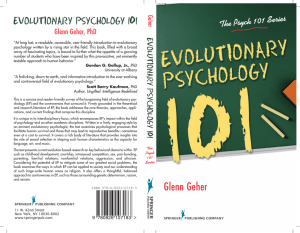
... of controversy, this approach to psychology may be seen as having more potential than any other area of the behavioral sciences to help us understand who we really are. The basic claims of evolutionary psychologists are, in fact, modest when one considers that they are rooted in the highly accepted ...
... of controversy, this approach to psychology may be seen as having more potential than any other area of the behavioral sciences to help us understand who we really are. The basic claims of evolutionary psychologists are, in fact, modest when one considers that they are rooted in the highly accepted ...

Ch.15, 16, 17 Review Know the parts of Darwin`s Theory of
... Know how disruptive, directional and stabilizing selection could affect a trait such as beak size ...
... Know how disruptive, directional and stabilizing selection could affect a trait such as beak size ...

Chapter 13
... species and noted patterns of similarities and differences. • In the early 1800s, French naturalist Jean Baptiste Lamarck suggested that life evolves, and explained this evolution as the refinement of traits that equip organisms to perform successfully in their environment. ...
... species and noted patterns of similarities and differences. • In the early 1800s, French naturalist Jean Baptiste Lamarck suggested that life evolves, and explained this evolution as the refinement of traits that equip organisms to perform successfully in their environment. ...
lecture 13, diversification - Cal State LA
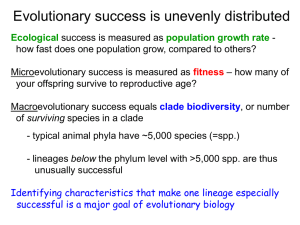
... Ecological success is measured as population growth rate how fast does one population grow, compared to others? Microevolutionary success is measured as fitness – how many of your offspring survive to reproductive age? Macroevolutionary success equals clade biodiversity, or number of surviving speci ...
... Ecological success is measured as population growth rate how fast does one population grow, compared to others? Microevolutionary success is measured as fitness – how many of your offspring survive to reproductive age? Macroevolutionary success equals clade biodiversity, or number of surviving speci ...

Bird Beak Adaptations Activity
... conditions change and also the idea that new species descend from common ancestors over many generations. Ultimately, evolution can explain the vast diversity of life on this planet and the idea that all life on Earth shares a common ancestor. Although there are many mechanisms for organisms to chan ...
... conditions change and also the idea that new species descend from common ancestors over many generations. Ultimately, evolution can explain the vast diversity of life on this planet and the idea that all life on Earth shares a common ancestor. Although there are many mechanisms for organisms to chan ...