
Darwin`s Contributions
... “…there is even a difference between the inhabitants of the different islands; yet all show a marked relationship with those of America, though separated from that continent by an open space of ocean, between 500 and 600 miles in width.” Green Iguana – Central and South America ...
... “…there is even a difference between the inhabitants of the different islands; yet all show a marked relationship with those of America, though separated from that continent by an open space of ocean, between 500 and 600 miles in width.” Green Iguana – Central and South America ...

V. Evolutionary Computing History vs. Science Part 5B: Thermodynamics & Evolution
... “Central Dogma” of Genetics • “The transfer of information from nucleic acid to nucleic acid, or from nucleic acid to protein may be possible, but transfer from protein to protein, or from protein to nucleic acid is impossible.” ...
... “Central Dogma” of Genetics • “The transfer of information from nucleic acid to nucleic acid, or from nucleic acid to protein may be possible, but transfer from protein to protein, or from protein to nucleic acid is impossible.” ...

Chapter 11 Sections 1
... Genetic variation in a population increases the chance that some individuals will survive. • Genetic variation leads to phenotypic variation. • Phenotypic variation is necessary for natural selection. • Genetic variation is stored in a population’s gene pool. – made up of all alleles in a population ...
... Genetic variation in a population increases the chance that some individuals will survive. • Genetic variation leads to phenotypic variation. • Phenotypic variation is necessary for natural selection. • Genetic variation is stored in a population’s gene pool. – made up of all alleles in a population ...

Evidence of Variation
... answers. The points given for this assignment aren’t just given to you for going. This exercise is based on one by William McComas printed in Investigating Evolutionary Biology in the Laboratory by William McComas (Lancaster Press, Lancaster, PA, 1994). ...
... answers. The points given for this assignment aren’t just given to you for going. This exercise is based on one by William McComas printed in Investigating Evolutionary Biology in the Laboratory by William McComas (Lancaster Press, Lancaster, PA, 1994). ...

Unit 3 Presentation Ch4
... 4-2 How Does the Earth’s Life Change Over Time? • Concept 4-2A The scientific theory of evolution explains how life on earth changes over time through changes in the genes of populations. • Concept 4-2B Populations evolve when genes mutate and give some individuals genetic traits that enhance their ...
... 4-2 How Does the Earth’s Life Change Over Time? • Concept 4-2A The scientific theory of evolution explains how life on earth changes over time through changes in the genes of populations. • Concept 4-2B Populations evolve when genes mutate and give some individuals genetic traits that enhance their ...

Evolution Review Questions
... a. It is also called selective breeding. b. It occurs when humans select natural variations they find useful. c. It produces organisms that look very different from their ancestors. d. It is no longer used today. 7. Match each term with its correct definition: _____ fitness a. any inherited characte ...
... a. It is also called selective breeding. b. It occurs when humans select natural variations they find useful. c. It produces organisms that look very different from their ancestors. d. It is no longer used today. 7. Match each term with its correct definition: _____ fitness a. any inherited characte ...

Natural selection power point
... are said to have low fitness. This difference in rates of survival and reproduction is called survival of the fittest. In evolutionary terms, survival means reproducing and passing adaptations on to the next generation. ...
... are said to have low fitness. This difference in rates of survival and reproduction is called survival of the fittest. In evolutionary terms, survival means reproducing and passing adaptations on to the next generation. ...

Evolution Notes and Activities Day 1 – What is meant by “evolution
... Evolution (change over time) is how modern organisms have descended from ancient ancestors over long periods of time. It is responsible for the remarkable similarities we see across all life and the amazing diversity of that life. Evolution is often described as "descent with modification." (passing ...
... Evolution (change over time) is how modern organisms have descended from ancient ancestors over long periods of time. It is responsible for the remarkable similarities we see across all life and the amazing diversity of that life. Evolution is often described as "descent with modification." (passing ...

Chapter 1 Honors Textbook ppt
... Science Is a Human Endeavor 1. In the 1920s, bacteriologist Alexander Fleming grew bacteria in cultures 2. One of the bacterial cultures became contaminated with a mold 3. Fleming nearly destroyed the culture when he noticed the mold (Penicillium) inhibited bacterial growth in the culture ...
... Science Is a Human Endeavor 1. In the 1920s, bacteriologist Alexander Fleming grew bacteria in cultures 2. One of the bacterial cultures became contaminated with a mold 3. Fleming nearly destroyed the culture when he noticed the mold (Penicillium) inhibited bacterial growth in the culture ...

Chapters 22, 23, and 24 Natural Selection and Mechanisms of
... 2. What is the unit of natural selection (i.e. what is selected for or against?) What is the unit of evolution? 3. In a population of mice, some individuals have brown fur and some have black fur. At present, both phenotypes are equally fit. What could happen to change the relative fitness of the tw ...
... 2. What is the unit of natural selection (i.e. what is selected for or against?) What is the unit of evolution? 3. In a population of mice, some individuals have brown fur and some have black fur. At present, both phenotypes are equally fit. What could happen to change the relative fitness of the tw ...

CHAPTER 2--THE DEVELOPMENT OF EVOLUTIONARY THEORY
... C. the inheritance of acquired characteristics D. catastrophism E. the fixity of species 28. Which of the following concepts did NOT influence Darwin in developing his theory of evolution? A. Population size increases more rapidly than food supplies. B. There is competition among individuals for res ...
... C. the inheritance of acquired characteristics D. catastrophism E. the fixity of species 28. Which of the following concepts did NOT influence Darwin in developing his theory of evolution? A. Population size increases more rapidly than food supplies. B. There is competition among individuals for res ...

Symbiogenesis, natural selection, and the dynamic Earth
... (Fig. 2b) has been measured in the field and may be sufficiently strong enough to cause significant evolutionary change within a relatively short time period (in some case studies, less than one hundred generations, see Majerus 2009; Majerus and Mundy 2003). Moreover, Klingsolver and Pfennig (2007) ...
... (Fig. 2b) has been measured in the field and may be sufficiently strong enough to cause significant evolutionary change within a relatively short time period (in some case studies, less than one hundred generations, see Majerus 2009; Majerus and Mundy 2003). Moreover, Klingsolver and Pfennig (2007) ...
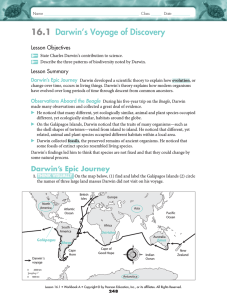
16.1 Darwin`s Voyage of Discovery
... Darwin’s Epic Journey Darwin developed a scientific theory to explain how evolution, or change over time, occurs in living things. Darwin’s theory explains how modern organisms have evolved over long periods of time through descent from common ancestors. Observations Aboard the Beagle During his fiv ...
... Darwin’s Epic Journey Darwin developed a scientific theory to explain how evolution, or change over time, occurs in living things. Darwin’s theory explains how modern organisms have evolved over long periods of time through descent from common ancestors. Observations Aboard the Beagle During his fiv ...
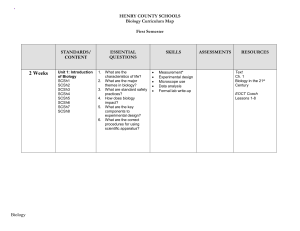
Biology Curriculum Map
... 5. What is the relationship between changes in DNA & the potential appearance of new traits (types of mutation)? 6. What are factors that can cause changes on DNA? ...
... 5. What is the relationship between changes in DNA & the potential appearance of new traits (types of mutation)? 6. What are factors that can cause changes on DNA? ...

Picking Holes in the Concept of Natural Selection
... to do so. Philosophers of biology have worked hard to elaborate these ideas about forms of casual explanation; it is regrettable that Fodor and PiattelliPalmarini ignore their contributions. The authors’ neglect of the philosophy of biology is unfortunate for another reason. In recent years, some ph ...
... to do so. Philosophers of biology have worked hard to elaborate these ideas about forms of casual explanation; it is regrettable that Fodor and PiattelliPalmarini ignore their contributions. The authors’ neglect of the philosophy of biology is unfortunate for another reason. In recent years, some ph ...

Just What Were You Thinking
... 3. What term describes all the individuals of the same species that live in the same area? (A) environmental group (B) population (C) community (D) competitive group 4. Which term is a measure of the ability to survive and produce the most offspring? (A) overproduction (B) variation (C) adaptation ( ...
... 3. What term describes all the individuals of the same species that live in the same area? (A) environmental group (B) population (C) community (D) competitive group 4. Which term is a measure of the ability to survive and produce the most offspring? (A) overproduction (B) variation (C) adaptation ( ...

Understanding Evolution: Gene Selection vs. Group Selection
... of animal strategies, ESSs will evolve that give an average beneÞt to all members and that penalize any deviance from the norm. The second and opposing point of view in this controversy is the new version of group selection, also known as Multilevel Selection Theory. Evolutionary theorists who suppo ...
... of animal strategies, ESSs will evolve that give an average beneÞt to all members and that penalize any deviance from the norm. The second and opposing point of view in this controversy is the new version of group selection, also known as Multilevel Selection Theory. Evolutionary theorists who suppo ...

Evolutionary Forces Scenarios 2B-II
... cactus out of the soil--they usually had to make a conscious decision about what type of cactus they should dig up. The cacti with too many spines were seen as too difficult to dig out and the visitors didn't likely have gloves to protect their hands. The cacti with too few spines were seen as "home ...
... cactus out of the soil--they usually had to make a conscious decision about what type of cactus they should dig up. The cacti with too many spines were seen as too difficult to dig out and the visitors didn't likely have gloves to protect their hands. The cacti with too few spines were seen as "home ...

Changes Over Time
... *This led to the passage of the Endangered Species Act of 1973. As a result, many captive breeding programs were established. They are expensive and for some species, they may be too late. ...
... *This led to the passage of the Endangered Species Act of 1973. As a result, many captive breeding programs were established. They are expensive and for some species, they may be too late. ...

7th gd Evolution
... *This led to the passage of the Endangered Species Act of 1973. As a result, many captive breeding programs were established. They are expensive and for some species, they may be too late. ...
... *This led to the passage of the Endangered Species Act of 1973. As a result, many captive breeding programs were established. They are expensive and for some species, they may be too late. ...

Evolution and alleles
... Many diseases caused by bacteria have been successfully treated with penicillin and other antibiotics. However, since WWII, when the use of antibiotics became widespread, many disease-causing bacteria have developed resistance against antibiotics. There are strains of bacteria causing tuberculosis, ...
... Many diseases caused by bacteria have been successfully treated with penicillin and other antibiotics. However, since WWII, when the use of antibiotics became widespread, many disease-causing bacteria have developed resistance against antibiotics. There are strains of bacteria causing tuberculosis, ...

Notes - Dr. Bruce Owen
... − The deeper the beak, the more likely the bird was to survive during the drought years − the distribution of beak depths shifted from a shallower average during the early, wet years, to a deeper average after a year of drought − more birds with shallow beaks died, while only a few of the deep-beake ...
... − The deeper the beak, the more likely the bird was to survive during the drought years − the distribution of beak depths shifted from a shallower average during the early, wet years, to a deeper average after a year of drought − more birds with shallow beaks died, while only a few of the deep-beake ...

Fall 2009 Biology
... How does natural selection drive evolution? Why does natural selection need variation? Vestigial Structures Homologous Structures “Are We Still Evolving”? –Why is the rate of evolution in developing countries different than the rate of evolution in the western world? What is the connection ...
... How does natural selection drive evolution? Why does natural selection need variation? Vestigial Structures Homologous Structures “Are We Still Evolving”? –Why is the rate of evolution in developing countries different than the rate of evolution in the western world? What is the connection ...

Inclusive fitness: 50 years on - Department of Zoology, University of
... However, correlations between an individual’s genes and her fitness need not reflect a direct, causal relationship. For example, genes for altruism can be associated with greater fitness, despite the direct cost that they inflict on their bearer, if relatives interact as social partners. This is bec ...
... However, correlations between an individual’s genes and her fitness need not reflect a direct, causal relationship. For example, genes for altruism can be associated with greater fitness, despite the direct cost that they inflict on their bearer, if relatives interact as social partners. This is bec ...

Fall 2009 Biology
... How does natural selection drive evolution? Why does natural selection need variation? Vestigial Structures Homologous Structures “Are We Still Evolving”? –Why is the rate of evolution in developing countries different than the rate of evolution in the western world? What is the connection ...
... How does natural selection drive evolution? Why does natural selection need variation? Vestigial Structures Homologous Structures “Are We Still Evolving”? –Why is the rate of evolution in developing countries different than the rate of evolution in the western world? What is the connection ...