
Document
... A demonstration that frequencies of genes do not change from one generation to the next if all members mate at random and there is no advantage to any gene. This is the foundation of all population genetics, because by adding terms for selection and migration, it can be shown that gene frequencies d ...
... A demonstration that frequencies of genes do not change from one generation to the next if all members mate at random and there is no advantage to any gene. This is the foundation of all population genetics, because by adding terms for selection and migration, it can be shown that gene frequencies d ...

FINAL EXAM REVIEW 2014 – BIOLOGY – MICHALEC
... Directions: You will need to answer these questions on a google doc and share it with me at [email protected]. This is due no later than May 30th. Chapter 16 - Evolutionary Theory 1. What is Lamarck’s theory of evolution? Explain it using a giraffe as an example. 2. Explain Darwin’s theory of ...
... Directions: You will need to answer these questions on a google doc and share it with me at [email protected]. This is due no later than May 30th. Chapter 16 - Evolutionary Theory 1. What is Lamarck’s theory of evolution? Explain it using a giraffe as an example. 2. Explain Darwin’s theory of ...

Chapter 17
... • On his return, he learned that there were 13 species • He attempted to correlate variations in their traits with environmental challenges ...
... • On his return, he learned that there were 13 species • He attempted to correlate variations in their traits with environmental challenges ...

Slide 1
... • The Earth has millions of kinds of organisms with an amazing amount of diversity, yet, we all share similarities, the core of which is DNA. (Every living organism has it!) • How are all these different organisms related to each other? • Evolution, or change in a species over time, is the process b ...
... • The Earth has millions of kinds of organisms with an amazing amount of diversity, yet, we all share similarities, the core of which is DNA. (Every living organism has it!) • How are all these different organisms related to each other? • Evolution, or change in a species over time, is the process b ...


Evolution: Theories put forward to explain the origin of life Theory of
... Aquatic animals like fishes breathe by gills, but these totally unsuitable on land. Terrestrial animals have developed air breathing organs such as lungs. Terrestrial organisms are liable to lose water by evaporation: Both active and passive mechanisms have evolved to copy with this. The Passive te ...
... Aquatic animals like fishes breathe by gills, but these totally unsuitable on land. Terrestrial animals have developed air breathing organs such as lungs. Terrestrial organisms are liable to lose water by evaporation: Both active and passive mechanisms have evolved to copy with this. The Passive te ...

9-12 Life Science
... to mutation and sexual reproduction, (3) competition for limited resources, and (4) the proliferation of those organisms that are better able to survive and reproduce in the environment . HS-LS4-3 Apply concepts of statistics and probability to support explanations that organisms with an advantageou ...
... to mutation and sexual reproduction, (3) competition for limited resources, and (4) the proliferation of those organisms that are better able to survive and reproduce in the environment . HS-LS4-3 Apply concepts of statistics and probability to support explanations that organisms with an advantageou ...


STUDY GUIDE FOR EXAM I
... Understand how recently observed incidences of microevolutionary change provide evidence that such processes have been occurring since life on earth began. Know the meaning/significance of: Bergmann’s Rule, evolution as compromise, reproductive isolation. Know the different types and levels of repro ...
... Understand how recently observed incidences of microevolutionary change provide evidence that such processes have been occurring since life on earth began. Know the meaning/significance of: Bergmann’s Rule, evolution as compromise, reproductive isolation. Know the different types and levels of repro ...

Chapter 23 Presentation-The Evolution of Populations
... These provide variety within gene pools. Mutations are changes in the nucleotide sequences that give rise to new genes and new alleles. Sometimes they’re good, usually they are not. Most mutations occur in somatic cells and are never passed on. Only a small percentage of gametes ever get int ...
... These provide variety within gene pools. Mutations are changes in the nucleotide sequences that give rise to new genes and new alleles. Sometimes they’re good, usually they are not. Most mutations occur in somatic cells and are never passed on. Only a small percentage of gametes ever get int ...

sample thesis paper
... North and South America. In the past, glyptodonts lived in the Americas (Modern Biology 281). Biogeographic evidence indicates that organisms evolve and go through evolution. Embryology is also an aspect of science that points to evolution as the process of how life first came about. Embryology is t ...
... North and South America. In the past, glyptodonts lived in the Americas (Modern Biology 281). Biogeographic evidence indicates that organisms evolve and go through evolution. Embryology is also an aspect of science that points to evolution as the process of how life first came about. Embryology is t ...

Sample Thesis Paper (MLA)
... North and South America. In the past, glyptodonts lived in the Americas (Modern Biology 281). Biogeographic evidence indicates that organisms evolve and go through evolution. Embryology is also an aspect of science that points to evolution as the process of how life first came about. Embryology is t ...
... North and South America. In the past, glyptodonts lived in the Americas (Modern Biology 281). Biogeographic evidence indicates that organisms evolve and go through evolution. Embryology is also an aspect of science that points to evolution as the process of how life first came about. Embryology is t ...

EXPERIMENTAL EVOLUTION OF MULTICELLULARITY IN THE
... The transition to multicellular life was one of a few major events in the history of life that created new opportunities for more complex biological systems to evolve. Indeed, multicellularity is a prerequisite for the evolution of large, complex organisms such as plants and animals. An understandin ...
... The transition to multicellular life was one of a few major events in the history of life that created new opportunities for more complex biological systems to evolve. Indeed, multicellularity is a prerequisite for the evolution of large, complex organisms such as plants and animals. An understandin ...

15-3 Darwin Presents His Case
... Each of these limbs has adapted in ways that enable organisms to survive in different environments. Despite these different functions, however, these limb bones all develop from the same clumps of cells in embryos. Structures that have different mature forms but develop from the same embryonic tissu ...
... Each of these limbs has adapted in ways that enable organisms to survive in different environments. Despite these different functions, however, these limb bones all develop from the same clumps of cells in embryos. Structures that have different mature forms but develop from the same embryonic tissu ...

File - Biology and Botany/Ecology Class!
... Darwin realized the struggle for survival due to the difficulties (or selection pressure) caused by nature must be selecting for heritable trait variations that will allow one organism within a population to out-reproduce the other members of the population. Darwin published these ideas in his book ...
... Darwin realized the struggle for survival due to the difficulties (or selection pressure) caused by nature must be selecting for heritable trait variations that will allow one organism within a population to out-reproduce the other members of the population. Darwin published these ideas in his book ...
Document
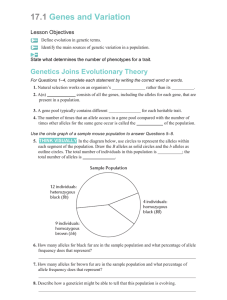
... 13. Big-beaked finches that prefer to mate with other big-beaked finches are isolated from small-beaked finches living on the same island. 14. Write a paragraph that summarizes how speciation likely occurred in the Galápagos finches. Use the following terms in your response: geographic isolation, ge ...
... 13. Big-beaked finches that prefer to mate with other big-beaked finches are isolated from small-beaked finches living on the same island. 14. Write a paragraph that summarizes how speciation likely occurred in the Galápagos finches. Use the following terms in your response: geographic isolation, ge ...

Biology Ch. 15 Notes Tracing Evolutionary History Opening Essay
... absolute age of a fossil. Absolute Age: Determining the age of rocks or artifacts using radiometric dating, the rate of decay of unstable isotopes. Relative Age: Indirect way to estimate the age of much older fossils. K-40 (half-life = 1.3 by) used to date volcanic rock layers. The age of fossils fo ...
... absolute age of a fossil. Absolute Age: Determining the age of rocks or artifacts using radiometric dating, the rate of decay of unstable isotopes. Relative Age: Indirect way to estimate the age of much older fossils. K-40 (half-life = 1.3 by) used to date volcanic rock layers. The age of fossils fo ...
Study Questions for Exam 1 Biology 354 Lecture 1: Natural selection
... What is the theory of blending inheritance and why was it a challenge to Darwin’s hypothesis? Given a set of genotype frequencies, be able to estimate the gene frequencies in that generation, and both the genotype and gene frequencies in the next generation. In the absence of selection, migration, e ...
... What is the theory of blending inheritance and why was it a challenge to Darwin’s hypothesis? Given a set of genotype frequencies, be able to estimate the gene frequencies in that generation, and both the genotype and gene frequencies in the next generation. In the absence of selection, migration, e ...


univERsity oF copEnhAGEn
... which the species is naturally outbreeding or inbreeding. Outbreeders have biological barriers which act against self-fertilizaton or fertilization by close relatives and thus favour mating with unrelated or distantly related individuals. Inbreeders lack such barriers. Some agricultural crops such a ...
... which the species is naturally outbreeding or inbreeding. Outbreeders have biological barriers which act against self-fertilizaton or fertilization by close relatives and thus favour mating with unrelated or distantly related individuals. Inbreeders lack such barriers. Some agricultural crops such a ...

The Evolution of Evolutionary Thinking in Chile
... activities that caught the attention of Darwin and reinforced his idea of a world in continuous change (Darwin 1846; Moorehead 1969). Naturalists were not rare in Chile at that time, as indicated by Darwin himself in a letter to Henslow in October 28, 1834 “I had hoped during this time to have ...
... activities that caught the attention of Darwin and reinforced his idea of a world in continuous change (Darwin 1846; Moorehead 1969). Naturalists were not rare in Chile at that time, as indicated by Darwin himself in a letter to Henslow in October 28, 1834 “I had hoped during this time to have ...

Finch?
... diversity of structure in one small, intimately related group of birds, one might really fancy that from an original paucity of birds in this archipelago, one species has been taken & modified for different ends. ...
... diversity of structure in one small, intimately related group of birds, one might really fancy that from an original paucity of birds in this archipelago, one species has been taken & modified for different ends. ...

Natural Selection
... genetic makeup of the next generation • Genetic bottlenecks – result in a loss in genetic diversity following an extreme reduction in the size of the population (following a natural disaster, over-hunting, etc) • Founder effect – occurs when individuals establish a new population (the finches moving ...
... genetic makeup of the next generation • Genetic bottlenecks – result in a loss in genetic diversity following an extreme reduction in the size of the population (following a natural disaster, over-hunting, etc) • Founder effect – occurs when individuals establish a new population (the finches moving ...
Evidence for Evolution
... scientists can determine if the sequences belong to the same, closely related, or distantly related species. Again, the greater the similarity, the closer the species are related. The most common method used to compare DNA sequences is called DNA hybridization. (See Figure 2-11.) DNA molecules from ...
... scientists can determine if the sequences belong to the same, closely related, or distantly related species. Again, the greater the similarity, the closer the species are related. The most common method used to compare DNA sequences is called DNA hybridization. (See Figure 2-11.) DNA molecules from ...

Powerpoint
... Alleles Continually Arise By Mutation! We have just demonstrated that new alleles arise continuously via mutation Many are lost by genetic drift, but others drift higher and get fixed over 4Ne generations. Remember allele freqs. sum to 1 so previously common alleles have drifted lower and are ...
... Alleles Continually Arise By Mutation! We have just demonstrated that new alleles arise continuously via mutation Many are lost by genetic drift, but others drift higher and get fixed over 4Ne generations. Remember allele freqs. sum to 1 so previously common alleles have drifted lower and are ...