
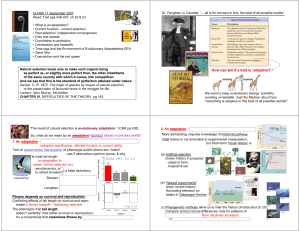
How can tell if a trait is `adaptive?`
... ... it is unclear whether this evolution is a result of direct selection for this ability, or as a correlated byby-product of selection against fear and aggression toward humans - as is the case with a number of morphological and physiological changes associated with domestication. We show here that ...
... ... it is unclear whether this evolution is a result of direct selection for this ability, or as a correlated byby-product of selection against fear and aggression toward humans - as is the case with a number of morphological and physiological changes associated with domestication. We show here that ...

LIFE HISTORY EVOLUTION: Why do we get old and die?
... • Hence, life histories include many components that contribute to an individual’s fitness ...
... • Hence, life histories include many components that contribute to an individual’s fitness ...

ARTICLE- Lamarck vs. Darwin
... that complexity evolved simply as a result of life adapting to its local conditions from one generation to the next. He also argued that species could go extinct rather than change into new forms. But Darwin also relied on much the same evidence for evolution that Lamarck did (such as vestigial stru ...
... that complexity evolved simply as a result of life adapting to its local conditions from one generation to the next. He also argued that species could go extinct rather than change into new forms. But Darwin also relied on much the same evidence for evolution that Lamarck did (such as vestigial stru ...


Evolution - Killeen ISD
... (more than can survive with given food) • Individuals in population have variations • Certain variations are more useful (these will survive better) • Over time, “good” genes prevail in the population, while “bad” ones fade out ...
... (more than can survive with given food) • Individuals in population have variations • Certain variations are more useful (these will survive better) • Over time, “good” genes prevail in the population, while “bad” ones fade out ...

Biological and Physical Constraints on the Evolution of Form in
... while population genetics focuses on only two cell divisions, what is more important is the sequence of events that leads to the final form. We believe that de Beer’s sentiment is in general still valid. Just because one can identify genes or molecular sequences because of advances in technology, th ...
... while population genetics focuses on only two cell divisions, what is more important is the sequence of events that leads to the final form. We believe that de Beer’s sentiment is in general still valid. Just because one can identify genes or molecular sequences because of advances in technology, th ...

APA Sample Thesis paper
... men of science had begun putting forth their own theories regarding why organisms had the traits they possessed. These ranged from profound to absurd. After a lengthy study and the collection of an abundance of data, Darwin contented himself with the idea that, while there were holes in his theory o ...
... men of science had begun putting forth their own theories regarding why organisms had the traits they possessed. These ranged from profound to absurd. After a lengthy study and the collection of an abundance of data, Darwin contented himself with the idea that, while there were holes in his theory o ...

TITLE OF PAPER 1 NATURAL SELECTION LEADS TO EVOLUTION
... men of science had begun putting forth their own theories regarding why organisms had the traits they possessed. These ranged from profound to absurd. After a lengthy study and the collection of an abundance of data, Darwin contented himself with the idea that, while there were holes in his theory o ...
... men of science had begun putting forth their own theories regarding why organisms had the traits they possessed. These ranged from profound to absurd. After a lengthy study and the collection of an abundance of data, Darwin contented himself with the idea that, while there were holes in his theory o ...

Evolution 4 chapter 24 and 25
... Biological Species Concept Ray’s idea updated into the biological species concept. “Species are groups of actually or potentially interbreeding natural populations, which are reproductively isolated from other such groups.” Ernst Mayr. ...
... Biological Species Concept Ray’s idea updated into the biological species concept. “Species are groups of actually or potentially interbreeding natural populations, which are reproductively isolated from other such groups.” Ernst Mayr. ...

Diversity of life Notes: WAP 111
... major lineages of extant organisms. The environmental and biological processes behind major milestones in evolution are discussed along with their basis in evidence and methodology. The diversity of major groups is explored in their evolutionary context. The Diversity of Life Course emphasizes the u ...
... major lineages of extant organisms. The environmental and biological processes behind major milestones in evolution are discussed along with their basis in evidence and methodology. The diversity of major groups is explored in their evolutionary context. The Diversity of Life Course emphasizes the u ...

Title of Unit It`s Evolution, Baby! Grade Level 9
... population can change when conditions change. (HS-LS4-3 Changes in the physical environment, whether naturally occurring or human induced, have thus contributed to the expansion of some species, the emergence of new distinct species as populations diverge under different conditions, and the decline– ...
... population can change when conditions change. (HS-LS4-3 Changes in the physical environment, whether naturally occurring or human induced, have thus contributed to the expansion of some species, the emergence of new distinct species as populations diverge under different conditions, and the decline– ...

Summary
... explaining the creation of various species in nature, with no need of a spiritualmetaphysical explanation. For HaRaAYaH in contrast, evolution with all of its mechanism is one of the ways in which God acts in reality. The belief whereby the entire universe was created randomly, was rejected by HaRaA ...
... explaining the creation of various species in nature, with no need of a spiritualmetaphysical explanation. For HaRaAYaH in contrast, evolution with all of its mechanism is one of the ways in which God acts in reality. The belief whereby the entire universe was created randomly, was rejected by HaRaA ...
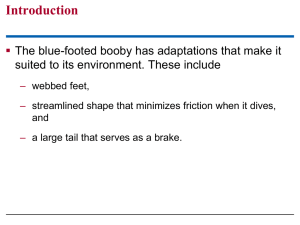
Darwin proposed natural selection as the mechanism of evolution
... Darwin reasoned that – organisms with traits that increase their chance of surviving and reproducing in their environment tend to leave more offspring than others and – this unequal reproduction will lead to the accumulation of favorable traits in a population over generations. ...
... Darwin reasoned that – organisms with traits that increase their chance of surviving and reproducing in their environment tend to leave more offspring than others and – this unequal reproduction will lead to the accumulation of favorable traits in a population over generations. ...

Elements of Biology: Evolution
... • What are the basic principles behind the theory of evolution? (The theory of evolution states that new species emerge from earlier forms of life and that species change as a result of a process called natural selection. Natural selection holds that only those organisms best suited to survive in th ...
... • What are the basic principles behind the theory of evolution? (The theory of evolution states that new species emerge from earlier forms of life and that species change as a result of a process called natural selection. Natural selection holds that only those organisms best suited to survive in th ...

Evidence for evolution - Plattsburgh State Faculty and
... Darwin proposed evolution was the inevitable outcome of 4 postulates: ...
... Darwin proposed evolution was the inevitable outcome of 4 postulates: ...

Science COS-Biology 2011-2012
... Genes are defined as segments of DNA molecules on chromosomes. Inserting, deleting or substituting DNA segments alter genes. An altered gene is passed to every cell that develops from it. The resulting features may increase, decrease or have no observable effect on the offspring's success in its env ...
... Genes are defined as segments of DNA molecules on chromosomes. Inserting, deleting or substituting DNA segments alter genes. An altered gene is passed to every cell that develops from it. The resulting features may increase, decrease or have no observable effect on the offspring's success in its env ...

Evolution - My Teacher Pages
... Darwin proposed natural selection as the mechanism of evolution • Darwin hypothesized that there was a force in nature that worked like artificial selection. ...
... Darwin proposed natural selection as the mechanism of evolution • Darwin hypothesized that there was a force in nature that worked like artificial selection. ...

Heterotroph Theory
... way to see microscopic organisms. You see maggots growing on raw meat and mold growing on old bread. You know these organisms are alive, so where did they come from? ...
... way to see microscopic organisms. You see maggots growing on raw meat and mold growing on old bread. You know these organisms are alive, so where did they come from? ...

Incomplete dominance
... • Only the most fit individuals survive. Individuals with traits best adapted for survival in the environment are able to ...
... • Only the most fit individuals survive. Individuals with traits best adapted for survival in the environment are able to ...

Document
... 15. In a small group of people living in a remote area, there is a high incidence of “blue skin”, a condition that results from a variation in the structure of hemoglobin. All of the “blue-skinned” residents can trace their ancestry to one couple, who were among the original settlers of this region. ...
... 15. In a small group of people living in a remote area, there is a high incidence of “blue skin”, a condition that results from a variation in the structure of hemoglobin. All of the “blue-skinned” residents can trace their ancestry to one couple, who were among the original settlers of this region. ...


Charles Darwin, Natural Selection, and the Origin of Species
... • Marshaled a large body of evidence in support of the fact of evolution (that all species are descended from other species). ...
... • Marshaled a large body of evidence in support of the fact of evolution (that all species are descended from other species). ...
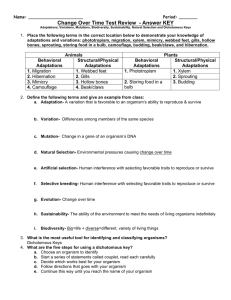
Change Over Time Review ANSWER KEY
... Mutations cause changes in the genes of an organism. These changes will then cause differences to appear among organisms of a species called variation. If these variations are favorable and help the organism to survive, they are then known as adaptations Mutation -> Variation -> Adaptation 15. What ...
... Mutations cause changes in the genes of an organism. These changes will then cause differences to appear among organisms of a species called variation. If these variations are favorable and help the organism to survive, they are then known as adaptations Mutation -> Variation -> Adaptation 15. What ...

Natural Selection
... – This selection is done by the environment – Those which are best suited reproduce – They pass these well suited characteristics on to their young ...
... – This selection is done by the environment – Those which are best suited reproduce – They pass these well suited characteristics on to their young ...