
DOC
... 32. give a description of the theory of natural selection. 33. compare and contrast the outcomes of the processes of mutation, sexual selection, and natural selection. 34. draw a diagram showing how natural selection can lead to pesticide resistance in insects or antibiotic resistance in bacteria. 3 ...
... 32. give a description of the theory of natural selection. 33. compare and contrast the outcomes of the processes of mutation, sexual selection, and natural selection. 34. draw a diagram showing how natural selection can lead to pesticide resistance in insects or antibiotic resistance in bacteria. 3 ...

Study Guide for Exam 2– Biol-1, C. Briggs, rev. SP16 Test
... 32. give a description of the theory of natural selection. 33. compare and contrast the outcomes of the processes of mutation, sexual selection, and natural selection. 34. draw a diagram showing how natural selection can lead to pesticide resistance in insects or antibiotic resistance in bacteria. 3 ...
... 32. give a description of the theory of natural selection. 33. compare and contrast the outcomes of the processes of mutation, sexual selection, and natural selection. 34. draw a diagram showing how natural selection can lead to pesticide resistance in insects or antibiotic resistance in bacteria. 3 ...
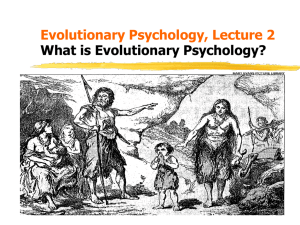
What is Evolutionary Psychology?
... The cognitive modules that constitute the human brain are assumed to have developed via natural selection. Evolutionary theory (as devised by Wallace and Darwin) consists of several simple principles: 1. 'Principle of Variation': Individuals within a species show variation in their physical an ...
... The cognitive modules that constitute the human brain are assumed to have developed via natural selection. Evolutionary theory (as devised by Wallace and Darwin) consists of several simple principles: 1. 'Principle of Variation': Individuals within a species show variation in their physical an ...

行為遺傳學
... – Ethologists were interested in species’ differences – Comparative psychologists searched for general “laws” of behavior. ...
... – Ethologists were interested in species’ differences – Comparative psychologists searched for general “laws” of behavior. ...


Essential Idea: There is overwhelming evidence for the evolution of
... Charles Darwin accumulated a tremendous collection of facts to support the theory of evolution by natural selection. One of his difficulties in demonstrating the theory, however, was the lack of an example of evolution over a short period of time, which could be observed as it was taking place in na ...
... Charles Darwin accumulated a tremendous collection of facts to support the theory of evolution by natural selection. One of his difficulties in demonstrating the theory, however, was the lack of an example of evolution over a short period of time, which could be observed as it was taking place in na ...
Biology 11
... in a scientifically precise and objective orientated manner. Biology 11 will also have many labs. You will be expected to attend these and participate. There will be some animal dissections, please inform the teacher right away if you are not comfortable with these for religious or personal reasons. ...
... in a scientifically precise and objective orientated manner. Biology 11 will also have many labs. You will be expected to attend these and participate. There will be some animal dissections, please inform the teacher right away if you are not comfortable with these for religious or personal reasons. ...

Spring Semester Exam Review
... 7D Analyze and evaluate how the elements of natural selection including inherited variation, the potential to produce more offspring than can survive and a finite supply of environmental resources result in differential reproductive success. 7E Analyze and evaluate the relationship of natural select ...
... 7D Analyze and evaluate how the elements of natural selection including inherited variation, the potential to produce more offspring than can survive and a finite supply of environmental resources result in differential reproductive success. 7E Analyze and evaluate the relationship of natural select ...

Multilevel Selection Theory and Major Evolutionary Transitions
... economics, much of sociology, and all of psychology’s excursions into organizational theory. This is the dogma that all human social group processes are to be explained by laws of individual behavior.’’ Developments in evolutionary biology seemed to affirm the individualistic turn in psychology. Dar ...
... economics, much of sociology, and all of psychology’s excursions into organizational theory. This is the dogma that all human social group processes are to be explained by laws of individual behavior.’’ Developments in evolutionary biology seemed to affirm the individualistic turn in psychology. Dar ...

SI - TEST 4 STUDY GUIDE
... Under what benefit/cost conditions does nepotism evolve? Hamilton’s Rule = Br > C What are the three hypothesis of the inclusive fitness theory? ...
... Under what benefit/cost conditions does nepotism evolve? Hamilton’s Rule = Br > C What are the three hypothesis of the inclusive fitness theory? ...

Life on Earth - The Bicester School
... is variation between individuals of the same species. Some of this variation is genetic so can be passed on to offspring. Genetic variation is the result of changes that occur in genes (mutations) and may occasionally produce new characteristics. There ...
... is variation between individuals of the same species. Some of this variation is genetic so can be passed on to offspring. Genetic variation is the result of changes that occur in genes (mutations) and may occasionally produce new characteristics. There ...

Darwin`s Theory of Evolution
... b. It occurs when humans select natural variations they find useful. c. It produces organisms that look very different from their ancestors. d. It is no longer used today. ...
... b. It occurs when humans select natural variations they find useful. c. It produces organisms that look very different from their ancestors. d. It is no longer used today. ...

Facing the facts
... perhaps being an unlikely end product of evolution, there are many qualitatively similar cooperative strategies that are more robust, so the problem cannot lie in the very particular implementation of reciprocity investigated by Axelrod & Hamilton (1981). What remains is then either that the structu ...
... perhaps being an unlikely end product of evolution, there are many qualitatively similar cooperative strategies that are more robust, so the problem cannot lie in the very particular implementation of reciprocity investigated by Axelrod & Hamilton (1981). What remains is then either that the structu ...
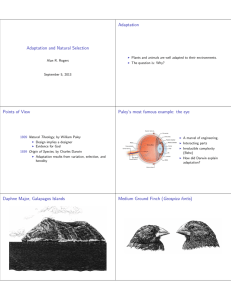
Adaptation and Natural Selection Adaptation Points of View Paley`s
... Birds differed in beak depth. ...
... Birds differed in beak depth. ...

Evolution and Medicine - Create and Use Your home.uchicago.edu
... languages, and they see the natural world in different ways. These differences have helped to keep these fields apart and continue to hinder their integration. ...
... languages, and they see the natural world in different ways. These differences have helped to keep these fields apart and continue to hinder their integration. ...
ANNOUNCEMENT OF VACANCY Departments of Biology and
... BIOL 225 Molecules, Genes and Cells. An examination of various aspects of cell biology, introducing basic understandings of biochemistry, cell biology, and genetics. Through classroom discussions and laboratory experimentation, students will become familiar with the current techniques and technologi ...
... BIOL 225 Molecules, Genes and Cells. An examination of various aspects of cell biology, introducing basic understandings of biochemistry, cell biology, and genetics. Through classroom discussions and laboratory experimentation, students will become familiar with the current techniques and technologi ...

Evolutionary Theory
... theory together with newer studies of fossils, anatomy, genetics, and more. This unification is called the modern synthesis of evolutionary theory. In particular, biologists have learned that evolution can result from processes other than natural selection. ...
... theory together with newer studies of fossils, anatomy, genetics, and more. This unification is called the modern synthesis of evolutionary theory. In particular, biologists have learned that evolution can result from processes other than natural selection. ...

Genes in Populations II: Deviations from Hardy
... Migration – movement of individuals between populations • “gene flow” between gene pools • maintains genetic variation within populations by bringing in new alleles • prevents populations from genetically diverging (and eventually becoming ...
... Migration – movement of individuals between populations • “gene flow” between gene pools • maintains genetic variation within populations by bringing in new alleles • prevents populations from genetically diverging (and eventually becoming ...

SF Ev L8 Speciation in animals
... In practice this is most often used in difficult cases - based on the visible differences between species. Taxonomists look for discontinuities in the morphological variation between the populations in question. If variation is continuous then it’s not a species e.g. different galapagos finches are ...
... In practice this is most often used in difficult cases - based on the visible differences between species. Taxonomists look for discontinuities in the morphological variation between the populations in question. If variation is continuous then it’s not a species e.g. different galapagos finches are ...

Evolution Cont`d
... • DNA & Protein analysis are new tools for testing evolution • DNA passed from parents to offspring, so should show evolution (i.e. ancestry) • Darwin hypothesized that all life forms are related. He was right and it is proven in the fact that DNA is the common language in which traits are passed. ...
... • DNA & Protein analysis are new tools for testing evolution • DNA passed from parents to offspring, so should show evolution (i.e. ancestry) • Darwin hypothesized that all life forms are related. He was right and it is proven in the fact that DNA is the common language in which traits are passed. ...

How Populations Evolve
... Those individuals with the traits most suitable to their environment are more likely to survive and reproduce and pass those traits on to the next generation. Tuesday, January 22, 2013 ...
... Those individuals with the traits most suitable to their environment are more likely to survive and reproduce and pass those traits on to the next generation. Tuesday, January 22, 2013 ...

here
... [G]enes are important, and different from other components of the developmental process. With all due respect to cytoplasmic inheritance and maternal effects, there doesn’t seem to be much here.” – Günter Wagner, in response to our book ...
... [G]enes are important, and different from other components of the developmental process. With all due respect to cytoplasmic inheritance and maternal effects, there doesn’t seem to be much here.” – Günter Wagner, in response to our book ...

Nature, red in tooth and claw, so what?
... more thousands of generations, this divergence would lead to different species. Darwin did not support this by any kind of evidence about species per se, much less anything quantitative or related, say, to ideas of genetic incompatibility (though that is perhaps implicit in later chapters where he c ...
... more thousands of generations, this divergence would lead to different species. Darwin did not support this by any kind of evidence about species per se, much less anything quantitative or related, say, to ideas of genetic incompatibility (though that is perhaps implicit in later chapters where he c ...

Revised Exam 1 Review
... Naturalist who established that all species of life have descended over time from common ancestry, and proposed the scientific theory that this branching pattern of evolution resulted from a process that he called natural selection. ...
... Naturalist who established that all species of life have descended over time from common ancestry, and proposed the scientific theory that this branching pattern of evolution resulted from a process that he called natural selection. ...

- Munich Personal RePEc Archive
... such deep-rooted prejudices that the prospect of dispelling them does not seem very bright” (45, vol II, p 9), but I will try, including a rough sketch of three intellectual obstacles which invariably block the doorway to these illusive truths. Presently, we'll consider the most formidable issue; th ...
... such deep-rooted prejudices that the prospect of dispelling them does not seem very bright” (45, vol II, p 9), but I will try, including a rough sketch of three intellectual obstacles which invariably block the doorway to these illusive truths. Presently, we'll consider the most formidable issue; th ...