
THE EVOLUTION OF POPULATIONS THE EVOLUTION OF
... NEWLY FOUNDED POPULATION The new population will be dominated by the genetic features present in the founding members. ...
... NEWLY FOUNDED POPULATION The new population will be dominated by the genetic features present in the founding members. ...


6.1 Notes
... • A fossil is the preserved remains or traces of an organism that lived in the past. • Darwin was puzzled by some fossils he found. • He found sloth bones, but they were WAY bigger than the sloths he could find in the forest. • He wondered what happened to these giant sloths of the past. ...
... • A fossil is the preserved remains or traces of an organism that lived in the past. • Darwin was puzzled by some fossils he found. • He found sloth bones, but they were WAY bigger than the sloths he could find in the forest. • He wondered what happened to these giant sloths of the past. ...

Laboratory 6: Video - "What Darwin Never Saw"
... occurs- whether gradually, or intermittently in huge changes precipitated by climatic or environmental change. The events in this film describe two climatic changes (first the drought – then the heavy rain) that resulted in two natural selection events. These events occurred over a relatively short ...
... occurs- whether gradually, or intermittently in huge changes precipitated by climatic or environmental change. The events in this film describe two climatic changes (first the drought – then the heavy rain) that resulted in two natural selection events. These events occurred over a relatively short ...

Darwin and Lamarck Power Point
... Natural Selection: •The process by which individuals that are better adapted to their environment are more likely to survive and reproduce than other members of the same species. •AKA: “Survival of the Fittest” ...
... Natural Selection: •The process by which individuals that are better adapted to their environment are more likely to survive and reproduce than other members of the same species. •AKA: “Survival of the Fittest” ...

Keystone Practice Questions #3 Gene Tech., Evolution
... 14. In North America, the eastern spotted skunk mates in late winter, and the western spotted skunk mates in late summer. Even thought their geographic ranges overlap, the species do not mate with e ...
... 14. In North America, the eastern spotted skunk mates in late winter, and the western spotted skunk mates in late summer. Even thought their geographic ranges overlap, the species do not mate with e ...

1 Evolution, Variation, and Adaptation
... -this method gives equal importance to all characteristics -all members of a group may not share a specific characteristic, like the form of their beaks or feet -does not consider other evidence, like fossils that may represent shared ancestors -is most useful in classifying large groups of similar ...
... -this method gives equal importance to all characteristics -all members of a group may not share a specific characteristic, like the form of their beaks or feet -does not consider other evidence, like fossils that may represent shared ancestors -is most useful in classifying large groups of similar ...

Misconceptions - Brookings School District
... Species evolve over time. Evolution is the consequence of the interactions of: (1) the potential for a species to increase its numbers, (2) the genetic variability of offspring due to mutation and recombination of genes, (3) a finite supply of the resources required for life, and (4) the ensuing sel ...
... Species evolve over time. Evolution is the consequence of the interactions of: (1) the potential for a species to increase its numbers, (2) the genetic variability of offspring due to mutation and recombination of genes, (3) a finite supply of the resources required for life, and (4) the ensuing sel ...


Anthropology 390a Office: 308 Asbury Evolution for Everyone Office
... Darwin’s evidence was extensive, and he characterized Origin of Species as an “outline!” Read: Pallen, “The Evidence for Evolution” (pp. 77-103) Through research in many disciplines, our current knowledge of evolution has gone far beyond what was known in Darwin’s time. Our discussion will of course ...
... Darwin’s evidence was extensive, and he characterized Origin of Species as an “outline!” Read: Pallen, “The Evidence for Evolution” (pp. 77-103) Through research in many disciplines, our current knowledge of evolution has gone far beyond what was known in Darwin’s time. Our discussion will of course ...

workshops
... Molecular population genetic data from many organisms preclude the use of summary statistics in population genetic analyses, because they violate the Hardy-Weinberg Equilibrium (HWE), or show linkage disequilibrium (LD). Recent possibilities to generate large data sets of molecular markers (e.g. sev ...
... Molecular population genetic data from many organisms preclude the use of summary statistics in population genetic analyses, because they violate the Hardy-Weinberg Equilibrium (HWE), or show linkage disequilibrium (LD). Recent possibilities to generate large data sets of molecular markers (e.g. sev ...
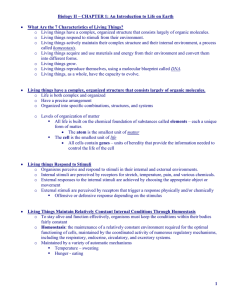
Biology II – CHAPTER 1: An Introduction to Life on Earth
... o Living things have the capacity to evolve, therefore, over time mutations and variable offspring create diversity in the genetic material of a species or evolution. o The scientific theory of evolution states that modern organisms descended – with modification – from preexisting life-forms, ultima ...
... o Living things have the capacity to evolve, therefore, over time mutations and variable offspring create diversity in the genetic material of a species or evolution. o The scientific theory of evolution states that modern organisms descended – with modification – from preexisting life-forms, ultima ...
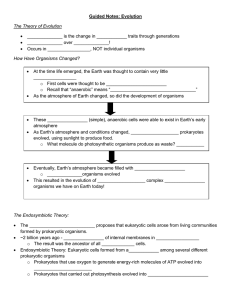
Evolution Guided Notes
... Genetic Recombination: Dominant and Recessive alleles in genes, along with polygenetic traits and complex genetics, lead to individual organisms with different ________________ (and thus, adaptations) ...
... Genetic Recombination: Dominant and Recessive alleles in genes, along with polygenetic traits and complex genetics, lead to individual organisms with different ________________ (and thus, adaptations) ...

Darwin Formulates His Theory - Hatboro
... reasoned that over thousands of generations, natural selection could also cause major change. Of course, there are important differences between artificial and natural selection. The traits that become more common in a population through artificial selection are those that humans choose. In contrast ...
... reasoned that over thousands of generations, natural selection could also cause major change. Of course, there are important differences between artificial and natural selection. The traits that become more common in a population through artificial selection are those that humans choose. In contrast ...

Darwin Formulates His Theory
... reasoned that over thousands of generations, natural selection could also cause major change. Of course, there are important differences between artificial and natural selection. The traits that become more common in a population through artificial selection are those that humans choose. In contrast ...
... reasoned that over thousands of generations, natural selection could also cause major change. Of course, there are important differences between artificial and natural selection. The traits that become more common in a population through artificial selection are those that humans choose. In contrast ...

Charles Darwin-reserach-term1
... sailed in a ship called the Beagle. The Beagle was not a big ship, it was only about 28 metres long and had to be home to 74 people for the whole voyage. Darwin took with him a copy of the bible and books by Milton, Humboldt as well as a copy of Lyell's first volume on Principles Of Geology. He also ...
... sailed in a ship called the Beagle. The Beagle was not a big ship, it was only about 28 metres long and had to be home to 74 people for the whole voyage. Darwin took with him a copy of the bible and books by Milton, Humboldt as well as a copy of Lyell's first volume on Principles Of Geology. He also ...


sexual dimorphism - Glenelg High School
... Population – a localized group of individuals capable of interbreeding and producing fertile offspring (of the same species) Gene pool – the aggregate of genes in a population at any one time Modern Synthesis – integrated theory of evolution, “individuals are selected, populations evolve” ...
... Population – a localized group of individuals capable of interbreeding and producing fertile offspring (of the same species) Gene pool – the aggregate of genes in a population at any one time Modern Synthesis – integrated theory of evolution, “individuals are selected, populations evolve” ...

Unit 1 - Susan Kerr`s Anthropology Site
... 1. What is anthropology? What are the four fields of anthropology, and what kinds of phenomena do anthropologists working in these areas study (give examples of anthropologists and their research)? 2. What makes anthropology unique when compared to other disciplines (hint: think “holistically”)? 3. ...
... 1. What is anthropology? What are the four fields of anthropology, and what kinds of phenomena do anthropologists working in these areas study (give examples of anthropologists and their research)? 2. What makes anthropology unique when compared to other disciplines (hint: think “holistically”)? 3. ...

Ch19
... There are many different adaptations within organisms on this planet. Examples include ; camouflage, a human’s thumb, an Eagle’s eyesight, etc. Adaptations help an organism survive and therefore that organism will have a better chance of passing on to its offspring the particular characteristic whic ...
... There are many different adaptations within organisms on this planet. Examples include ; camouflage, a human’s thumb, an Eagle’s eyesight, etc. Adaptations help an organism survive and therefore that organism will have a better chance of passing on to its offspring the particular characteristic whic ...

Natural Selection Introduction
... Charles Darwin (1809 -1882) Charles Darwin is famous for the theory of evolution and Natural Selection, or ‘Survival of the Fittest’. He dedicated his life to studying plants and animals and believed that the desires of animals have nothing to do with how they evolve. He said that organisms, even of ...
... Charles Darwin (1809 -1882) Charles Darwin is famous for the theory of evolution and Natural Selection, or ‘Survival of the Fittest’. He dedicated his life to studying plants and animals and believed that the desires of animals have nothing to do with how they evolve. He said that organisms, even of ...
Purple packet-Changes over Time/Evolution (PDF
... Fossils are traces of organisms that lived in the past. When fossils are found, they are analyzed to determine the age of the fossil. The absolute age of the fossil can be determined though radiometric dating and determining the layer of rock in which the fossil was found. Older layers are found dee ...
... Fossils are traces of organisms that lived in the past. When fossils are found, they are analyzed to determine the age of the fossil. The absolute age of the fossil can be determined though radiometric dating and determining the layer of rock in which the fossil was found. Older layers are found dee ...


Misconceptions About Evolution
... work in progress. • New discoveries are made and explanations adjusted when necessary. • We do know a great deal about: – The history of life – The pattern of lineagesplitting through time – The mechanisms that caused these changes ...
... work in progress. • New discoveries are made and explanations adjusted when necessary. • We do know a great deal about: – The history of life – The pattern of lineagesplitting through time – The mechanisms that caused these changes ...