
A.1 Watch video and spot wrong information on the transcript A.2
... plants which are best suited to their environment will, on average, survive better. There is a struggle for existence. Those who survive will produce the next generation. Their genes will be passed on, and the genes of those who did not reproduce will not. This is the basic mechanism which changes a ...
... plants which are best suited to their environment will, on average, survive better. There is a struggle for existence. Those who survive will produce the next generation. Their genes will be passed on, and the genes of those who did not reproduce will not. This is the basic mechanism which changes a ...

Modern Evolution
... Reproductive Isolation •If the isolated population becomes so different from the main population that members of the two cannot interbreed, even if the geographic barriers are removed. •When two populations can no longer interbreed and produce fertile offspring, they have become two distinct specie ...
... Reproductive Isolation •If the isolated population becomes so different from the main population that members of the two cannot interbreed, even if the geographic barriers are removed. •When two populations can no longer interbreed and produce fertile offspring, they have become two distinct specie ...

Chapter 1 Environmental Problems, Their Causes, and Sustainability
... Individuals Matter: Edward O. Wilson: A Champion of Biodiversity ...
... Individuals Matter: Edward O. Wilson: A Champion of Biodiversity ...

EVOLUTION AND ECOLOGY TAKE HOME PACKET
... 17. What happens to living things when humans change the environment? 18. How does a living thing increase its chance of survival? 19. Where can you find moss? 20. Fossils show how _______ has changed on Earth. 21. The ammonites lived 200 million years ago. What are they related to today? 22. What i ...
... 17. What happens to living things when humans change the environment? 18. How does a living thing increase its chance of survival? 19. Where can you find moss? 20. Fossils show how _______ has changed on Earth. 21. The ammonites lived 200 million years ago. What are they related to today? 22. What i ...

ch16_lecture
... • If one species can evolve into another, there should be transitional forms • When Darwin published his work, no such forms were known • First fossil Archaeopteryx found in 1860 ...
... • If one species can evolve into another, there should be transitional forms • When Darwin published his work, no such forms were known • First fossil Archaeopteryx found in 1860 ...

Chapter1 The Scientific Study of Life - OCC
... through producers, then consumers. B Nutrients become incorporated into the cells of producers and consumers. Some nutrients released by decomposition cycle back to producers. C All energy that enters an ecosystem eventually flows out of it, mainly as heat. Stepped Art Fig. 1-3, p. 6 ...
... through producers, then consumers. B Nutrients become incorporated into the cells of producers and consumers. Some nutrients released by decomposition cycle back to producers. C All energy that enters an ecosystem eventually flows out of it, mainly as heat. Stepped Art Fig. 1-3, p. 6 ...

Natural Selection Script (long) - University of Alaska Anchorage
... In order to make a solid case for evolution, he needed to explain how evolution happens. ...
... In order to make a solid case for evolution, he needed to explain how evolution happens. ...

Evidence of Evolution
... Survival of the Fittest Fitness describes how well an organism can survive and reproduce in its environment. Individuals with adaptations that are well-suited to their environment will survive and reproduce at a higher rate. This difference in rates of survival and reproduction is called survival of ...
... Survival of the Fittest Fitness describes how well an organism can survive and reproduce in its environment. Individuals with adaptations that are well-suited to their environment will survive and reproduce at a higher rate. This difference in rates of survival and reproduction is called survival of ...

evolution - Dr. Field`s Notes
... humans and recognized that all species can produce numbers greater than can be supported. • Remember carrying capacity and competition if too many of a species occupy an habitat. • Most of the time, only a small amount of offspring will survive. • The second observation was the variation seen among ...
... humans and recognized that all species can produce numbers greater than can be supported. • Remember carrying capacity and competition if too many of a species occupy an habitat. • Most of the time, only a small amount of offspring will survive. • The second observation was the variation seen among ...

Evolution-Darwin and Natural Selection
... organisms lost parts because they did not use them — like the missing eyes & digestive system of the ...
... organisms lost parts because they did not use them — like the missing eyes & digestive system of the ...

Chapter 23
... The Founder Effect • founder effect – occurs when a few individuals become isolated from a larger pop • I.e. part of a population migrates to a different area, becoming geographically isolated from the original population. The individuals of the migrating group are the “founders” of the ...
... The Founder Effect • founder effect – occurs when a few individuals become isolated from a larger pop • I.e. part of a population migrates to a different area, becoming geographically isolated from the original population. The individuals of the migrating group are the “founders” of the ...
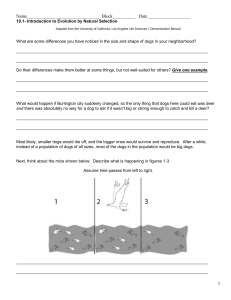
10.1-Intro to Evolution
... These genes would be more common in the next generation, since more of the cubs with these genes would survive to reproduce. Remember, any characteristic that is influenced by genes and passed from parents to offspring is heritable. Over many generations, heritable adaptive characteristics that incr ...
... These genes would be more common in the next generation, since more of the cubs with these genes would survive to reproduce. Remember, any characteristic that is influenced by genes and passed from parents to offspring is heritable. Over many generations, heritable adaptive characteristics that incr ...

Name: TOC#_____ Origins Unit Exam Study Guide Station 1
... 4. Explain what it means that: Living Things Obtain and Use Energy a. Energy is obtained and used to grow, develop and reproduce b. Metabolism: The total sum of all chemical reactions in the body i. Anabolism: Synthesizing substances to store energy ii. Catabolism: Breaking down substances to releas ...
... 4. Explain what it means that: Living Things Obtain and Use Energy a. Energy is obtained and used to grow, develop and reproduce b. Metabolism: The total sum of all chemical reactions in the body i. Anabolism: Synthesizing substances to store energy ii. Catabolism: Breaking down substances to releas ...

Lesson 6 - Fort Bend ISD
... The organism evolves into two or more different species. The organisms are dependent on each other for survival. 2. What type of evolution is occurring? ...
... The organism evolves into two or more different species. The organisms are dependent on each other for survival. 2. What type of evolution is occurring? ...

Chapter 7 notes
... adaptations survive better than other members of the same species. 2. How is your answer for number one similar to Darwin's theory of Evolution by Means of Natural Selection? It is the same. Darwin says that these organisms survive and are more likely to produce offspring with the same adaptations. ...
... adaptations survive better than other members of the same species. 2. How is your answer for number one similar to Darwin's theory of Evolution by Means of Natural Selection? It is the same. Darwin says that these organisms survive and are more likely to produce offspring with the same adaptations. ...

Chapter 14
... Western Historical Context Within this context, Charles Darwin (18091882) served as Ship’s Naturalist on the HMS Beagle’s circumnavigation of the globe ...
... Western Historical Context Within this context, Charles Darwin (18091882) served as Ship’s Naturalist on the HMS Beagle’s circumnavigation of the globe ...

Science 9
... 11. Julia collected data on the structure of the human ear from 4 members of her class. Using the following table, which of the following terms describe lobe ...
... 11. Julia collected data on the structure of the human ear from 4 members of her class. Using the following table, which of the following terms describe lobe ...

Lesson 3 - Darwin`s conclusions.notebook
... Organisms from the same species vary, and these variations can be inherited by their offspring. Organisms produce more offspring than can survive, others don't reproduce. This leads to competition within species. Those who survive have a high level of fitness. Organisms best a ...
... Organisms from the same species vary, and these variations can be inherited by their offspring. Organisms produce more offspring than can survive, others don't reproduce. This leads to competition within species. Those who survive have a high level of fitness. Organisms best a ...

Chapter 1
... Charles Darwin wrote On the Origin of Species presenting substantiating data. Evolution is a core concept in biology, medicine, anthropology, environmental science, conservation biology, agriculture, forestry, etc. • explains so many different types of observations in every many different fields ...
... Charles Darwin wrote On the Origin of Species presenting substantiating data. Evolution is a core concept in biology, medicine, anthropology, environmental science, conservation biology, agriculture, forestry, etc. • explains so many different types of observations in every many different fields ...

Natural Selection
... The skin color of frogs naturally varies from green to brown to orange to red to blue. None of the frogs pictured below is poisonous, but all live in an area covered with green plants. Which frog will be more likely to survive and reproduce? ...
... The skin color of frogs naturally varies from green to brown to orange to red to blue. None of the frogs pictured below is poisonous, but all live in an area covered with green plants. Which frog will be more likely to survive and reproduce? ...

lecture_ch08_clickers
... 1. After 100 years, the frequency of alleles in island horses will be different from horses on the mainland. 2. The horses experienced a form of genetic drift. 3. Changes in the frequency of alleles in the island horse population would lead to ...
... 1. After 100 years, the frequency of alleles in island horses will be different from horses on the mainland. 2. The horses experienced a form of genetic drift. 3. Changes in the frequency of alleles in the island horse population would lead to ...

Chapter 1 Active Reading Guide Introduction: Themes in the Study
... Adapted from Campbell Biology (9 Edition) – © 2011 Pearson Education, Inc. ...
... Adapted from Campbell Biology (9 Edition) – © 2011 Pearson Education, Inc. ...

adaptations
... thumb has helped humans adapt to their environment and survive. • What are ways in which the use of the thumb enables humans to better survive in their environment? ...
... thumb has helped humans adapt to their environment and survive. • What are ways in which the use of the thumb enables humans to better survive in their environment? ...

Chapter 19 – Introducing Evolution ()
... James Hutton. Hutton had stated that the Earth’s geological features were in a slow continuous cycle of change. As a result of reading this book, Darwin began to question the age of the Earth as proposed by biblical scholars who suggested that it was only 6000 years old. Darwin applied the idea of s ...
... James Hutton. Hutton had stated that the Earth’s geological features were in a slow continuous cycle of change. As a result of reading this book, Darwin began to question the age of the Earth as proposed by biblical scholars who suggested that it was only 6000 years old. Darwin applied the idea of s ...

Option D: Evolution - Somers Public Schools
... D.3.7 Explain the biochemical evidence provided by the universality of DNA and protein structures for the common ancestry of living organisms • Remember the idea of the “Universal Genetic Code”… all organisms utilize the standard genetic code – All have DNA – DNA is transcribed into RNA – RNA is tr ...
... D.3.7 Explain the biochemical evidence provided by the universality of DNA and protein structures for the common ancestry of living organisms • Remember the idea of the “Universal Genetic Code”… all organisms utilize the standard genetic code – All have DNA – DNA is transcribed into RNA – RNA is tr ...