EVOLUTIONARY ETHICS: ITS ORIGINS AND CONTEMPORARY
... the claim, “one ought not to commit infanticide.” If an advocate of this claim were to support it by pointing out that (1) newborns have the potential to develop into adults, (2) newborns are unable to protect themselves, and (3) killing a newborn means taking a life, she or he would have failed to ...
... the claim, “one ought not to commit infanticide.” If an advocate of this claim were to support it by pointing out that (1) newborns have the potential to develop into adults, (2) newborns are unable to protect themselves, and (3) killing a newborn means taking a life, she or he would have failed to ...

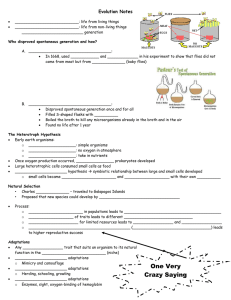
Evolution notes PDP - Lincoln Park High School
... Adaptations will become more common over time Date: Natural Selection (survival of the fittest) – individuals better suited to their env. survive & reproduce most successfully o Dependent on genetic variation & specific env./habitat o Can only edit existing characteristics; does not create new one ...
... Adaptations will become more common over time Date: Natural Selection (survival of the fittest) – individuals better suited to their env. survive & reproduce most successfully o Dependent on genetic variation & specific env./habitat o Can only edit existing characteristics; does not create new one ...

Adaptation II. Modes of Selection III. Adaptation “Survival of the Fittest”
... I. Natural Selecion II. Modes of Selection III. Adaptation ...
... I. Natural Selecion II. Modes of Selection III. Adaptation ...

Ch. 15 notes
... The organs of many animals are so reduced in size that they are just vestiges, or traces, of homologous organs in other species. These organs are called vestigial organs. Similarities in Embryology The early stages, or embryos, of many animals with backbones are very similar. The same groups of embr ...
... The organs of many animals are so reduced in size that they are just vestiges, or traces, of homologous organs in other species. These organs are called vestigial organs. Similarities in Embryology The early stages, or embryos, of many animals with backbones are very similar. The same groups of embr ...

Natural Selection vs. Selective Breeding
... survive have VARIATIONS BEST SUITED FOR THAT ENVIRONMENT. • Darwin studied the FINCHES on the Galapagos Islands. He noticed they had different BEAKS. They formed so the birds could EAT DIFFERENT FOODS. ...
... survive have VARIATIONS BEST SUITED FOR THAT ENVIRONMENT. • Darwin studied the FINCHES on the Galapagos Islands. He noticed they had different BEAKS. They formed so the birds could EAT DIFFERENT FOODS. ...

Link - Australian eJournal of Theology
... Another aspect of Darwin’s theory is that it is restricted to a single level of causality. Challenges to survival impact upon the causal agent (organism) and are met, through natural selection, by evolutionary change.11 Darwinism is thoroughly reductionist, finding natural selection as a series of a ...
... Another aspect of Darwin’s theory is that it is restricted to a single level of causality. Challenges to survival impact upon the causal agent (organism) and are met, through natural selection, by evolutionary change.11 Darwinism is thoroughly reductionist, finding natural selection as a series of a ...

What is ecology? Levels of biological hierarchy
... Summary: • The study of natural selection in progress requires these critical factors: ...
... Summary: • The study of natural selection in progress requires these critical factors: ...

Chapter 15 Darwin*s Theory of Evolution
... about species diversity and the evolution process. He shelved his manuscript for years and told his wife to publish it in case he died. In 1858, Darwin received a short essay from naturalist Alfred Wallace. In 1859, Darwin published his book, On the Origin of Species. ...
... about species diversity and the evolution process. He shelved his manuscript for years and told his wife to publish it in case he died. In 1858, Darwin received a short essay from naturalist Alfred Wallace. In 1859, Darwin published his book, On the Origin of Species. ...

CH. 23 (A): EVOLUTION of
... o …this is because the 5 conditions required for non-evolving populations (i.e.___________-______________ _________________) are ___________ met for long in nature: 1) Extremely large population size. The smaller the population, the greater the role played by chance fluctuations in allele frequenci ...
... o …this is because the 5 conditions required for non-evolving populations (i.e.___________-______________ _________________) are ___________ met for long in nature: 1) Extremely large population size. The smaller the population, the greater the role played by chance fluctuations in allele frequenci ...

The Darwinian Revolution
... 2) Common Descent 3) Variation & Natural Selection 4) “Population Thinking” and Allopatric Speciation 5) Gradualness ...
... 2) Common Descent 3) Variation & Natural Selection 4) “Population Thinking” and Allopatric Speciation 5) Gradualness ...

Philosophy and Biology - Princeton University Press
... In a broad sense, all philosophy of biology is part of the “philosophy of science.” But with an eye to the distinction just made, we can also distinguish philosophy of science, in a narrower sense, from philosophy of nature. Philosophy of science in this narrower sense is an attempt to understand th ...
... In a broad sense, all philosophy of biology is part of the “philosophy of science.” But with an eye to the distinction just made, we can also distinguish philosophy of science, in a narrower sense, from philosophy of nature. Philosophy of science in this narrower sense is an attempt to understand th ...

CHAPTER 7: INTRODUCING EVOLUTION Adaptions and Variations
... and competition for food, space, and mates are all challenges that organisms may or may not be able to survive. Organisms that survive long enough to reproduce have the opportunity to pass along to their offspring the genetic information that helped them survive. The diversity within species and the ...
... and competition for food, space, and mates are all challenges that organisms may or may not be able to survive. Organisms that survive long enough to reproduce have the opportunity to pass along to their offspring the genetic information that helped them survive. The diversity within species and the ...

Review- Evidence for Evolution
... B. Convergent evolution occurs when two species living in different areas become reestablished and are able to reproduce. C. Convergent evolution occurs when two species living in the same area are competing for the same resource thus causing one to evolve away from the other. D. Convergent evolutio ...
... B. Convergent evolution occurs when two species living in different areas become reestablished and are able to reproduce. C. Convergent evolution occurs when two species living in the same area are competing for the same resource thus causing one to evolve away from the other. D. Convergent evolutio ...

Evidence of Evolution
... B. Convergent evolution occurs when two species living in different areas become reestablished and are able to reproduce. C. Convergent evolution occurs when two species living in the same area are competing for the same resource thus causing one to evolve away from the other. D. Convergent evolutio ...
... B. Convergent evolution occurs when two species living in different areas become reestablished and are able to reproduce. C. Convergent evolution occurs when two species living in the same area are competing for the same resource thus causing one to evolve away from the other. D. Convergent evolutio ...

THREE DOMAINS NOTES
... viable, fertile offspring but cannot (or at least usually do not) interbreed with members of other groups 2. Essential feature of the definition - reproductive isolation (genetic isolation) 3. Two separate species exist when the two can occupy the same space without interbreeding 4. Members of a spe ...
... viable, fertile offspring but cannot (or at least usually do not) interbreed with members of other groups 2. Essential feature of the definition - reproductive isolation (genetic isolation) 3. Two separate species exist when the two can occupy the same space without interbreeding 4. Members of a spe ...

Conor Cunningham, Darwin`s Pious Idea
... their size (reserving the quotations, which as I mentioned are excellent), and if the author had simply sketched out the views and said “I do not like this view—here is one I like better”, rather than attempting to refute them. Incidentally, one might ask why the author so coarsely shortchanges bio ...
... their size (reserving the quotations, which as I mentioned are excellent), and if the author had simply sketched out the views and said “I do not like this view—here is one I like better”, rather than attempting to refute them. Incidentally, one might ask why the author so coarsely shortchanges bio ...

APBIO Evolution (22 and 23) 2014 15
... If the hypothesis is correct, these fruit characteristics can no longer be considered adaptations for seed distribution. Janzen, D.H., and P.S. Martin. 1982. Neotropical anachronisms: The fruits the gomphotheres ...
... If the hypothesis is correct, these fruit characteristics can no longer be considered adaptations for seed distribution. Janzen, D.H., and P.S. Martin. 1982. Neotropical anachronisms: The fruits the gomphotheres ...

Bodensee Nature Museum Evolution Worksheets: Selection and
... Kin Selection: because relatives share some proportion of the same genetic material, they will help individuals that are closely related even when there is a cost to their own survival. Helping relatives increases your own ‘inclusive fitness’. An organism’s inclusive fitness includes its own offspri ...
... Kin Selection: because relatives share some proportion of the same genetic material, they will help individuals that are closely related even when there is a cost to their own survival. Helping relatives increases your own ‘inclusive fitness’. An organism’s inclusive fitness includes its own offspri ...

sexual reproduction and meiosis
... 51. What part of Darwin’s natural selection theory couldn’t he explain? Whose work was discovered after Darwin’s death to fill the gaps in his theory? ...
... 51. What part of Darwin’s natural selection theory couldn’t he explain? Whose work was discovered after Darwin’s death to fill the gaps in his theory? ...

Evolution Vocabulary
... A group of similar organisms that can mate with each other and produce fertile offspring. A trait that helps an organism survive and reproduce. The process by which species gradually ...
... A group of similar organisms that can mate with each other and produce fertile offspring. A trait that helps an organism survive and reproduce. The process by which species gradually ...

Exam 1 Student Learning Objectives
... 11. How do pre-zygotic and post-zygotic barriers affect speciation by isolating organisms? 12. What are the ideas used to explain the pace or trends of evolution and how do Exaptation and Allometric growth play a role in species evolution? Student Learning Objectives: Origins of Life 1. Which are th ...
... 11. How do pre-zygotic and post-zygotic barriers affect speciation by isolating organisms? 12. What are the ideas used to explain the pace or trends of evolution and how do Exaptation and Allometric growth play a role in species evolution? Student Learning Objectives: Origins of Life 1. Which are th ...


Evolution Video Series: Evolutionary Arms Race
... Describe the process of evolution by means of natural selection. Examine the evidence for evolution by natural selection. Describe observed examples of evolution, including the evolution of drug-resistant bacteria and sickle-cell anemia in Coastal West Africa. Distinguish between processes l ...
... Describe the process of evolution by means of natural selection. Examine the evidence for evolution by natural selection. Describe observed examples of evolution, including the evolution of drug-resistant bacteria and sickle-cell anemia in Coastal West Africa. Distinguish between processes l ...

08 - SCERT
... lead to evolution. This is known as mutation theory. Hugo de Vries Neodarwinism is the modern theory of evolution that explains Darwin's evolutionary concepts in the light of the latest information in genetics. Mutations in genes and chromosomes will lead to variations within species. When they unde ...
... lead to evolution. This is known as mutation theory. Hugo de Vries Neodarwinism is the modern theory of evolution that explains Darwin's evolutionary concepts in the light of the latest information in genetics. Mutations in genes and chromosomes will lead to variations within species. When they unde ...