
Not by Design: Retiring Darwin`s Watchmaker
... need of some way to stay afloat, only to be saved by the improving force of natural selection. As pointed out by Croizat (1962), among others, this mode of thinking is not only teleological but also Lamarckian: a need gives rise to an organ to fulfill that need. While the best solution might be to d ...
... need of some way to stay afloat, only to be saved by the improving force of natural selection. As pointed out by Croizat (1962), among others, this mode of thinking is not only teleological but also Lamarckian: a need gives rise to an organ to fulfill that need. While the best solution might be to d ...

158-3(7-15-00) Lab ecosystems show signs of evolving
... A test of natural selection among ecosystems miniaturized to the size of flowerpots bolsters the formerly shocking concept of group selection, argues a group of New York researchers. Group selection holds that natural selection operates on groups, such as diverse ecosystems, just as it does on indiv ...
... A test of natural selection among ecosystems miniaturized to the size of flowerpots bolsters the formerly shocking concept of group selection, argues a group of New York researchers. Group selection holds that natural selection operates on groups, such as diverse ecosystems, just as it does on indiv ...
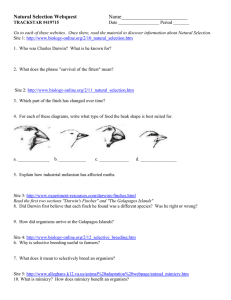
Natural Selection Webquest
... 13. What are the 4 reasons that natural selection occurs? 1. ________________________________________________________________________ 2. ________________________________________________________________________ 3. ________________________________________________________________________ 4. ___________ ...
... 13. What are the 4 reasons that natural selection occurs? 1. ________________________________________________________________________ 2. ________________________________________________________________________ 3. ________________________________________________________________________ 4. ___________ ...

Unit Plan Template - Gates County Schools
... How do the different scientific theories of evolution explain the diversity of life on Earth? How and why do different structures found in very different organisms (such as plant vs. animals) perform similar functions? How do populations change over time? How do new species evolve? What makes allele ...
... How do the different scientific theories of evolution explain the diversity of life on Earth? How and why do different structures found in very different organisms (such as plant vs. animals) perform similar functions? How do populations change over time? How do new species evolve? What makes allele ...

EVPP 110 Lecture - Populations - Evoluti
... – in the late 1800s, industrial pollution from the Industrial Revolution killed large numbers of lichens, exposing the darker tree bark or rock • the dark variety of the moth became increasing more abundant since it now was camouflaged against the dark surface and the lighter variety was not • by th ...
... – in the late 1800s, industrial pollution from the Industrial Revolution killed large numbers of lichens, exposing the darker tree bark or rock • the dark variety of the moth became increasing more abundant since it now was camouflaged against the dark surface and the lighter variety was not • by th ...

How New Species Evolve
... of the coadaptations of organic beings to each other and to their physical condition of life, untouched and unexplained. It is, therefore, of the highest importance to gain a clear insight into the means of modification and coadaptation. At the commencement of my observations it seemed to me probabl ...
... of the coadaptations of organic beings to each other and to their physical condition of life, untouched and unexplained. It is, therefore, of the highest importance to gain a clear insight into the means of modification and coadaptation. At the commencement of my observations it seemed to me probabl ...

A View of Life
... 2. Reproduction. Organisms reproduce; life comes only from life (biogenesis). 3. Growth and Development. Heritable programs stored in DNA direct the speciesspecific pattern of growth and development. 4. Energy Utilization. Organisms take in and transform energy to do work, including the maintenance ...
... 2. Reproduction. Organisms reproduce; life comes only from life (biogenesis). 3. Growth and Development. Heritable programs stored in DNA direct the speciesspecific pattern of growth and development. 4. Energy Utilization. Organisms take in and transform energy to do work, including the maintenance ...

Taking a Chance on Evolution
... understood, there is nothing in the theory of natural selection that predicts progress in any global sense: only a tendency to get better at whatever you happen to be doing. But if we concentrate only on the most complex entities present in the biosphere at any moment, we ca ...
... understood, there is nothing in the theory of natural selection that predicts progress in any global sense: only a tendency to get better at whatever you happen to be doing. But if we concentrate only on the most complex entities present in the biosphere at any moment, we ca ...


Evolution Test - Fall2009BSC307
... can look at homologous structures, or structures that have different mature forms that are from the same embryonic tissues. An example of this is the limbs of mammals. Embryology is the study of embryos and early development and provide evidence for evolution because, for example, chicken, turtles, ...
... can look at homologous structures, or structures that have different mature forms that are from the same embryonic tissues. An example of this is the limbs of mammals. Embryology is the study of embryos and early development and provide evidence for evolution because, for example, chicken, turtles, ...

review
... According to this definition of fitness, which lion would biologists consider the “fittest”? Explain why.__________ _____________________________________________________________________________________________ __________________________________________________________________________________________ ...
... According to this definition of fitness, which lion would biologists consider the “fittest”? Explain why.__________ _____________________________________________________________________________________________ __________________________________________________________________________________________ ...

Chapter 22 Outline
... Fossil Evidence Indicates That Evolution Has Occurred. How Does The Fossil Record Provide Evidence That Evolution Has Occurred? ...
... Fossil Evidence Indicates That Evolution Has Occurred. How Does The Fossil Record Provide Evidence That Evolution Has Occurred? ...

Evolution - Aurora City Schools
... history of evolution in the DNA sequences of organisms. If two species have genes with sequences that match closely, biologists conclude that these sequences must have been inherited from a relatively recent common ancestor. In contrast, the greater the number of sequence differences between spe ...
... history of evolution in the DNA sequences of organisms. If two species have genes with sequences that match closely, biologists conclude that these sequences must have been inherited from a relatively recent common ancestor. In contrast, the greater the number of sequence differences between spe ...

WHICH PATTERN IS IT?
... Idea that allele frequency will remain constant unless one or more factors cause those frequencies to change Hardy-Weinberg Principle ...
... Idea that allele frequency will remain constant unless one or more factors cause those frequencies to change Hardy-Weinberg Principle ...

NAME OF GAME - local.brookings.k12.sd.us
... Idea that allele frequency will remain constant unless one or more factors cause those frequencies to change Hardy-Weinberg Principle ...
... Idea that allele frequency will remain constant unless one or more factors cause those frequencies to change Hardy-Weinberg Principle ...

Descent with Modification – A Darwinian View of Life
... Other Observations about Evolution • 3. Artificial Selection - humans have modified other species over many generations by selecting and breeding individuals that possess desired traits ...
... Other Observations about Evolution • 3. Artificial Selection - humans have modified other species over many generations by selecting and breeding individuals that possess desired traits ...

E D I T O R I A L
... mutations to be beneficial. There is a strong consensus among biologists that observed mutations are mostly harmful, or neutral at best. Many mutations are known to be associated with disease, which is not what one would expect from guidance by a righteous divinity. Helpful mutations are generally t ...
... mutations to be beneficial. There is a strong consensus among biologists that observed mutations are mostly harmful, or neutral at best. Many mutations are known to be associated with disease, which is not what one would expect from guidance by a righteous divinity. Helpful mutations are generally t ...

Evolution - Studies Today
... The founder population is small and again the alleles present in this small population will not be representative of the original population. Saltation (from Latin, saltus, "leap") is a sudden change from one generation to the next, that is large, or very large, in comparison with the usual variatio ...
... The founder population is small and again the alleles present in this small population will not be representative of the original population. Saltation (from Latin, saltus, "leap") is a sudden change from one generation to the next, that is large, or very large, in comparison with the usual variatio ...

population
... Darwin noted that humans have modified other species by selecting and breeding individuals with desired traits, a process called artificial selection Darwin drew two inferences from two observations ...
... Darwin noted that humans have modified other species by selecting and breeding individuals with desired traits, a process called artificial selection Darwin drew two inferences from two observations ...

History of Science School Program
... earth’s crust first became apparent. Out of this practical study of minerals came a methodology for identifying the sequence in which the successive rocks had been deposited in the course of the earth’s history. The identification of a rock’s position in the sequence of deposits implied identifying ...
... earth’s crust first became apparent. Out of this practical study of minerals came a methodology for identifying the sequence in which the successive rocks had been deposited in the course of the earth’s history. The identification of a rock’s position in the sequence of deposits implied identifying ...


Chapter 4
... 4-2 How Does the Earth’s Life Change over Time? • Concept 4-2A The scientific theory of evolution explains how life on earth changes over time through changes in the genes of populations. • Concept 4-2B Populations evolve when genes mutate and give some individuals genetic traits that enhance their ...
... 4-2 How Does the Earth’s Life Change over Time? • Concept 4-2A The scientific theory of evolution explains how life on earth changes over time through changes in the genes of populations. • Concept 4-2B Populations evolve when genes mutate and give some individuals genetic traits that enhance their ...

Evolution and Diversity of Life
... members of the species will survive to reproduce. – There is competition for food, space, mates etc. – Only the members who are successful competitors will survive to reproduce. – The genetic traits that allow an organism to survive are called its “fitness”. – The survivors are said to be “adapted” ...
... members of the species will survive to reproduce. – There is competition for food, space, mates etc. – Only the members who are successful competitors will survive to reproduce. – The genetic traits that allow an organism to survive are called its “fitness”. – The survivors are said to be “adapted” ...

Evolutionary biology 2009 - (ecobio), rennes
... give an overview of the research methods in evolutionary biology and will provide state of the art reviews on timely questions in evolutionary biology, by internationally leading scientists in the field. Posters could be proposed by the participants, to be discussed with the invited speakers in even ...
... give an overview of the research methods in evolutionary biology and will provide state of the art reviews on timely questions in evolutionary biology, by internationally leading scientists in the field. Posters could be proposed by the participants, to be discussed with the invited speakers in even ...