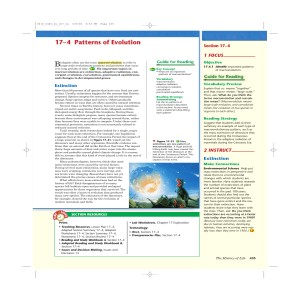
17–4 Patterns of Evolution
... How quickly does evolution operate? Does it always occur at the same speed? These are questions on which some modern biologists would disagree with Darwin. Recall that Darwin was enormously impressed by the way Hutton and Lyell discussed the slow and steady nature of geologic change. Darwin, in turn ...
... How quickly does evolution operate? Does it always occur at the same speed? These are questions on which some modern biologists would disagree with Darwin. Recall that Darwin was enormously impressed by the way Hutton and Lyell discussed the slow and steady nature of geologic change. Darwin, in turn ...

EVOLUTION
... Darwin was asked by the naturalist Alfred Wallace, in 1856 (22 years after Darwin returned to England on the Beagle) to review his paper on “Natural Selection” as a mechanism for Evolution. Darwin decided to publish his own work on evolution. Both papers were presented to the Linnaean Society of Lo ...
... Darwin was asked by the naturalist Alfred Wallace, in 1856 (22 years after Darwin returned to England on the Beagle) to review his paper on “Natural Selection” as a mechanism for Evolution. Darwin decided to publish his own work on evolution. Both papers were presented to the Linnaean Society of Lo ...

Chapter 10: Principles of Evolution
... Uniformitarianism states that the geologic processes that shape Earth are uniform through time. This soon replaced catastrophism as the favored theory of geologic change. What important concepts about Earth did Hutton and Lyell agree upon? 10.2: Darwin’s Observations Objectives: Describe how Dar ...
... Uniformitarianism states that the geologic processes that shape Earth are uniform through time. This soon replaced catastrophism as the favored theory of geologic change. What important concepts about Earth did Hutton and Lyell agree upon? 10.2: Darwin’s Observations Objectives: Describe how Dar ...

Natural Selection Webquest
... Go to each of these websites. Once there, read the material to discover information about Natural Selection. To make the webquest easier, you can also visit MrTranScience.Weebly.com/documents.html for links! Site 1: http://www.biology-online.org/2/10_natural_selection.htm 1. Who was Charles Darwin? ...
... Go to each of these websites. Once there, read the material to discover information about Natural Selection. To make the webquest easier, you can also visit MrTranScience.Weebly.com/documents.html for links! Site 1: http://www.biology-online.org/2/10_natural_selection.htm 1. Who was Charles Darwin? ...

Size Matters: A Look at Evolution in Action
... specimens were actually closely related . This idea helped Darwin shape his theories, which he presented in his work, The Origin of Species, and consequently the birds became known as “Darwin’s Finches.” One of Darwin’s most notable theories is the idea that change between generations does not accum ...
... specimens were actually closely related . This idea helped Darwin shape his theories, which he presented in his work, The Origin of Species, and consequently the birds became known as “Darwin’s Finches.” One of Darwin’s most notable theories is the idea that change between generations does not accum ...

Developmental Constraints, Genetic Correlations
... Wagner GP (1988) The influence of variation and of developmental constraints on the rate of multivariate phenotypic evolution. Journal of Evolutionary Biology 1, 45-66. ...
... Wagner GP (1988) The influence of variation and of developmental constraints on the rate of multivariate phenotypic evolution. Journal of Evolutionary Biology 1, 45-66. ...

Q5. Which areas of the world are primarily understudied?
... The word ‘evolution’ is used widely, but in Biology we specifically mean ‘the process that has transformed life on Earth from its earliest beginnings to the diversity of forms we know about today. Species that have lived on Earth were and are formed by a process of continuous change – evolution. Thi ...
... The word ‘evolution’ is used widely, but in Biology we specifically mean ‘the process that has transformed life on Earth from its earliest beginnings to the diversity of forms we know about today. Species that have lived on Earth were and are formed by a process of continuous change – evolution. Thi ...

The Origin of Species
... Gene flow is interrupted or reduced when a population is divided into two or more geographically isolated subpopulations ...
... Gene flow is interrupted or reduced when a population is divided into two or more geographically isolated subpopulations ...


Natural Selection - Solon City Schools
... INDIVIDUALS…only populations! • It does NOT happen quickly…the Earth has a Looooooong history! • It does NOT explain how life came to be on Earth, just how it evolved after it was here. • It does NOT have any driving force except the competition for limited resources. ...
... INDIVIDUALS…only populations! • It does NOT happen quickly…the Earth has a Looooooong history! • It does NOT explain how life came to be on Earth, just how it evolved after it was here. • It does NOT have any driving force except the competition for limited resources. ...

Evolutionary Classification
... time- sci. theory Theory-well-tested explanation that explains a wide range of observations. Adaptation- any trait that helps an organism survive and reproduce ...
... time- sci. theory Theory-well-tested explanation that explains a wide range of observations. Adaptation- any trait that helps an organism survive and reproduce ...

Natural Selection Script (short)
... In order to make a solid case for evolution, he needed to explain how evolution happens. ...
... In order to make a solid case for evolution, he needed to explain how evolution happens. ...

File
... What is the fossil record? Is it complete? How can a fossil be used to trace the theory of evolution? What is embryology? How is it used to trace the theory of evolution? What is speciation? What are the three types of isolation that lead to a new species? Define and give examples of each. What is a ...
... What is the fossil record? Is it complete? How can a fossil be used to trace the theory of evolution? What is embryology? How is it used to trace the theory of evolution? What is speciation? What are the three types of isolation that lead to a new species? Define and give examples of each. What is a ...

Populations
... According to the Hardy-Weinberg principle, no evolution will take place if A. all five of the Hardy-Weinberg conditions are met. B. any one of the Hardy-Weinberg conditions is met. C. at least three of the Hardy-Weinberg conditions are met. D. none of the Hardy-Weinberg conditions are met. ...
... According to the Hardy-Weinberg principle, no evolution will take place if A. all five of the Hardy-Weinberg conditions are met. B. any one of the Hardy-Weinberg conditions is met. C. at least three of the Hardy-Weinberg conditions are met. D. none of the Hardy-Weinberg conditions are met. ...

Chapter 13 - Evolution
... idea that living species are descendents of ancestral species that were different from present-day ones • Evolution describes the genetic changes in a population over time ...
... idea that living species are descendents of ancestral species that were different from present-day ones • Evolution describes the genetic changes in a population over time ...
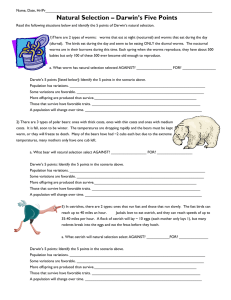
Natural Selection – Darwin`s Five Points
... coats. It is fall, soon to be winter. The temperatures are dropping rapidly and the bears must be kept warm, or they will freeze to death. Many of the bears have had ~2 cubs each but due to the extreme temperatures, many mothers only have one cub left. a. What bear will natural selection select AGAI ...
... coats. It is fall, soon to be winter. The temperatures are dropping rapidly and the bears must be kept warm, or they will freeze to death. Many of the bears have had ~2 cubs each but due to the extreme temperatures, many mothers only have one cub left. a. What bear will natural selection select AGAI ...

UNIT 05 OBJECTIVES Darwin`s Theory of Evolution
... influenced Darwin’s development of the idea of natural selection. D) Describe Darwin’s observations and inferences in developing the concept of natural selection. II) Explain why individuals cannot evolve and why evolution does not lead to perfectly adapted organisms. III) Describe two examples of n ...
... influenced Darwin’s development of the idea of natural selection. D) Describe Darwin’s observations and inferences in developing the concept of natural selection. II) Explain why individuals cannot evolve and why evolution does not lead to perfectly adapted organisms. III) Describe two examples of n ...

Objectives
... Know what evidence led Darwin to his Theory. a. Know about the finches of the Galapagos. b. Know his 4 conclusions that led to his theory, 9. Know what variations are and how they compare to adaptations 10. Know some forms of adaptations, such as camouflage and mimicry. 11. Know what the Hardy-Weinb ...
... Know what evidence led Darwin to his Theory. a. Know about the finches of the Galapagos. b. Know his 4 conclusions that led to his theory, 9. Know what variations are and how they compare to adaptations 10. Know some forms of adaptations, such as camouflage and mimicry. 11. Know what the Hardy-Weinb ...

Do Species Change? Outline There is no doubt that species change
... “I have never seen a dog specially created and I have never seen one type of animal evolve into another type, and I shall therefore continue to record a verdict of ‘not proven’ until either the special creationist or the evolutionist produce persuasive proof in favour of their views.” Arnold Lunn in ...
... “I have never seen a dog specially created and I have never seen one type of animal evolve into another type, and I shall therefore continue to record a verdict of ‘not proven’ until either the special creationist or the evolutionist produce persuasive proof in favour of their views.” Arnold Lunn in ...

Evolutionary_Theory_03_11_14
... others because they have different properties. 5. Then the protein composition of a population, and so also the genetic composition, changes in time. ...
... others because they have different properties. 5. Then the protein composition of a population, and so also the genetic composition, changes in time. ...

The origin of species
... • Hybrid sterility: hybrids are sterile (mules) • Hybrid breakdown: offspring produced by hybrids are weak or infertile (ligers) ...
... • Hybrid sterility: hybrids are sterile (mules) • Hybrid breakdown: offspring produced by hybrids are weak or infertile (ligers) ...

Evolution:
... •For example, thinks giraffes developed long necks because they had to stretch to reach higher branches. •Now, this theory is believed to be incorrect, (accepted idea is that species evolve by genetic changes instead). •Lamarck theorizing still contributed because he observed that species change and ...
... •For example, thinks giraffes developed long necks because they had to stretch to reach higher branches. •Now, this theory is believed to be incorrect, (accepted idea is that species evolve by genetic changes instead). •Lamarck theorizing still contributed because he observed that species change and ...

Examples of Natural Selection
... Natural Selection For many years scientists suspected that life changes over time, but they did not understand how it worked. Charles Darwin was the first person to offer the mechanism that is still accepted as true today. He called his theory of how evolution worked natural selection. Natural sele ...
... Natural Selection For many years scientists suspected that life changes over time, but they did not understand how it worked. Charles Darwin was the first person to offer the mechanism that is still accepted as true today. He called his theory of how evolution worked natural selection. Natural sele ...

Evolutionary Principles - Bremen High School District 228
... Z:\Biology-Regular\Biology UBD Units\Evolution\Evolutionary Principles\Evolutionary Principles.doc ...
... Z:\Biology-Regular\Biology UBD Units\Evolution\Evolutionary Principles\Evolutionary Principles.doc ...

Developmental Constraints, Genetic Correlations
... evolution at the multi-trait level is often nonoptimal in the sense that not every trait, or even no traits, are at their optimal value. In this sense, many regard constraints and genetic correlations as interfering or limiting adaptive evolution via natural selection. ...
... evolution at the multi-trait level is often nonoptimal in the sense that not every trait, or even no traits, are at their optimal value. In this sense, many regard constraints and genetic correlations as interfering or limiting adaptive evolution via natural selection. ...