
Changes Over Time
... reproduce and pass these desired variations on to the next generation. (survival of the fittest) http://learn.genetics.utah.edu/content/variation/recipe/ ...
... reproduce and pass these desired variations on to the next generation. (survival of the fittest) http://learn.genetics.utah.edu/content/variation/recipe/ ...

darwinism - Science Vision
... Zimmer (2009) quoted Darwin on how something as intricate as an “eye” could have evolved. But Darwin argued that new complex organs could evolve through a series of intermediate forms. Until 1980, biologists had almost no knowledge of the genes that built them. Over the past 25 years, biologists hav ...
... Zimmer (2009) quoted Darwin on how something as intricate as an “eye” could have evolved. But Darwin argued that new complex organs could evolve through a series of intermediate forms. Until 1980, biologists had almost no knowledge of the genes that built them. Over the past 25 years, biologists hav ...

Fossils and Darwin
... work which he had been working on for 21 years after Alfred Wallace approached Darwin with his paper outlining the process of evolution by ...
... work which he had been working on for 21 years after Alfred Wallace approached Darwin with his paper outlining the process of evolution by ...

Chapter-16 - Sarasota Military Academy
... aspect of form, function, behavior, or development that contributes to the fit between an individual and its environment An adaptive trait improves the odds of surviving and reproducing, or at least it did so under conditions that prevailed when genes for the trait first ...
... aspect of form, function, behavior, or development that contributes to the fit between an individual and its environment An adaptive trait improves the odds of surviving and reproducing, or at least it did so under conditions that prevailed when genes for the trait first ...


Evolution
... Origin of Species: Two Main Points 2. Natural selection: – only the organisms best adapted to their environment tend to survive and pass on their genes ...
... Origin of Species: Two Main Points 2. Natural selection: – only the organisms best adapted to their environment tend to survive and pass on their genes ...

Ch 14
... Use and disuse of a structure can bring about inherited change Long neck in giraffes developed from stretching to reach food Not supported—people who were blinded in an accident would have blind children Modern genetics—phenotypic changes acquired during the lifetime do not result in genetic ...
... Use and disuse of a structure can bring about inherited change Long neck in giraffes developed from stretching to reach food Not supported—people who were blinded in an accident would have blind children Modern genetics—phenotypic changes acquired during the lifetime do not result in genetic ...

Science of Biology - Austin Community College
... Evolution • Can explain the unity and diversity of life • Charles Darwin synthesized the theory of evolution by natural selection, his book on evolution presented two important concepts. ...
... Evolution • Can explain the unity and diversity of life • Charles Darwin synthesized the theory of evolution by natural selection, his book on evolution presented two important concepts. ...

Slide 1
... • We rely on our religious texts for moral, emotional and spiritual guidance • We rely on science and other intellectual pursuits to gain knowledge about the natural world ...
... • We rely on our religious texts for moral, emotional and spiritual guidance • We rely on science and other intellectual pursuits to gain knowledge about the natural world ...
Causality and patterns in evolutionary systems
... one or the other. The particle physicist might find that the collisions of interest often occur on the surface of the sun; if so, a detailed study of that particular object might help to infer the general law. Symmetrically, the astronomer interested in obtaining an accurate description of the star ...
... one or the other. The particle physicist might find that the collisions of interest often occur on the surface of the sun; if so, a detailed study of that particular object might help to infer the general law. Symmetrically, the astronomer interested in obtaining an accurate description of the star ...

013368718X_CH16_247
... the same time as Darwin began to challenge these ideas. These scientists had an important influence on the development of Darwin’s theory of evolution. Geologists James Hutton and Charles Lyell argued that Earth is many millions of years old. They also argued that the processes changing Earth to ...
... the same time as Darwin began to challenge these ideas. These scientists had an important influence on the development of Darwin’s theory of evolution. Geologists James Hutton and Charles Lyell argued that Earth is many millions of years old. They also argued that the processes changing Earth to ...

Flexbook ()
... Here’s how natural selection can keep a harmful allele in a gene pool: The allele (S) for sickle-cell anemia is a harmful autosomal recessive. It is caused by a mutation in the normal allele (A) for hemoglobin (a protein on red blood cells). Malaria is a deadly tropical disease. It is common in many ...
... Here’s how natural selection can keep a harmful allele in a gene pool: The allele (S) for sickle-cell anemia is a harmful autosomal recessive. It is caused by a mutation in the normal allele (A) for hemoglobin (a protein on red blood cells). Malaria is a deadly tropical disease. It is common in many ...

I. The “Vice Versa” of Animals and Plants
... choose, on the basis of certain traits, the animals and plants that will reproduce. 1. Ex: docile silver foxes 2. Artificial selection is only possible because the original population exhibits a range of characteristics. 3. Several varieties of vegetables can be traced to a single ancestor. a) Ex: C ...
... choose, on the basis of certain traits, the animals and plants that will reproduce. 1. Ex: docile silver foxes 2. Artificial selection is only possible because the original population exhibits a range of characteristics. 3. Several varieties of vegetables can be traced to a single ancestor. a) Ex: C ...

Darwin`s Theory of Evolution by Means of natural selection
... A bunch of flies were minding their own business eating a banana A hurricane washed the banana & flies onto an island Since conditions & food are different on the island, the flies evolve separate from their mainland relatives When some of the flies mix with the mainland relatives, they can no ...
... A bunch of flies were minding their own business eating a banana A hurricane washed the banana & flies onto an island Since conditions & food are different on the island, the flies evolve separate from their mainland relatives When some of the flies mix with the mainland relatives, they can no ...

Evolution - Fort Bend ISD
... The “fittest” are those with an inherited characteristic that makes that individual better suited to survive and be able to reproduce. ...
... The “fittest” are those with an inherited characteristic that makes that individual better suited to survive and be able to reproduce. ...

Evolution and Classification
... • 3. Natural selection favors the individuals with a certain trait. This doesn’t mean that everyone else dies, but they won’t have as many offspring. • 4. Over time, this trait will be more frequent in the population, because nature has selected that trait. ...
... • 3. Natural selection favors the individuals with a certain trait. This doesn’t mean that everyone else dies, but they won’t have as many offspring. • 4. Over time, this trait will be more frequent in the population, because nature has selected that trait. ...

ppt 1 - hrsbstaff.ednet.ns.ca
... 5. Individuals best suited to their environment survive and reproduce most successfully. The characteristics that make them best suited to their environment are passed on to offspring. Individuals whose characteristics are not as well suited to their environment die or leave fewer offspring. 6. Spec ...
... 5. Individuals best suited to their environment survive and reproduce most successfully. The characteristics that make them best suited to their environment are passed on to offspring. Individuals whose characteristics are not as well suited to their environment die or leave fewer offspring. 6. Spec ...

(natural selection).
... Vital renewable resource Species diversity Ecosystem diversity Functional diversity ...
... Vital renewable resource Species diversity Ecosystem diversity Functional diversity ...

Wizard Test Maker
... (3) variation exists within a species (4) the environment does not change 32. Darwin's studies of finches suggest that the differences in beak structure were most directly due to (1) acquired characteristics in the parent finches (2) the size of the island where the finches live (3) mating behaviors ...
... (3) variation exists within a species (4) the environment does not change 32. Darwin's studies of finches suggest that the differences in beak structure were most directly due to (1) acquired characteristics in the parent finches (2) the size of the island where the finches live (3) mating behaviors ...

122 [Study Guide] 22-2 Evidence for Evolution
... Scientists can use well-supported evolutionary trees to make predictions about the biology of ...
... Scientists can use well-supported evolutionary trees to make predictions about the biology of ...

Anthro 1050, University of Utah Evolution of Human Nature Study
... detect traces of common descent in living organisms? I might give you a data set like those in tables 4.1 and 4.2 and ask you to reconstruct a tree. What does this sort of data tell us about the question of large changes in evolutionary history? What is pax6, and how does it bear on this question? D ...
... detect traces of common descent in living organisms? I might give you a data set like those in tables 4.1 and 4.2 and ask you to reconstruct a tree. What does this sort of data tell us about the question of large changes in evolutionary history? What is pax6, and how does it bear on this question? D ...

WEEK 6 EOC Review Evolution, Human Body, Biotechnology
... 7. In his book On the Origin of the Species, Charles Darwin described how species change over time. Which of the following is NOT part of his observations that describes the mechanisms of natural selection? A. Organisms produce more offspring than can survive. B. Disease and natural disaster will li ...
... 7. In his book On the Origin of the Species, Charles Darwin described how species change over time. Which of the following is NOT part of his observations that describes the mechanisms of natural selection? A. Organisms produce more offspring than can survive. B. Disease and natural disaster will li ...


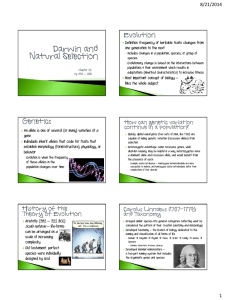
Darwin and Natural Selection
... contrasting with the “acquired characteristics” view. Only the most fit individuals survive. “Survival of the fittest” occurs because individuals with adapted traits are able to out-compete those that aren’t so adapted. Evolution occurs as favorable traits accumulate in the population. The individua ...
... contrasting with the “acquired characteristics” view. Only the most fit individuals survive. “Survival of the fittest” occurs because individuals with adapted traits are able to out-compete those that aren’t so adapted. Evolution occurs as favorable traits accumulate in the population. The individua ...