
Changes over Time
... • creatures developed traits during their lifetime • give those traits to their offspring ...
... • creatures developed traits during their lifetime • give those traits to their offspring ...

Philosophical Issues in Evolution Course Guide
... Course Aims and Objectives This course introduces key topics in the philosophy of biology, with a special focus on evolutionary theory. By the end of the course, the student should be able to: Articulate the basic structure of evolutionary explanation Discuss the distinguishing features of biolo ...
... Course Aims and Objectives This course introduces key topics in the philosophy of biology, with a special focus on evolutionary theory. By the end of the course, the student should be able to: Articulate the basic structure of evolutionary explanation Discuss the distinguishing features of biolo ...

General_Biology_lecture_3-_Spring_2014
... pathways, and some ultrastructural designs. •Evolution from a common origin explains both unity and diversity of all known life forms •Charles Darwin is credited for developing the successful scientific concept of evolution. •According to Darwin, the mechanism of evolution includes overproduction an ...
... pathways, and some ultrastructural designs. •Evolution from a common origin explains both unity and diversity of all known life forms •Charles Darwin is credited for developing the successful scientific concept of evolution. •According to Darwin, the mechanism of evolution includes overproduction an ...

Evolution new Cole 2008
... 3. Charles Darwin- theorized that evolution occurred as a result of Natural Selection.. The main points of his theory: ...
... 3. Charles Darwin- theorized that evolution occurred as a result of Natural Selection.. The main points of his theory: ...

Why Evolution PPT
... Darwin contributed two main ideas: 1. Evolution, which he called “Descent with Modification.” 2. The mechanism of evolution: Natural Selection ...
... Darwin contributed two main ideas: 1. Evolution, which he called “Descent with Modification.” 2. The mechanism of evolution: Natural Selection ...

File - The Science of Payne
... Genetic variation in a population increases the chance that some individuals will survive. • Genetic variation leads to phenotypic variation. • Phenotypic variation is necessary for natural selection. • Genetic variation is stored in a population’s gene pool. – made up of all alleles in a population ...
... Genetic variation in a population increases the chance that some individuals will survive. • Genetic variation leads to phenotypic variation. • Phenotypic variation is necessary for natural selection. • Genetic variation is stored in a population’s gene pool. – made up of all alleles in a population ...

Evolution and Natural Selection
... manuscript from Alfred Russell Wallace, who had developed a theory of natural selection similar to Darwin’s. • Darwin quickly finished his book, entitled The Origin of Species and published it the next year. ...
... manuscript from Alfred Russell Wallace, who had developed a theory of natural selection similar to Darwin’s. • Darwin quickly finished his book, entitled The Origin of Species and published it the next year. ...


Charles Darwin - District 196 e
... had gotten a tropical disease, later identified as Chagas’s disease, from a beetle bite in South America. It plagued him for the rest of his life. For many years, Darwin led a double life. Publicly, he studied things such as barnacles and cross-pollination of plants. He published books about data he ...
... had gotten a tropical disease, later identified as Chagas’s disease, from a beetle bite in South America. It plagued him for the rest of his life. For many years, Darwin led a double life. Publicly, he studied things such as barnacles and cross-pollination of plants. He published books about data he ...


Chapter Six Section one and two Study Guide Outline Teacher Copy
... The tortoises developed longer necks in order or eat from different types of plants. ...
... The tortoises developed longer necks in order or eat from different types of plants. ...

Presentation ()
... alleles of the same gene • Black cards and red cards each represent different copies of an allele (BB vs. rr) • Colors will start at about average frequency in the “population” • While music is playing, wander around chair area • Sit down when the music stops and exchange one card with the person yo ...
... alleles of the same gene • Black cards and red cards each represent different copies of an allele (BB vs. rr) • Colors will start at about average frequency in the “population” • While music is playing, wander around chair area • Sit down when the music stops and exchange one card with the person yo ...
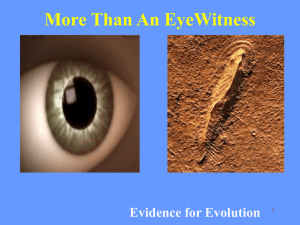
More Than An EyeWitness
... fin/wing, you would find very different bone structures. These organisms have adapted to similar environments. ...
... fin/wing, you would find very different bone structures. These organisms have adapted to similar environments. ...

Life_AdRdStdyWkBk_064
... • Food and other resources are limited. Members of a species must compete with each other for these resources. Some members of a species may not find enough to eat, so they do not survive. • Any difference between individuals of the same species is called a variation. • Some variations make individu ...
... • Food and other resources are limited. Members of a species must compete with each other for these resources. Some members of a species may not find enough to eat, so they do not survive. • Any difference between individuals of the same species is called a variation. • Some variations make individu ...

Name:_Answer Key_ Population and Diversity
... Type a 100-200 word summary about genetic drift and its impact on genetic diversity Rapid changes in gene frequencies totally independent of mutation, recombination, and natural selection. These changes are due solely to chance factors. The smaller the population, the more susceptible it is to such ...
... Type a 100-200 word summary about genetic drift and its impact on genetic diversity Rapid changes in gene frequencies totally independent of mutation, recombination, and natural selection. These changes are due solely to chance factors. The smaller the population, the more susceptible it is to such ...

Darwin`s Theory of Evolution
... By spraying crops with poisons to kill insect pests, humans have favored the reproduction of insects with inherited resistance to the poisons over those with no resistance. ...
... By spraying crops with poisons to kill insect pests, humans have favored the reproduction of insects with inherited resistance to the poisons over those with no resistance. ...


Darwin`s finches
... Darwinian natural selection The logic of The Origin of Species by Means of Natural Selection ...
... Darwinian natural selection The logic of The Origin of Species by Means of Natural Selection ...

WHAT TO KNOW FOR CH
... How might one species of finch evolved into 13 species on the Galapagos Islands? What is the estimated age of Earth? What are meteorites & why might they be important for the evolution of life on Earth? What was Oparin & Haldane’s hypothesis concerning the early Earth? What was the "primordial soup" ...
... How might one species of finch evolved into 13 species on the Galapagos Islands? What is the estimated age of Earth? What are meteorites & why might they be important for the evolution of life on Earth? What was Oparin & Haldane’s hypothesis concerning the early Earth? What was the "primordial soup" ...

ORGANIZATION AND CLASSIFICATION
... Observe each fruit and choose four characteristics by which you can tell the fruits apart. Label the columns in your table with these four characteristics. Fill out the chart. ...
... Observe each fruit and choose four characteristics by which you can tell the fruits apart. Label the columns in your table with these four characteristics. Fill out the chart. ...

Ch 23 Activity List File
... How do populations evolve over time? Study Questions: 1. Explain the statement “It is the population, not the individual, that evolves.” 2. Explain how Mendel’s particulate hypothesis of inheritance provided much-needed support for Darwin’s theory of evolution by natural selection. 3. Distinguish be ...
... How do populations evolve over time? Study Questions: 1. Explain the statement “It is the population, not the individual, that evolves.” 2. Explain how Mendel’s particulate hypothesis of inheritance provided much-needed support for Darwin’s theory of evolution by natural selection. 3. Distinguish be ...

natural selection and gene frequency
... GENE FREQUENCY ANALYSIS Our hypotheses were validated because the mutations affected allele frequencies significantly. The positive mutations led to an increase in population % whereas the negative mutations lead to a decrease in population %. Also, new species emerged with the introduction of the ...
... GENE FREQUENCY ANALYSIS Our hypotheses were validated because the mutations affected allele frequencies significantly. The positive mutations led to an increase in population % whereas the negative mutations lead to a decrease in population %. Also, new species emerged with the introduction of the ...

NATURAL SELECTION AND GENE FREQUENCY
... GENE FREQUENCY ANALYSIS Our hypotheses were validated because the mutations affected allele frequencies significantly. The positive mutations led to an increase in population % whereas the negative mutations lead to a decrease in population %. Also, new species emerged with the introduction of the ...
... GENE FREQUENCY ANALYSIS Our hypotheses were validated because the mutations affected allele frequencies significantly. The positive mutations led to an increase in population % whereas the negative mutations lead to a decrease in population %. Also, new species emerged with the introduction of the ...
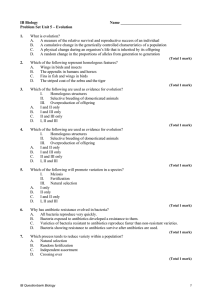
IB Biology Name Problem Set Unit 5 – Evolution 1. What is evolution
... If an adaptation to the environment is useful, an individual will develop it and pass it on to its offspring. D. Variations amongst individuals of a population are selected by a changing environment. ...
... If an adaptation to the environment is useful, an individual will develop it and pass it on to its offspring. D. Variations amongst individuals of a population are selected by a changing environment. ...

evolution: the highlights
... distribution, and paleoecological and systematic relationships of fossil organisms. Darwin recognized that the fossils from South America more closely resembled living South American forms than any other fossils known at the time. As for the second theory contained in The Origin of Species (the esse ...
... distribution, and paleoecological and systematic relationships of fossil organisms. Darwin recognized that the fossils from South America more closely resembled living South American forms than any other fossils known at the time. As for the second theory contained in The Origin of Species (the esse ...