
Notes with questions
... Seminal text: On the Origin of Species (1859) Note: genetics of inheritance unknown – Mendel in ...
... Seminal text: On the Origin of Species (1859) Note: genetics of inheritance unknown – Mendel in ...

25-Evolution
... grand scale Encompasses the origins of new species and major episodes of extinction ...
... grand scale Encompasses the origins of new species and major episodes of extinction ...

Chapter 22: History of Darwin`s Theory of Evolution – Part 2
... “weak” vs. “strong”(Strong traits would be beneficial in surviving and reproducing; whereas, weak traits would not be beneficial to reproducing or surviving the harsh characteristics of that environment.) B. Environmental stresses affect the success rate of individuals in a population in different ...
... “weak” vs. “strong”(Strong traits would be beneficial in surviving and reproducing; whereas, weak traits would not be beneficial to reproducing or surviving the harsh characteristics of that environment.) B. Environmental stresses affect the success rate of individuals in a population in different ...

The Organization of Life Section 2 A. Evolution by Natural Selection
... A. Evolution by Natural Selection • 1. English naturalist Charles Darwin observed that organisms in a population differ slightly from each other in form, function, and behavior. • 2. Some of these differences are hereditary. • Darwin proposed that the environment exerts a strong influence over which ...
... A. Evolution by Natural Selection • 1. English naturalist Charles Darwin observed that organisms in a population differ slightly from each other in form, function, and behavior. • 2. Some of these differences are hereditary. • Darwin proposed that the environment exerts a strong influence over which ...

Darwin`s Finches and Natural Selection
... CQ9: If beak depth increased during the drought, primarily due to selective mortality, can we really say that this natural selection was driven by environment favoring the survival of birds with deeper beaks? A: No. Beak depth changed due to birds dying, not to birds surviving. B: Yes. Birds with d ...
... CQ9: If beak depth increased during the drought, primarily due to selective mortality, can we really say that this natural selection was driven by environment favoring the survival of birds with deeper beaks? A: No. Beak depth changed due to birds dying, not to birds surviving. B: Yes. Birds with d ...

NOTES: Natural Selection
... _____________ is the changing of species over time. Organisms must _______________ to survive. Those organisms that are more ________ have more traits that help them survive. A trait that helps an organism survive is called an __________________. Since there is ______________ in a population, not al ...
... _____________ is the changing of species over time. Organisms must _______________ to survive. Those organisms that are more ________ have more traits that help them survive. A trait that helps an organism survive is called an __________________. Since there is ______________ in a population, not al ...

Evolution and Classification
... damage. These enzymes can have different metals as part of their structure. A study to compare two dismutases from Escherichia coli bacteria and two dismutases from eukaryotic cells was undertaken. The following enzymes were used: ...
... damage. These enzymes can have different metals as part of their structure. A study to compare two dismutases from Escherichia coli bacteria and two dismutases from eukaryotic cells was undertaken. The following enzymes were used: ...

Self-study Problems #1: Evolution
... The view that geological strata and fossils are explicable by the action of the same processes we observe today, like deposition of sand by a river, accumulating their effects over a very long period of time. 5. Is Darwin’s theory of evolution catastrophist, or uniformitarian? Why? Uniformitarian, b ...
... The view that geological strata and fossils are explicable by the action of the same processes we observe today, like deposition of sand by a river, accumulating their effects over a very long period of time. 5. Is Darwin’s theory of evolution catastrophist, or uniformitarian? Why? Uniformitarian, b ...

ORIGINS Genesis 1: 20-25 Session 7: Evolution Part 1
... “Not only has life evolved, but life has evolved to evolve. That is, correlations within protein structure have evolved, and mechanisms to manipulate these correlations have evolved in tandem. The rates at which the various events within the hierarchy of evolutionary moves occur are not random or ar ...
... “Not only has life evolved, but life has evolved to evolve. That is, correlations within protein structure have evolved, and mechanisms to manipulate these correlations have evolved in tandem. The rates at which the various events within the hierarchy of evolutionary moves occur are not random or ar ...

Sample Test Questions -- Midterm 2 - People
... 61. Death of some individuals due to dehydration in a desert would be an example of _____ selection. a. natural b. artificial c. sexual d. parental 62. Average beak size in one generation of Galapagos finches is associated with a. amount of rain the previous year b. average temperatures the previous ...
... 61. Death of some individuals due to dehydration in a desert would be an example of _____ selection. a. natural b. artificial c. sexual d. parental 62. Average beak size in one generation of Galapagos finches is associated with a. amount of rain the previous year b. average temperatures the previous ...

Station 2 - kroymbhs
... Observe Figure D and answer the following question. 1. Discuss the importance of fossils as a record of evolutionary change over time. The questions below relate to Figure E, showing a hypothetical rock profile from two locations separated by a distance of 67 km. There are some differences between t ...
... Observe Figure D and answer the following question. 1. Discuss the importance of fossils as a record of evolutionary change over time. The questions below relate to Figure E, showing a hypothetical rock profile from two locations separated by a distance of 67 km. There are some differences between t ...

Evolution: Fact or Theory?
... theory of evolution and determine exactly what are the facts. First, what exactly is the theory of evolution? For the answer, we must go to the source: Charles Darwin’s famous book, On the Origin of Species, published in 1859. Darwin claimed that the thousands of different species of animals, insect ...
... theory of evolution and determine exactly what are the facts. First, what exactly is the theory of evolution? For the answer, we must go to the source: Charles Darwin’s famous book, On the Origin of Species, published in 1859. Darwin claimed that the thousands of different species of animals, insect ...

Chapter 23: Microevolution
... one generation would lead to offspring with longer necks 5. understanding of genetic inheritance has led to rejection of acquired traits models D. birth of modern geology – Lyell, uniformitarianism, and the ancient Earth 1. prior to the early 1800s, the world view of most was that the Earth is very ...
... one generation would lead to offspring with longer necks 5. understanding of genetic inheritance has led to rejection of acquired traits models D. birth of modern geology – Lyell, uniformitarianism, and the ancient Earth 1. prior to the early 1800s, the world view of most was that the Earth is very ...

Natural Selection Notes
... • Those individuals are then also able to have more offspring. • If these traits are hereditary, then the offspring would also have these traits. • In the next generation, there will be more individuals with the beneficial trait. ...
... • Those individuals are then also able to have more offspring. • If these traits are hereditary, then the offspring would also have these traits. • In the next generation, there will be more individuals with the beneficial trait. ...

Student Resource 1: What is Evolution?
... specimens and wrote thousands of pages of notes. On his return he thought about his observations and consulted with others and the idea of evolution began to form. It was eight years later that Darwin wrote to Sir Joseph Hooker about his revolutionary idea, " At last gleams of light have come, and I ...
... specimens and wrote thousands of pages of notes. On his return he thought about his observations and consulted with others and the idea of evolution began to form. It was eight years later that Darwin wrote to Sir Joseph Hooker about his revolutionary idea, " At last gleams of light have come, and I ...

Unit 7 Test Review Natural Selection Test: Monday January 25th
... a scenario where you would observe this type of selection. 18. What does a graph look like of a population under disruptive selection? Describe a scenario where you would observe this type of selection. 19. What does a graph look like of a population under directional selection? Describe a scenario ...
... a scenario where you would observe this type of selection. 18. What does a graph look like of a population under disruptive selection? Describe a scenario where you would observe this type of selection. 19. What does a graph look like of a population under directional selection? Describe a scenario ...

Evolutionary Theory
... by Darwin’s Life Experiences: 3. Breeding and Selection • Darwin noticed that humans take advantage of the variations among organisms of the same species as they breed them • In other words, humans choose to breed the organisms with the “best” traits • Darwin called this artificial selection • What ...
... by Darwin’s Life Experiences: 3. Breeding and Selection • Darwin noticed that humans take advantage of the variations among organisms of the same species as they breed them • In other words, humans choose to breed the organisms with the “best” traits • Darwin called this artificial selection • What ...

Chapter 16 Population Genetics and Speciation
... Species: a single kind of organism. Members are morphologically similar (external structure and appearance) and can interbreed to produce fertile offspring. (biological species concept) ...
... Species: a single kind of organism. Members are morphologically similar (external structure and appearance) and can interbreed to produce fertile offspring. (biological species concept) ...
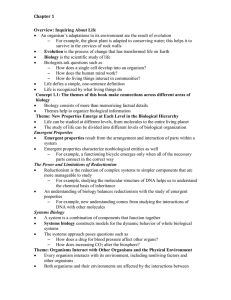
Chapter 1
... – For example, you replace your flashlight bulb, and it now works; this supports the hypothesis that your bulb was burnt out, but does not prove it (perhaps the first bulb was inserted incorrectly) Questions That Can and Cannot Be Addressed by Science ...
... – For example, you replace your flashlight bulb, and it now works; this supports the hypothesis that your bulb was burnt out, but does not prove it (perhaps the first bulb was inserted incorrectly) Questions That Can and Cannot Be Addressed by Science ...
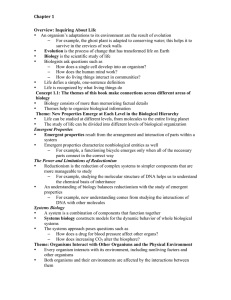
Chapter 1
... – For example, you replace your flashlight bulb, and it now works; this supports the hypothesis that your bulb was burnt out, but does not prove it (perhaps the first bulb was inserted incorrectly) Questions That Can and Cannot Be Addressed by Science ...
... – For example, you replace your flashlight bulb, and it now works; this supports the hypothesis that your bulb was burnt out, but does not prove it (perhaps the first bulb was inserted incorrectly) Questions That Can and Cannot Be Addressed by Science ...

A brief guide to Darwin`s theory of natural selection (evolution)
... What Darwin’s theory says Darwin did two things (1) convinced us that evolution actually occurs (2) provided an mechanism by how it occurs. Latter the more controversial. Darwins theory proceeds from three easy observations. - All species have variations within them. Individuals are not identical. - ...
... What Darwin’s theory says Darwin did two things (1) convinced us that evolution actually occurs (2) provided an mechanism by how it occurs. Latter the more controversial. Darwins theory proceeds from three easy observations. - All species have variations within them. Individuals are not identical. - ...

Natural Selection - Wando High School
... 12. A more complete definition of fitness is the ability to survive and produce offspring who can also survive and reproduce. Below are descriptions of four male lions. According to this definition of fitness, which lion would biologists consider the “fittest”? Explain why. ...
... 12. A more complete definition of fitness is the ability to survive and produce offspring who can also survive and reproduce. Below are descriptions of four male lions. According to this definition of fitness, which lion would biologists consider the “fittest”? Explain why. ...


Misconceptions - Local.brookings.k12.sd.us
... evolution can proceed at a relatively rapid pace under some circumstances. • “Darwinism” is continually being modified. Modification of theories to make them more representative of how things work is the role of scientists and of science itself. • Thus far, however, there have been no credible chall ...
... evolution can proceed at a relatively rapid pace under some circumstances. • “Darwinism” is continually being modified. Modification of theories to make them more representative of how things work is the role of scientists and of science itself. • Thus far, however, there have been no credible chall ...
