
Phil 306: Egoism and Altruism EVOLUTIONARY THEORY AND
... C. The survival of the fittest idea has been used as the basis of a social philosophy, “Social Darwinism” (Herbert Spencer), that departed substantially but not totally from Darwin’s own ideas. This social philosophy essentially rationalized the inequalities generated by capitalism as being a “natur ...
... C. The survival of the fittest idea has been used as the basis of a social philosophy, “Social Darwinism” (Herbert Spencer), that departed substantially but not totally from Darwin’s own ideas. This social philosophy essentially rationalized the inequalities generated by capitalism as being a “natur ...

Chapter 16 - Mrs. Pam Stewart
... Variations in the genotypes of a population arise by: mutation – changes in genes that occur either naturally or influenced by environment Passed to offspring if occurs in gametes Recombination – the law of independent assortment (chromosomes) and crossing over during meiosis random pairing ...
... Variations in the genotypes of a population arise by: mutation – changes in genes that occur either naturally or influenced by environment Passed to offspring if occurs in gametes Recombination – the law of independent assortment (chromosomes) and crossing over during meiosis random pairing ...

Ch 23 Populations
... Hardy-Weinberg equations. They do not realize that the Hardy-Weinberg theorem clarifies the factors that alter allele frequency, and that it does not imply that allele frequencies are static. These students do not appreciate that the Hardy-Weinberg equations are used with respect to a particular gen ...
... Hardy-Weinberg equations. They do not realize that the Hardy-Weinberg theorem clarifies the factors that alter allele frequency, and that it does not imply that allele frequencies are static. These students do not appreciate that the Hardy-Weinberg equations are used with respect to a particular gen ...

Evolution Challenges – Integrating Research and Practice in
... Evans, Karl S Rosengren, Jonathan D Lane, and Kristin LS Price, such constraints can both help and hinder learning. For example, by the time students encounter the idea of evolution, they already have some ideas about biological categories: children tend to think of species as fixed and discrete cat ...
... Evans, Karl S Rosengren, Jonathan D Lane, and Kristin LS Price, such constraints can both help and hinder learning. For example, by the time students encounter the idea of evolution, they already have some ideas about biological categories: children tend to think of species as fixed and discrete cat ...

Evolution, brain and the human mind
... The human mind is built from a multitude of cognitive structures specialized to solve particular issues (Panksepp, 1998). All these structures interact flexibly, helping us solve new and complex problems. Cognitive structures, as a result of the evolution process, are involved in the relation betwee ...
... The human mind is built from a multitude of cognitive structures specialized to solve particular issues (Panksepp, 1998). All these structures interact flexibly, helping us solve new and complex problems. Cognitive structures, as a result of the evolution process, are involved in the relation betwee ...

Evolution
... • Charles Darwin – 1859 published his theory of evolution in the major work, On the Origin of Species – Mechanism of Evolution = Natural Selection ...
... • Charles Darwin – 1859 published his theory of evolution in the major work, On the Origin of Species – Mechanism of Evolution = Natural Selection ...

Carlton le Willows learning cycle – GCSE Astronomy
... Describe the roles of Darwin and Wallace in developing the idea of Evolution through Natural Selection. Explain the process of natural selection with reference to examples in nature. How has the human species evolved? What are stone tools and how can they be used to chart human evolution? What is a ...
... Describe the roles of Darwin and Wallace in developing the idea of Evolution through Natural Selection. Explain the process of natural selection with reference to examples in nature. How has the human species evolved? What are stone tools and how can they be used to chart human evolution? What is a ...

Darwin`s Ideas of Natural Selection Exemplified
... In 1859, naturalist Charles Darwin published On the Origin of Species, which argued that organisms change over time or evolve based on genetic variation and natural selection of traits that allow for better survival and increased reproduction. In chapter ten of On the origin of Species, Darwin discu ...
... In 1859, naturalist Charles Darwin published On the Origin of Species, which argued that organisms change over time or evolve based on genetic variation and natural selection of traits that allow for better survival and increased reproduction. In chapter ten of On the origin of Species, Darwin discu ...

Science 8 Topic 6 - The Best Selection Name
... The diversity of life in the Galapagos Islands helped Darwin explain his theory of natural selection. It can be summed up in four statements: 1. All organisms produce more offspring than can possibly survive. 2. There is incredible variation within each species. 3. Some of the variations increase th ...
... The diversity of life in the Galapagos Islands helped Darwin explain his theory of natural selection. It can be summed up in four statements: 1. All organisms produce more offspring than can possibly survive. 2. There is incredible variation within each species. 3. Some of the variations increase th ...

Evolution/Geologic Time Questions
... back together and interbred. The offspring that they produced were now hybrids and were sterile. The two populations of fruit flies are now separated genetically. 17- This man studied many types of evolution in his lifetime and came up with the theory of Natural Selection. 18- Nature is considered t ...
... back together and interbred. The offspring that they produced were now hybrids and were sterile. The two populations of fruit flies are now separated genetically. 17- This man studied many types of evolution in his lifetime and came up with the theory of Natural Selection. 18- Nature is considered t ...

Spring 2012
... The stage of meiosis during which homologous chromosomes separate is: The most significant difference between mitosis and meiosis is: Genetic variation results from: Gregor Mendel deduced the laws of: Dr. Smith’s parents have normal hearing. However, Dr. Smith has an inherited form of deafness cause ...
... The stage of meiosis during which homologous chromosomes separate is: The most significant difference between mitosis and meiosis is: Genetic variation results from: Gregor Mendel deduced the laws of: Dr. Smith’s parents have normal hearing. However, Dr. Smith has an inherited form of deafness cause ...

Title of Unit
... a. Explain that physical characteristics of organisms have changed over successive generations (e.g. Darwin’s finches and peppered moths of Manchester). b. Describe ways in which species on earth have evolved due to natural selection. c. Trace evidence that the fossil record found in sedimentary roc ...
... a. Explain that physical characteristics of organisms have changed over successive generations (e.g. Darwin’s finches and peppered moths of Manchester). b. Describe ways in which species on earth have evolved due to natural selection. c. Trace evidence that the fossil record found in sedimentary roc ...

PPT
... collected previously unknown plants & animals; used Linnaeus’ taxonomy for classification Gregor Mendel – a botanist, considered the founder of modern genetics, concluded that characteristics are passed down from generation to generation ...
... collected previously unknown plants & animals; used Linnaeus’ taxonomy for classification Gregor Mendel – a botanist, considered the founder of modern genetics, concluded that characteristics are passed down from generation to generation ...

Heredity and Evolution - E
... For example- Hands of human beings and wings of birds. Analogous organs- Organs which have different basic structure and origin but have similar function are called analogous organs. For example(1) wing of bat and wing of bird. (2) wing of birds and wing of insect. ...
... For example- Hands of human beings and wings of birds. Analogous organs- Organs which have different basic structure and origin but have similar function are called analogous organs. For example(1) wing of bat and wing of bird. (2) wing of birds and wing of insect. ...

Practice worksheet
... antibiotics, the infection remains in the person’s lungs. 7a. 4 factors of evolution by natural selection: Identify the 4 factors in the ...
... antibiotics, the infection remains in the person’s lungs. 7a. 4 factors of evolution by natural selection: Identify the 4 factors in the ...

animal welfare - ELISTA Education
... Animals change to best suit their environment- we can become the environment…this happens during and after domestication ...
... Animals change to best suit their environment- we can become the environment…this happens during and after domestication ...

Principles of Evolution - AP Biology with Ms. Costigan
... Correlation of Species to Food Source ...
... Correlation of Species to Food Source ...

PPT File
... Genetic Drift, and Nonrandom Mating Result in Evolution Adaptation—a favored trait that evolves through natural selection. Adaptation also describes the process that produces the trait. Individuals with deleterious mutations are less likely to survive and reproduce and to pass their alleles on to th ...
... Genetic Drift, and Nonrandom Mating Result in Evolution Adaptation—a favored trait that evolves through natural selection. Adaptation also describes the process that produces the trait. Individuals with deleterious mutations are less likely to survive and reproduce and to pass their alleles on to th ...

Charles Darwin - CivFanatics Forums
... As much as Darwin could explain with his theory of evolution based on natural selection, there were still a number of holes in the theory; he could not explain where variations between individuals within a species came from, or the mechanism through which traits are passed on to the next generation. ...
... As much as Darwin could explain with his theory of evolution based on natural selection, there were still a number of holes in the theory; he could not explain where variations between individuals within a species came from, or the mechanism through which traits are passed on to the next generation. ...

Marco Trujillo Human Origins 1020 8/7/13 Professor Teri Potter
... During the twentieth century, genetics was integrated with Darwin’s mechanism, allowing us to evaluate natural selection as the differential survival and reproduction of genotypes, corresponding to particular phenotypes. Natural selection can only work on existing variation within a population. Such ...
... During the twentieth century, genetics was integrated with Darwin’s mechanism, allowing us to evaluate natural selection as the differential survival and reproduction of genotypes, corresponding to particular phenotypes. Natural selection can only work on existing variation within a population. Such ...

Unit 6 – Evolutionary Biology Part 3: Modes of Speciation (segue
... Permian–Triassic extinction event: 251 mya - Earth's largest extinction killed 57% of all families, 83% of all genera and 90% to 96% of all species. The "Great Dying" had enormous evolutionary significance: on land, it ended the primacy of mammal-like reptiles. The recovery of vertebrates took 30 mi ...
... Permian–Triassic extinction event: 251 mya - Earth's largest extinction killed 57% of all families, 83% of all genera and 90% to 96% of all species. The "Great Dying" had enormous evolutionary significance: on land, it ended the primacy of mammal-like reptiles. The recovery of vertebrates took 30 mi ...

Chapter 1 Intro
... • natural selection – ancestral species descendent species – Ex. finch species of Galápagos Islands ...
... • natural selection – ancestral species descendent species – Ex. finch species of Galápagos Islands ...
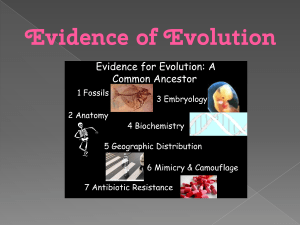
Evidence of Evolution
... Darwin’s Evidence What types of evidence did Darwin use to support his theory? › Today’s species are related to extinct species ⚫ Fossils show changes in species over time ⚫ Use of fossils and Relative Dating ...
... Darwin’s Evidence What types of evidence did Darwin use to support his theory? › Today’s species are related to extinct species ⚫ Fossils show changes in species over time ⚫ Use of fossils and Relative Dating ...

The influences of Buffon and Lyell on Darwin`s theory of evolution
... occurred gradually, over extended intervals of time. Lyell also provided the groundwork for another process which resulted in speciation via natural selection specifically, geographic isolation where a single population becomes geographically isolated and making them both reproductively isolate ...
... occurred gradually, over extended intervals of time. Lyell also provided the groundwork for another process which resulted in speciation via natural selection specifically, geographic isolation where a single population becomes geographically isolated and making them both reproductively isolate ...

Chapter 6 Study Guide CH 6-Concepts-Science
... change over time because it provides species with favorable traits a greater ability to survive the selective pressure across a wider variety of long term catastrophic or environmental changes. In addition to having a greater chance for survival, natural selection over long periods of time, (many g ...
... change over time because it provides species with favorable traits a greater ability to survive the selective pressure across a wider variety of long term catastrophic or environmental changes. In addition to having a greater chance for survival, natural selection over long periods of time, (many g ...