
Natural Selection
... • Environment does not create the adaptations in an individual (a common misconception) • Thus the ecology and evolution are linked in the lives of organisms ...
... • Environment does not create the adaptations in an individual (a common misconception) • Thus the ecology and evolution are linked in the lives of organisms ...

Evolution
... struggle for existance is not random, but depends in part on the hereditary constitution of surviving individuals. Those individuals whose characteristics fit them best to the environment are likely to leave more offspring than less fit individuals • Inference #3: The unequal survival and reproducti ...
... struggle for existance is not random, but depends in part on the hereditary constitution of surviving individuals. Those individuals whose characteristics fit them best to the environment are likely to leave more offspring than less fit individuals • Inference #3: The unequal survival and reproducti ...

Transitional Fossils, Natural Selection Myths, and Evolutionary Trees
... mesonychids. Many other details about informative features in the groups of whale antecedents are well presented, including bone thickness, oxygen isotope ratios in teeth, comparisons of ear bones, semicircular canal size, nasal bone reduction, and sizes & positions of orbits and other skeletal feat ...
... mesonychids. Many other details about informative features in the groups of whale antecedents are well presented, including bone thickness, oxygen isotope ratios in teeth, comparisons of ear bones, semicircular canal size, nasal bone reduction, and sizes & positions of orbits and other skeletal feat ...

9 Science Final Review – Applied
... genus orders species algae cocci fruiting body plasmodium asymmetrical ...
... genus orders species algae cocci fruiting body plasmodium asymmetrical ...
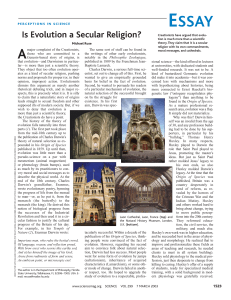
Is Evolution a Secular Religion?
... leads straight to sexual freedom and other supposed ills of modern society. But, if we wish to deny that evolution is more than just a scientific theory, the Creationists do have a point. The history of the theory of evolution falls naturally into three parts (1). The first part took place from the ...
... leads straight to sexual freedom and other supposed ills of modern society. But, if we wish to deny that evolution is more than just a scientific theory, the Creationists do have a point. The history of the theory of evolution falls naturally into three parts (1). The first part took place from the ...
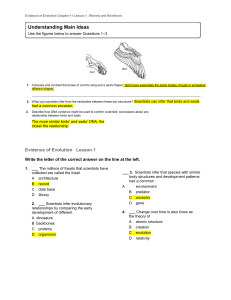
Chapter-11-Worshst-for-lessons-1-2-3-ANSWER
... 7. __True Without variation, all the members of a species would have the same traits. 8. domesticated To understand how evolution might occur, Darwin studied the offspring of wild animals that were produced by artificial selection. 9. _True In 1858, Alfred Russel Wallace and Charles Darwin proposed ...
... 7. __True Without variation, all the members of a species would have the same traits. 8. domesticated To understand how evolution might occur, Darwin studied the offspring of wild animals that were produced by artificial selection. 9. _True In 1858, Alfred Russel Wallace and Charles Darwin proposed ...


Darwinian Natural Selection (Ch. 3)
... • Groups are not a significant evolutionary unit (for most purposes) – Selection acts on individuals within a population – So selection does not produce adaptations that are “good for the group” or “good for the species” – If a trait promotes the reproduction of the individual that has it, then it i ...
... • Groups are not a significant evolutionary unit (for most purposes) – Selection acts on individuals within a population – So selection does not produce adaptations that are “good for the group” or “good for the species” – If a trait promotes the reproduction of the individual that has it, then it i ...

Evolution
... Conversely, individuals with harmful traits, like an inability to digest a nut that is the only food source, would not survive, and would not pass those traits to future generations. Darwin called this process “natural selection.” It is also sometimes known as “survival of the fittest,” but Darwin h ...
... Conversely, individuals with harmful traits, like an inability to digest a nut that is the only food source, would not survive, and would not pass those traits to future generations. Darwin called this process “natural selection.” It is also sometimes known as “survival of the fittest,” but Darwin h ...
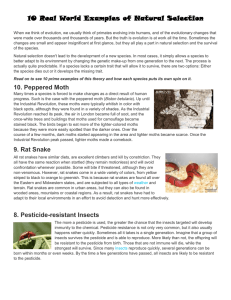
10 Real World Examples of Natural Selection
... about 9 percent of our genes are undergoing rapid evolution as we speak. The genes most affected by natural selection are those involving the immune system, sexual reproduction and sensory perception. Lactose intolerance is one example of natural selection. We are the only species that doesn't becom ...
... about 9 percent of our genes are undergoing rapid evolution as we speak. The genes most affected by natural selection are those involving the immune system, sexual reproduction and sensory perception. Lactose intolerance is one example of natural selection. We are the only species that doesn't becom ...

05 Lecture Evolution LO.10
... LECTURE 05 EVOLUTION Read CH6: 113-123; see also parts of CH 13 below MAJOR CONCEPTS 1) Organisms facing a changing environment can evolve only if genetic variation exists in population and natural selection favors alleles suitable for new environment. 2) The sources of genetic variation are mutatio ...
... LECTURE 05 EVOLUTION Read CH6: 113-123; see also parts of CH 13 below MAJOR CONCEPTS 1) Organisms facing a changing environment can evolve only if genetic variation exists in population and natural selection favors alleles suitable for new environment. 2) The sources of genetic variation are mutatio ...

Lecture Outline Ch 23 Natural Selection
... Can Natural Selection Be Studied Experimentally? 1. Candace Galen observed alpine skypilot plants above and below timberline. a. Plants growing in the treeless tundra above timberline have larger flowers with longer stalks, are sweet smelling, and are pollinated by bumblebees. b. Plants growing in t ...
... Can Natural Selection Be Studied Experimentally? 1. Candace Galen observed alpine skypilot plants above and below timberline. a. Plants growing in the treeless tundra above timberline have larger flowers with longer stalks, are sweet smelling, and are pollinated by bumblebees. b. Plants growing in t ...

Evolution Unit Review
... 32. What did the darker frogs have that the lighter ones did not? A. Acquired traits B. Vestigial organs C. Adaptations 33. The dark frogs had to have greater __________________ to survive and reproduce. A. Adaptation B. Fitness C. Coloration 34. The change in the frog population is a result of a d ...
... 32. What did the darker frogs have that the lighter ones did not? A. Acquired traits B. Vestigial organs C. Adaptations 33. The dark frogs had to have greater __________________ to survive and reproduce. A. Adaptation B. Fitness C. Coloration 34. The change in the frog population is a result of a d ...

Chapter 15 notes I. Darwin`s Voyage and Discovery A. 1809 Charles
... 3. Fittest individuals tend to leave the most offspring 4. Different reproductive success within a population 5. Population tends to produce more individuals than the environment can support (survival of the fittest) b. Natural selection is NOT based on 1. Making organisms ‘better’. a. Adaptations d ...
... 3. Fittest individuals tend to leave the most offspring 4. Different reproductive success within a population 5. Population tends to produce more individuals than the environment can support (survival of the fittest) b. Natural selection is NOT based on 1. Making organisms ‘better’. a. Adaptations d ...


Darwin–Lab - Mrs. Hoenshell Science 2016
... Name ___________________________________________ Per ________ Read the passage then answer the below questions before you complete your lab for today. What is Natural Selection? Natural selection is a term coined by Charles Darwin. It describes the way a species’ environment selects favorable traits ...
... Name ___________________________________________ Per ________ Read the passage then answer the below questions before you complete your lab for today. What is Natural Selection? Natural selection is a term coined by Charles Darwin. It describes the way a species’ environment selects favorable traits ...

Chapter 2 Review Questions
... 27. Although the sickle cell anemia mutation makes individuals sick, it provides resistance to malaria. Illness from sickle cell anemia is a better alternative than death from malaria, so the gene persists in the population. 28. The removal of malaria from the population would probably result in a ...
... 27. Although the sickle cell anemia mutation makes individuals sick, it provides resistance to malaria. Illness from sickle cell anemia is a better alternative than death from malaria, so the gene persists in the population. 28. The removal of malaria from the population would probably result in a ...


Misconceptions about Evolution
... survive and reproduce if they can move quickly through water. Speed helps them to capture prey and escape danger. Animals such as sharks, tuna, dolphins and ichthyosaurs have evolved streamlined body shapes that allow them to swim fast. As they evolved, individuals with more streamlined bodies were ...
... survive and reproduce if they can move quickly through water. Speed helps them to capture prey and escape danger. Animals such as sharks, tuna, dolphins and ichthyosaurs have evolved streamlined body shapes that allow them to swim fast. As they evolved, individuals with more streamlined bodies were ...

Tempo and mode - Integrative Biology
... Exaptation (previously called preadaptation): a structure that evolves and functions in one environmental context, but performs an additional function when placed in some new environment. The term is applied when a large change in function is accomplished with little change of structure. It is not c ...
... Exaptation (previously called preadaptation): a structure that evolves and functions in one environmental context, but performs an additional function when placed in some new environment. The term is applied when a large change in function is accomplished with little change of structure. It is not c ...

Evidence for NS
... comes in 2 forms – light and dark. During the Industrial Revolution, soot and ...
... comes in 2 forms – light and dark. During the Industrial Revolution, soot and ...

“Evolution” of Finch Beaks—Again
... variation within the animal kinds. Such effects are largely responsible for generating the tremendous diversity seen in the living world.7 In addition, as seen with G. magnirostris, natural selection leads to a decrease in genetic information and only those with already-present greater genetic varie ...
... variation within the animal kinds. Such effects are largely responsible for generating the tremendous diversity seen in the living world.7 In addition, as seen with G. magnirostris, natural selection leads to a decrease in genetic information and only those with already-present greater genetic varie ...

Sexual selection
... • How does this advantage arise? Through genetic mutation. • If the mutation can be passed down, it’s considered heritable. • Because the mutation confers an advantage, it’s known as an adaptation. • Heritable adaptations then spread through the population, increasing in frequency until potentially ...
... • How does this advantage arise? Through genetic mutation. • If the mutation can be passed down, it’s considered heritable. • Because the mutation confers an advantage, it’s known as an adaptation. • Heritable adaptations then spread through the population, increasing in frequency until potentially ...

SB5 - Bibb County Schools
... 1)Some viral diseases require only one vaccination, which lasts for years. For other diseases like the flu, vaccinations last only one season. The flu vaccine lasts such a short time because the flu virus A) is more easily transmitted B) mutates much more rapidly C) is less dangerous D) is much smal ...
... 1)Some viral diseases require only one vaccination, which lasts for years. For other diseases like the flu, vaccinations last only one season. The flu vaccine lasts such a short time because the flu virus A) is more easily transmitted B) mutates much more rapidly C) is less dangerous D) is much smal ...