
I have put together a recommendation for teacher
... 12. Which statement best describes the current understanding of natural selection? A. Natural selection influences the frequency of adaptive traits in a population. B. Changes in gene frequencies due to natural selection have little effect on evolution. C. Natural selection has been discarded as an ...
... 12. Which statement best describes the current understanding of natural selection? A. Natural selection influences the frequency of adaptive traits in a population. B. Changes in gene frequencies due to natural selection have little effect on evolution. C. Natural selection has been discarded as an ...

Basis of Darwinism
... Basis of Darwinism 1. Organisms vary 2. Some of that variation is inherited 3. All organisms produce more offspring than can survive 4. On the average, those that survive will be the ones better adapted or suited to local environments (natural selection) N.B. As environments change, different charac ...
... Basis of Darwinism 1. Organisms vary 2. Some of that variation is inherited 3. All organisms produce more offspring than can survive 4. On the average, those that survive will be the ones better adapted or suited to local environments (natural selection) N.B. As environments change, different charac ...

The Tempo of Macroevolution
... Tempo and Mode in Evolutionary Thought Darwin’s embrace of Lyellian uniformitarianism meant that small-scale, observable change in modern populations was responsible for all evolutionary changes in the history of life. As Gould pointed out, this limited paleontology to documenting the history of lif ...
... Tempo and Mode in Evolutionary Thought Darwin’s embrace of Lyellian uniformitarianism meant that small-scale, observable change in modern populations was responsible for all evolutionary changes in the history of life. As Gould pointed out, this limited paleontology to documenting the history of lif ...

Evolution and Religion: Why they are not Mutually Exclusive
... • “For the reasons that follow, we conclude that the religious nature of ID would be readily apparent to an objective observer, adult or child.” • “The evidence at trial demonstrates that ID is nothing less than the progeny of creationism.” • “. . . it is additionally important to note that ID has f ...
... • “For the reasons that follow, we conclude that the religious nature of ID would be readily apparent to an objective observer, adult or child.” • “The evidence at trial demonstrates that ID is nothing less than the progeny of creationism.” • “. . . it is additionally important to note that ID has f ...

darwin
... • On the Galapagos Islands, Darwin observed species that lived no where else in the world. • These observations led Darwin to write a book. ...
... • On the Galapagos Islands, Darwin observed species that lived no where else in the world. • These observations led Darwin to write a book. ...

Let`s Focus On Evolution! - Evolution or Not by Former Judge
... contrivances for adjusting the focus to different distances, for admitting different amounts of light, and for the correction of spherical and chromatic aberration, could have been formed by natural selection, seems, I confess, “absurd” (emphasis supplied) in the highest degree." Biology Textbooks a ...
... contrivances for adjusting the focus to different distances, for admitting different amounts of light, and for the correction of spherical and chromatic aberration, could have been formed by natural selection, seems, I confess, “absurd” (emphasis supplied) in the highest degree." Biology Textbooks a ...

Darwin, Mendel, and the Rise of the Synthetic Theory
... does not affect the distribution of alleles for another trait ...
... does not affect the distribution of alleles for another trait ...

Physical Anthropology the nature of science
... • A system does not require a higher authority to regulate a system itself ...
... • A system does not require a higher authority to regulate a system itself ...

Theory of Evolution & Natural Selection
... Theory • In science, theories are statements or models that are used to support facts. • Theories have some important properties: – They explain a wide variety of data and observations – They can be used to make predictions – They are not absolute, they serve as a model of understanding the world a ...
... Theory • In science, theories are statements or models that are used to support facts. • Theories have some important properties: – They explain a wide variety of data and observations – They can be used to make predictions – They are not absolute, they serve as a model of understanding the world a ...

natural selection and gene frequency
... ANALYSIS Our hypotheses were validated because the mutations affected allele frequencies significantly. The positive mutations led to an increase in population % whereas the negative mutations lead to a decrease in population %. Also, new species emerged with the introduction of the dominant black • ...
... ANALYSIS Our hypotheses were validated because the mutations affected allele frequencies significantly. The positive mutations led to an increase in population % whereas the negative mutations lead to a decrease in population %. Also, new species emerged with the introduction of the dominant black • ...

Topic: Evolution
... • Survival & reproduction of those organisms best adapted to their surroundings ...
... • Survival & reproduction of those organisms best adapted to their surroundings ...

NATURAL SELECTION AND GENE FREQUENCY
... ANALYSIS Our hypotheses were validated because the mutations affected allele frequencies significantly. The positive mutations led to an increase in population % whereas the negative mutations lead to a decrease in population %. Also, new species emerged with the introduction of the dominant black • ...
... ANALYSIS Our hypotheses were validated because the mutations affected allele frequencies significantly. The positive mutations led to an increase in population % whereas the negative mutations lead to a decrease in population %. Also, new species emerged with the introduction of the dominant black • ...

Evolution study guide answer key
... and helped Darwin realize that selective pressures exist for all organisms and that all organisms that survive, survive because they all well adapted to their environment. b. What type of evidence (that is available today) did Darwin lack that help support his theory Darwin did not know how organism ...
... and helped Darwin realize that selective pressures exist for all organisms and that all organisms that survive, survive because they all well adapted to their environment. b. What type of evidence (that is available today) did Darwin lack that help support his theory Darwin did not know how organism ...

Life Over Time - chapter 6
... A. Scientists explore the concept of evolution. 1. Early ideas – Lamarck (acquired traits) 2. Darwin’s observations Galapagos Island tortoises – neck length ...
... A. Scientists explore the concept of evolution. 1. Early ideas – Lamarck (acquired traits) 2. Darwin’s observations Galapagos Island tortoises – neck length ...

Workshop on Macroevolution
... would, over the immensity of geological time, bring about ancestor-to-descendent evolutionary change. To use his expression, it would result in "descent with modification." Darwin was thus an advocate of phyletic gradualism, the idea that evolution is a consequence of the culmination over many gener ...
... would, over the immensity of geological time, bring about ancestor-to-descendent evolutionary change. To use his expression, it would result in "descent with modification." Darwin was thus an advocate of phyletic gradualism, the idea that evolution is a consequence of the culmination over many gener ...

Quiz 1- Natural Selection and Adaptations
... Part II. DIRECTIONS: There are 4 main principles to the theory of natural selection. Write the correct PRINCIPLE in the space next to its DEFINITION. Not all terms will be used. Wordbank: Adaptation, Mutation, Descent with modification, Overproduction, Speciation, Variation. PRINCIPLE ...
... Part II. DIRECTIONS: There are 4 main principles to the theory of natural selection. Write the correct PRINCIPLE in the space next to its DEFINITION. Not all terms will be used. Wordbank: Adaptation, Mutation, Descent with modification, Overproduction, Speciation, Variation. PRINCIPLE ...
A.P. Psychology 3-C (D) - Evolutionary Psychology
... that humans have changed physically due to Natural Selection? ...
... that humans have changed physically due to Natural Selection? ...

Honors Biology Chapter 3 – The Process of Science: Studying
... 1. species of organisms living on Earth today descended from ancestral species 2. descendants of the earliest organisms spread into various habitats over millions of years 3. In these habitats, they accum. diff. modifications, or adaptations, to diverse ways of life 4. descent with modification as a ...
... 1. species of organisms living on Earth today descended from ancestral species 2. descendants of the earliest organisms spread into various habitats over millions of years 3. In these habitats, they accum. diff. modifications, or adaptations, to diverse ways of life 4. descent with modification as a ...

chapter 13 - Fullfrontalanatomy.com
... 1. _________________ structures provide evidence of common ancestry (Figure 13-8) 2. Functionless structures are _____________ from ancestors (Figure 13-9) 3. Some anatomical similarities result from _____________ in similar ___________________ (Figure 13-10) C. ___________________ Similarity Sugges ...
... 1. _________________ structures provide evidence of common ancestry (Figure 13-8) 2. Functionless structures are _____________ from ancestors (Figure 13-9) 3. Some anatomical similarities result from _____________ in similar ___________________ (Figure 13-10) C. ___________________ Similarity Sugges ...
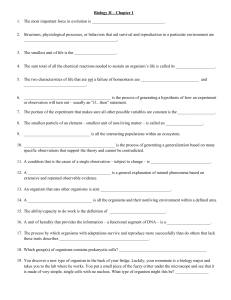
Biology II – Chapter 1 Study Guide
... 12. A ________________________________________ is a general explanation of natural phenomena based on extensive and repeated observable evidence. 13. An organism that eats other organisms is a(n) __________________________________. 14. A _______________________________ is all the organisms and their ...
... 12. A ________________________________________ is a general explanation of natural phenomena based on extensive and repeated observable evidence. 13. An organism that eats other organisms is a(n) __________________________________. 14. A _______________________________ is all the organisms and their ...

BioB 6W2 Review (divide by 4.9)
... the following key to identify the organisms' above: 1a The critter has flat sides – go to 3 1b The critter has rounded sides – go to 2 2a The critter is open in the center - Foramen aperire 2b The critter is solid in the center - Implevit circuli 3a The critter is triangular in shape – Triangulum iu ...
... the following key to identify the organisms' above: 1a The critter has flat sides – go to 3 1b The critter has rounded sides – go to 2 2a The critter is open in the center - Foramen aperire 2b The critter is solid in the center - Implevit circuli 3a The critter is triangular in shape – Triangulum iu ...

Evidence of Species Change
... Grant, British evolutionary biologists have spent six months of the year each year since 1973 capturing, tagging, and taking blood samples of the finches on the island. They have demonstrated how very rapid changes in body and beak size in response to changes in the food supply are driven by natu ...
... Grant, British evolutionary biologists have spent six months of the year each year since 1973 capturing, tagging, and taking blood samples of the finches on the island. They have demonstrated how very rapid changes in body and beak size in response to changes in the food supply are driven by natu ...

Chapter 15 Evolution
... Darwin saw during his travels first suggested evolution to Darwin. Rabbit in Europe ...
... Darwin saw during his travels first suggested evolution to Darwin. Rabbit in Europe ...

EaB 2.7 - 2011MrsHerbertYear11Biology
... unrelated organisms, such as marsupials (isolated in Australia) and placentals form other parts of the world. Marsupials and placentals that live in similar environments and have similar ways of life (similar niches) resemble each other structurally and physiologically. This similarity in unrelated ...
... unrelated organisms, such as marsupials (isolated in Australia) and placentals form other parts of the world. Marsupials and placentals that live in similar environments and have similar ways of life (similar niches) resemble each other structurally and physiologically. This similarity in unrelated ...

Darwin - Integrative Biology
... From the late 1700’s a large fossil record started to accumulate; changes in characteristics can be seen in fossils. Also, it was observed that species could go extinct, and that new species could appear. The study of fossils led to the realization that major changes had occurred in the earth's his ...
... From the late 1700’s a large fossil record started to accumulate; changes in characteristics can be seen in fossils. Also, it was observed that species could go extinct, and that new species could appear. The study of fossils led to the realization that major changes had occurred in the earth's his ...