
Ch. 15 Darwin`s Theory of Evolution
... Another influence of Darwin was Thomas Malthus. This scientist published a book in which he stated that babies were being born faster than people were dying. – Sooner or later food and living space will run out. ...
... Another influence of Darwin was Thomas Malthus. This scientist published a book in which he stated that babies were being born faster than people were dying. – Sooner or later food and living space will run out. ...

Reading Guide: Chapter 9: Evolution
... 2. Why don’t we present the idea of special creation in science classes? 3. What are 4 possible hypotheses about the relationships among organisms on Earth, and how do they differ from each other? Biological Classification Suggests Evolutionary Relationships (p 234) 1. What are some of the similarit ...
... 2. Why don’t we present the idea of special creation in science classes? 3. What are 4 possible hypotheses about the relationships among organisms on Earth, and how do they differ from each other? Biological Classification Suggests Evolutionary Relationships (p 234) 1. What are some of the similarit ...

Final Test Review
... 18. Natural selection is also known as ____________. 19. The number of times an allele occurs in a gene pool compared with the number of times other alleles for the same gene occurs is ________. 20. All individuals of the same species in a given area form a __________. True/False – make the statemen ...
... 18. Natural selection is also known as ____________. 19. The number of times an allele occurs in a gene pool compared with the number of times other alleles for the same gene occurs is ________. 20. All individuals of the same species in a given area form a __________. True/False – make the statemen ...

What is the Hierarchy Theory of Evolution?
... the first time from depending solely upon the resources afforded by their local ecosystems, and Homo sapiens became the first species whose local populations did not have ecological niches – and indeed were living outside local ecosystems. This condition underlies the nature of much of global human ...
... the first time from depending solely upon the resources afforded by their local ecosystems, and Homo sapiens became the first species whose local populations did not have ecological niches – and indeed were living outside local ecosystems. This condition underlies the nature of much of global human ...

Chapter 16: Evolutionary Theory Section 1: Developing a Theory A
... 2. Evidence of Natural Selection & Evolution a. Fossils – traces of organisms that lived in the past. May be preserved in sedimentary rocks, encased in tree sap that turned into amber, or bones that have been replaced by minerals. What evidence do we have to support Darwin’s idea that whales desce ...
... 2. Evidence of Natural Selection & Evolution a. Fossils – traces of organisms that lived in the past. May be preserved in sedimentary rocks, encased in tree sap that turned into amber, or bones that have been replaced by minerals. What evidence do we have to support Darwin’s idea that whales desce ...

Evolution Information
... 1. All species of plants and animals are capable of change 2. Organisms change from generation to generation depending on which characteristics they inherit 3. Offspring that inherit the most useful characteristics for a particular environment, have increase chances for survival ...
... 1. All species of plants and animals are capable of change 2. Organisms change from generation to generation depending on which characteristics they inherit 3. Offspring that inherit the most useful characteristics for a particular environment, have increase chances for survival ...


Aristotle Carolus Linnaeus Carolus Linnaeus
... • Variant traits may be inherited (Darwin didn’t know how) • Malthus’s Principle of Overproduction implies that many individuals must die or fail to reproduce • Individuals slightly better suited to their environment must be more likely to survive ...
... • Variant traits may be inherited (Darwin didn’t know how) • Malthus’s Principle of Overproduction implies that many individuals must die or fail to reproduce • Individuals slightly better suited to their environment must be more likely to survive ...

OGT Prep 2 - HensonsBiologyPage
... g. Humans select organisms with desirable traits to interbreed and pass those traits to the next generation h. Organisms which have certain traits that help them survive are more likely to pass those traits onto their offspring j. It is when nature selects traits that will most help an organism surv ...
... g. Humans select organisms with desirable traits to interbreed and pass those traits to the next generation h. Organisms which have certain traits that help them survive are more likely to pass those traits onto their offspring j. It is when nature selects traits that will most help an organism surv ...
BSC 1005
... – Almost all flasks treated this way remained free of bacterial growth as long as the neck was unbroken – When Pasteur tilted the flask so that the broth reached the lowest point in the neck, where any airborne particles would have settled, the broth rapidly became cloudy with life – Concluded that ...
... – Almost all flasks treated this way remained free of bacterial growth as long as the neck was unbroken – When Pasteur tilted the flask so that the broth reached the lowest point in the neck, where any airborne particles would have settled, the broth rapidly became cloudy with life – Concluded that ...

Variation and natural selection versus evolution
... be expected from copying errors, destroyed some of the original genetic information. Many evolutionists point to allegedly imperfect structures as ‘proof’ of evolution, although this is really an argument against perfect design rather than for evolution. But many allegedly imperfect structures can a ...
... be expected from copying errors, destroyed some of the original genetic information. Many evolutionists point to allegedly imperfect structures as ‘proof’ of evolution, although this is really an argument against perfect design rather than for evolution. But many allegedly imperfect structures can a ...

Honors Biology Test Review
... b. Define and explain mimicry and camouflage as examples of evidence for evolution. c. Describe how the fossil record accounts for the “time” part of the definition of evolution. d. Define homologous structure, analogous structure, and vestigial structure and describe how each is used as evidence fo ...
... b. Define and explain mimicry and camouflage as examples of evidence for evolution. c. Describe how the fossil record accounts for the “time” part of the definition of evolution. d. Define homologous structure, analogous structure, and vestigial structure and describe how each is used as evidence fo ...

Theory of Evolution - Council Rock School District
... – Cuvier and Lyell strongly disagreed with one another about how the Earth changed over time, but neither accepted the Church’s view either. Cuvier did not live long enough, but Lyell in time came to support Darwin’s work on biological evolution. They remained friends up until Darwin’s death ...
... – Cuvier and Lyell strongly disagreed with one another about how the Earth changed over time, but neither accepted the Church’s view either. Cuvier did not live long enough, but Lyell in time came to support Darwin’s work on biological evolution. They remained friends up until Darwin’s death ...

Lesson Plan
... Natural selection leads to organisms that are well suited for survival in particular environments. Chance alone can result in the persistence of some heritable characteristics having no survival or reproductive advantage or disadvantage for the organism. When an environment changes, the survival val ...
... Natural selection leads to organisms that are well suited for survival in particular environments. Chance alone can result in the persistence of some heritable characteristics having no survival or reproductive advantage or disadvantage for the organism. When an environment changes, the survival val ...

Biological Evolution
... The _____________ _____________ provides information regarding the dates and order of ____________ for phylogenies. ____________ fossils are fossils that show links in traits between groups of organisms used to document intermediate stages in the evolution of a species. o They _________ evolutio ...
... The _____________ _____________ provides information regarding the dates and order of ____________ for phylogenies. ____________ fossils are fossils that show links in traits between groups of organisms used to document intermediate stages in the evolution of a species. o They _________ evolutio ...

Populations PP
... might not inherit alleles for any trait. Mutation also leads to new alleles. New alleles may come as a result of genetic recombination during sexual reproduction. ...
... might not inherit alleles for any trait. Mutation also leads to new alleles. New alleles may come as a result of genetic recombination during sexual reproduction. ...
Lahti, David
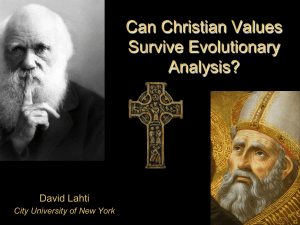
... ancient behavioral tendencies? 2. Evolutionary lag • ~100 generations of consistent natural selection = 2000 years! • Modern technology and cultural practices would have to continue for many hundreds of years to have an evolutionary effect • No genetic inheritance of acquired traits • Cultural c ...
... ancient behavioral tendencies? 2. Evolutionary lag • ~100 generations of consistent natural selection = 2000 years! • Modern technology and cultural practices would have to continue for many hundreds of years to have an evolutionary effect • No genetic inheritance of acquired traits • Cultural c ...


Domain
... Bacteria evolve much faster than complex cells The rate of evolution also differs within the same group of species In punctuated equilibrium, evolution occurs in spurts In gradualism, evolution occurs in a gradual, uniform way ...
... Bacteria evolve much faster than complex cells The rate of evolution also differs within the same group of species In punctuated equilibrium, evolution occurs in spurts In gradualism, evolution occurs in a gradual, uniform way ...

Go forth, evolve and prosper: the genetic basis of adaptive evolution
... evidence for genetically based evolutionary change. Shifts in allele frequencies could be caused by selection or could be the result of neutral processes, such as genetic bottlenecks and founder effects, which could certainly occur in an introduced species. However, this study provides several lines ...
... evidence for genetically based evolutionary change. Shifts in allele frequencies could be caused by selection or could be the result of neutral processes, such as genetic bottlenecks and founder effects, which could certainly occur in an introduced species. However, this study provides several lines ...


Misconceptions about Evolution
... evolution can proceed at a relatively rapid pace under some circumstances. In this sense, Darwinism is continually being modified. Modification of theories to make them more representative of how things work is the role of scientists and of science itself. Thus far, however, there have been no credi ...
... evolution can proceed at a relatively rapid pace under some circumstances. In this sense, Darwinism is continually being modified. Modification of theories to make them more representative of how things work is the role of scientists and of science itself. Thus far, however, there have been no credi ...


CHS H Bio Study Guide/Reading Questions for Evolution Chapters
... 1. What is a species? What is speciation? 2. What is reproductive isolation and how does it happen? What can result from this process? ...
... 1. What is a species? What is speciation? 2. What is reproductive isolation and how does it happen? What can result from this process? ...

What is Evolution?
... excavated and modern forms of the same creatures and noted the adaptation of animals to their environments. On the expedition he collected numerous specimens and wrote thousands of pages of notes. On his return he thought about his observations and consulted with others and the idea of evolution beg ...
... excavated and modern forms of the same creatures and noted the adaptation of animals to their environments. On the expedition he collected numerous specimens and wrote thousands of pages of notes. On his return he thought about his observations and consulted with others and the idea of evolution beg ...