
Population evolution
... ◦ Organisms may possess traits that make them more suitable to their environment. Those individuals survive, pass on those traits to future generations. (survival of the fittest) ◦ Requires genetic variation within a species. ◦ Is the process that leads to evolution (natural selection over many gene ...
... ◦ Organisms may possess traits that make them more suitable to their environment. Those individuals survive, pass on those traits to future generations. (survival of the fittest) ◦ Requires genetic variation within a species. ◦ Is the process that leads to evolution (natural selection over many gene ...

5.4: Evolution - HS Biology IB
... species produce more offspring that can survive; populations will show variation; individuals with favourable traits will survive; some variations are inherited; favourable (inherited) variations will increase in numbers; accept converse answer environmental changes will provide further selection; s ...
... species produce more offspring that can survive; populations will show variation; individuals with favourable traits will survive; some variations are inherited; favourable (inherited) variations will increase in numbers; accept converse answer environmental changes will provide further selection; s ...

Study Guide / Tips for Test
... Down 1. The animal that Darwin studied in detail during his travels to South America 2. One of Darwin's Six Main Points that discusses that living space and food are limited, so offspring from each generation must compete among themselves in order to live 3. An organism that was studied to model nat ...
... Down 1. The animal that Darwin studied in detail during his travels to South America 2. One of Darwin's Six Main Points that discusses that living space and food are limited, so offspring from each generation must compete among themselves in order to live 3. An organism that was studied to model nat ...

AS Variation - Skinners` School Physics
... Some differences enable the organism to survive better (compete more successfully, what for?) The ones with beneficial alleles survive, breed and pass on their alleles to the next generation Those without beneficial alleles die before they reproduce (why?) so their alleles are less likely to be pass ...
... Some differences enable the organism to survive better (compete more successfully, what for?) The ones with beneficial alleles survive, breed and pass on their alleles to the next generation Those without beneficial alleles die before they reproduce (why?) so their alleles are less likely to be pass ...

it did not explain how favorable traits were passed to offspring
... Each generation of a population will consist of... a mixture of individuals with more favorable traits and individuals with less favorable traits The overall characteristics of the population will change to reflect this better adaptation to the environment. The major problem with this theory was… it ...
... Each generation of a population will consist of... a mixture of individuals with more favorable traits and individuals with less favorable traits The overall characteristics of the population will change to reflect this better adaptation to the environment. The major problem with this theory was… it ...

Evolution is the biological history of life on Earth, from the earliest
... Adaptation: any inheritable trait that increases an individual’s ability to survive or reproduce (in a particular environment) compared to organisms that do not have that trait. The History of Evolutionary Theory: Steps Leading to Charles Darwin’s Theory The work of many scientists led to the develo ...
... Adaptation: any inheritable trait that increases an individual’s ability to survive or reproduce (in a particular environment) compared to organisms that do not have that trait. The History of Evolutionary Theory: Steps Leading to Charles Darwin’s Theory The work of many scientists led to the develo ...

Unit 9: Populations and Evolution
... some individuals in the population of trout to swim faster than others. The population density for the trout with this adaptation is shown to be increasing each year, whereas the population of the small tail trout appear to be decreasing. This is probably an example of ____. a. Overproduction of off ...
... some individuals in the population of trout to swim faster than others. The population density for the trout with this adaptation is shown to be increasing each year, whereas the population of the small tail trout appear to be decreasing. This is probably an example of ____. a. Overproduction of off ...

Darwin - APESBioassign
... social scientist who proposed theories on factors controlling population growth: People have more children than are able to survive. There are built-in population checks: disease, famine, and war. ...
... social scientist who proposed theories on factors controlling population growth: People have more children than are able to survive. There are built-in population checks: disease, famine, and war. ...
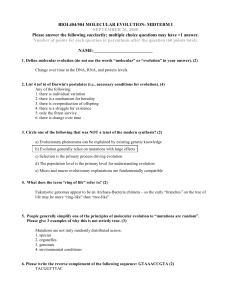
BIOL404/504 MOLECULAR EVOLUTION
... 1. there is individual variation 2. there is a mechanism for heredity 3. there is overproduction of offspring 4. there is a struggle for existence 5. only the fittest survive 6. there is change over time 3. Circle one of the following that was NOT a tenet of the modern synthesis? (2) a) Evolutionary ...
... 1. there is individual variation 2. there is a mechanism for heredity 3. there is overproduction of offspring 4. there is a struggle for existence 5. only the fittest survive 6. there is change over time 3. Circle one of the following that was NOT a tenet of the modern synthesis? (2) a) Evolutionary ...

Biology EVOLUTION Practice Test with Answer Key
... It was only very recently determined that giant pandas are much more closely related to bears, than to raccoons. Before this, many scientists believed that they were large members of the raccoon family. What is the best piece of evidence, that was probably used to re-classify giant pandas with bears ...
... It was only very recently determined that giant pandas are much more closely related to bears, than to raccoons. Before this, many scientists believed that they were large members of the raccoon family. What is the best piece of evidence, that was probably used to re-classify giant pandas with bears ...

Quiz 4 - Lone Star College
... 18) Genetic variations in natural populations develop due to: A) random mutations of the DNA. B) environmental catastrophies. C) changes in the environment. D) individual activities. E) changes in diet. ...
... 18) Genetic variations in natural populations develop due to: A) random mutations of the DNA. B) environmental catastrophies. C) changes in the environment. D) individual activities. E) changes in diet. ...

Evolution
... * Elsie’s natural variation is to produce more milk than Bessie * Which cow would the farmer use to reproduce offspring? Why? ...
... * Elsie’s natural variation is to produce more milk than Bessie * Which cow would the farmer use to reproduce offspring? Why? ...

Evolution by Natural Selection Evolution by Natural Selection
... superior physical, behavioral, or other traits are more likely to survive than those that are not so well-endowed. By surviving, they gain the opportunity to pass on their favorable characteristics to their offspring. As the frequency of these characteristics increases in the population, the nature ...
... superior physical, behavioral, or other traits are more likely to survive than those that are not so well-endowed. By surviving, they gain the opportunity to pass on their favorable characteristics to their offspring. As the frequency of these characteristics increases in the population, the nature ...

WHAT DOES “EVOLUTION” MEAN?
... 2. When food became scarce, longer-necked individuals could reach more food sources so they survived in greater numbers than those with shorter necks, many of whom starved and died. – more long necks survived, so more reproduced and passed the long-necked trait to their offspring. – each generation ...
... 2. When food became scarce, longer-necked individuals could reach more food sources so they survived in greater numbers than those with shorter necks, many of whom starved and died. – more long necks survived, so more reproduced and passed the long-necked trait to their offspring. – each generation ...

Universal Darwinism www.AssignmentPoint.com Universal
... intelligence as fundamental processes of selection. His aim was to explain the development of science and other forms of knowledge by focusing on the variation and selection of ideas and theories, thus laying the basis for the domain of evolutionary epistemology. In the 1990s, Campbell's formulation ...
... intelligence as fundamental processes of selection. His aim was to explain the development of science and other forms of knowledge by focusing on the variation and selection of ideas and theories, thus laying the basis for the domain of evolutionary epistemology. In the 1990s, Campbell's formulation ...

Evolution and the History of Life
... • the more migration or interbreeding occurs between two population, the more rapidly they become similar • gene flow is important because it explains how a species like humans can be essentially the same all around the world ...
... • the more migration or interbreeding occurs between two population, the more rapidly they become similar • gene flow is important because it explains how a species like humans can be essentially the same all around the world ...

2-6-17 Evolution Outline Packet 1
... routinely it must be of importance and therefore that body part will be passed on to the next generation. If an organism does not use a body part, it will disappear over time because it must not be important. (This is the part he got wrong… if it were true, think about body builders with their massi ...
... routinely it must be of importance and therefore that body part will be passed on to the next generation. If an organism does not use a body part, it will disappear over time because it must not be important. (This is the part he got wrong… if it were true, think about body builders with their massi ...
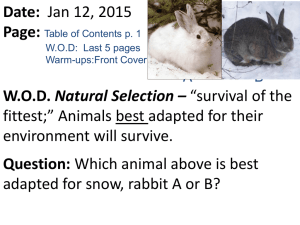
bio 1_13_15 natural selection
... species geographically and historically, and why (or why not) they are found in a geographical area. • Look at page 383 in your text. • What land is shared by two rodent species? • Why do you think rodent species in the Americas are divided into different ranges? or 832 ...
... species geographically and historically, and why (or why not) they are found in a geographical area. • Look at page 383 in your text. • What land is shared by two rodent species? • Why do you think rodent species in the Americas are divided into different ranges? or 832 ...

Diversity of Life
... survive and pass their traits to future offspring. Over time – due to environmental changes, some populations will change, leading to the formation of new species. ...
... survive and pass their traits to future offspring. Over time – due to environmental changes, some populations will change, leading to the formation of new species. ...

Evolution
... • Evolution is an undirected process, constrained – by physical laws (such as gravity) – by genetics (which might, for example, encode the directions for building breathing organs in a particular way), and – by the environment (which might not, for example, contain a niche for a large, slow-moving, ...
... • Evolution is an undirected process, constrained – by physical laws (such as gravity) – by genetics (which might, for example, encode the directions for building breathing organs in a particular way), and – by the environment (which might not, for example, contain a niche for a large, slow-moving, ...

Speciation
... Populations can be recognized as distinct species if they are reproductively isolated from each other, if they have distinct morphological characteristics, or if they form independent branches on a phylogenetic tree. ...
... Populations can be recognized as distinct species if they are reproductively isolated from each other, if they have distinct morphological characteristics, or if they form independent branches on a phylogenetic tree. ...

notes-2013-10-08-arnold-darwin
... o Create a favorable corner for England (1269) The Fuegian Savages and Jemmy (1262-69) o Bought as slave in order to “civilize” (1265) o The results (1268) Race – savages admire whitneness (1266) Suggests natural selection of humans (1267) Galapagos Archipelago (1839) (1269-72) Alien land (1 ...
... o Create a favorable corner for England (1269) The Fuegian Savages and Jemmy (1262-69) o Bought as slave in order to “civilize” (1265) o The results (1268) Race – savages admire whitneness (1266) Suggests natural selection of humans (1267) Galapagos Archipelago (1839) (1269-72) Alien land (1 ...

Darwin in the Galapagos Islands
... elaborate mating ritual : the male raises one blue foot in the air, then the other, as he struts in front of the female. ...
... elaborate mating ritual : the male raises one blue foot in the air, then the other, as he struts in front of the female. ...


natural selection
... so the more variety there is, the more there can be in the future. But evolution does not necessitate long term progress in some set direction. Evolutionary change appears to be like the growth of a bush: Some branches survive from the beginning with little or no change, many die out altogether, and ...
... so the more variety there is, the more there can be in the future. But evolution does not necessitate long term progress in some set direction. Evolutionary change appears to be like the growth of a bush: Some branches survive from the beginning with little or no change, many die out altogether, and ...