File
... Energy • Energy is the ability to do work. • Potential energy is stored. A certain height. • Kinetic energy is energy because an object is moving. • Energy can’t be created or destroyed only change forms. • Mechanical, sound, chemical, electrical, nuclear, light, heat. ...
... Energy • Energy is the ability to do work. • Potential energy is stored. A certain height. • Kinetic energy is energy because an object is moving. • Energy can’t be created or destroyed only change forms. • Mechanical, sound, chemical, electrical, nuclear, light, heat. ...
Lecture 4. - ChemWeb (UCC)
... Potential Energy • Energy due to position in a field of force Kinetic Energy • Energy due to motion Thermal Energy • Energy associated with random motion of atoms and molecules Chemical Energy • Energy stored in structural units of chemicals Units = Joules • 1 Joule (J) = 1 kg m2 /s2 • 1 Calorie (ca ...
... Potential Energy • Energy due to position in a field of force Kinetic Energy • Energy due to motion Thermal Energy • Energy associated with random motion of atoms and molecules Chemical Energy • Energy stored in structural units of chemicals Units = Joules • 1 Joule (J) = 1 kg m2 /s2 • 1 Calorie (ca ...
No Slide Title
... Renewable energy is often intermittent, and storage allows alignment with time of use. Compressed air, flywheels, weight-shifting (pumped water storage) are developing Batteries are traditional for small systems and electric vehicles; grid storage alternative Energy may be stored financially ...
... Renewable energy is often intermittent, and storage allows alignment with time of use. Compressed air, flywheels, weight-shifting (pumped water storage) are developing Batteries are traditional for small systems and electric vehicles; grid storage alternative Energy may be stored financially ...
Slide 1
... G. Potential Energy- the energy an object has because of its position or shape. It has energy because work has been already done to it. ...
... G. Potential Energy- the energy an object has because of its position or shape. It has energy because work has been already done to it. ...
Energy - Hudson Falls Central School District
... Elastic PE is found in a stretched or compressed elastic object (springs) If a spring is not stretched or compressed, then there is no elastic potential energy ...
... Elastic PE is found in a stretched or compressed elastic object (springs) If a spring is not stretched or compressed, then there is no elastic potential energy ...

Matter and Energy
... Matter can be found in the form of elements (distinctive building blocks) and compounds (two or more elements bonded together). Various elements, compounds, or both can be found in mixtures. ...
... Matter can be found in the form of elements (distinctive building blocks) and compounds (two or more elements bonded together). Various elements, compounds, or both can be found in mixtures. ...

Internal Resistance (def’n)
... A battery in a circuit can be regarded as a source of EMF (electromotive force), ε, and a resistor in series. If we measure the voltage, V, across the terminals of a battery in a circuit, we are therefore measuring: ...
... A battery in a circuit can be regarded as a source of EMF (electromotive force), ε, and a resistor in series. If we measure the voltage, V, across the terminals of a battery in a circuit, we are therefore measuring: ...


Sci_ch9_Lesson_3_notes
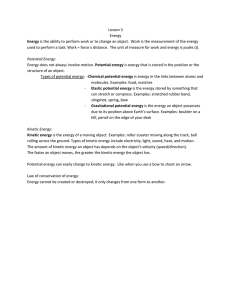
... Types of potential energy: -Chemical potential energy is energy in the links between atoms and molecules. Examples: food, matches - Elastic potential energy is the energy stored by something that can stretch or compress. Examples: stretched rubber band, slingshot, spring, bow - Gravitational potenti ...
... Types of potential energy: -Chemical potential energy is energy in the links between atoms and molecules. Examples: food, matches - Elastic potential energy is the energy stored by something that can stretch or compress. Examples: stretched rubber band, slingshot, spring, bow - Gravitational potenti ...
File
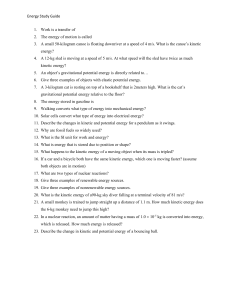
... 10. Solar cells convert what type of energy into electrical energy? 11. Describe the changes in kinetic and potential energy for a pendulum as it swings. 12. Why are fossil fuels so widely used? 13. What is the SI unit for work and energy? 14. What is energy that is stored due to position or shape? ...
... 10. Solar cells convert what type of energy into electrical energy? 11. Describe the changes in kinetic and potential energy for a pendulum as it swings. 12. Why are fossil fuels so widely used? 13. What is the SI unit for work and energy? 14. What is energy that is stored due to position or shape? ...
Different forms of energy
... waves such as visible light, x-rays and ultraviolet light Solar energy is part of radiant energy * green plants use solar energy during photosynthesis *most of the energy we use originally came from the Sun Some sources of radiant energy are: stars, lights, and microwaves ...
... waves such as visible light, x-rays and ultraviolet light Solar energy is part of radiant energy * green plants use solar energy during photosynthesis *most of the energy we use originally came from the Sun Some sources of radiant energy are: stars, lights, and microwaves ...
Glossary of Terms Energy – the ability to do work or the ability to
... Energy – the ability to do work or the ability to move an object. Electrical energy is usually measured in kilowatthours (kWh), while heat energy is usually measured in British thermal units (Btu). Potential energy – stored energy and the energy of position. Kinetic energy – the energy of a body whi ...
... Energy – the ability to do work or the ability to move an object. Electrical energy is usually measured in kilowatthours (kWh), while heat energy is usually measured in British thermal units (Btu). Potential energy – stored energy and the energy of position. Kinetic energy – the energy of a body whi ...

Forms of Energy
... Energy is found in different forms including light, heat, chemical, and motion. There are many forms of energy, but they can all be put into two categories: potential and kinetic. ...
... Energy is found in different forms including light, heat, chemical, and motion. There are many forms of energy, but they can all be put into two categories: potential and kinetic. ...

Chapter 13 Section 2 pg. 447-451
... stored in the chemical bonds that hold chemical compounds together. ...
... stored in the chemical bonds that hold chemical compounds together. ...

Presentation
... to be used, due to an object’s position or condition. Examples: - Nuclear -Chemical - Elastic - Gravitational ...
... to be used, due to an object’s position or condition. Examples: - Nuclear -Chemical - Elastic - Gravitational ...
Forms of Energy Conversions
... Forms of Energy Conversions: use the back of this page for drawing if you need more room. There are six forms of energy: thermal (heat), electrical (moving electrons), electromagnetic (light), nuclear (energy that binds the nuclei of atoms), chemical and mechanical (a kind of kinetic energy of movin ...
... Forms of Energy Conversions: use the back of this page for drawing if you need more room. There are six forms of energy: thermal (heat), electrical (moving electrons), electromagnetic (light), nuclear (energy that binds the nuclei of atoms), chemical and mechanical (a kind of kinetic energy of movin ...
Energy Powerpoint
... Thermal (or Heat) Energy • Temperature: a measure of how fast the particles are moving in a substance – What is temperature measured in? ...
... Thermal (or Heat) Energy • Temperature: a measure of how fast the particles are moving in a substance – What is temperature measured in? ...

Energy Transformations
... 4 - Cite evidence to support the Law of Conservation of Energy. 3 - Investigate and describe the transformation of energy that occurs in given examples. 2 - Differentiate between kinetic and potential energy. 1 - Identify examples of kinetic and potential energy. ...
... 4 - Cite evidence to support the Law of Conservation of Energy. 3 - Investigate and describe the transformation of energy that occurs in given examples. 2 - Differentiate between kinetic and potential energy. 1 - Identify examples of kinetic and potential energy. ...

Example
... the energy given out by food. It is difficult to measure the energy of food directly. So we have to measure it indirectly. We can measure the energy by burning it in calorimeter, since the (heat) energy given out in the burning process is nearly is the same when it is digested and absorb inside body ...
... the energy given out by food. It is difficult to measure the energy of food directly. So we have to measure it indirectly. We can measure the energy by burning it in calorimeter, since the (heat) energy given out in the burning process is nearly is the same when it is digested and absorb inside body ...