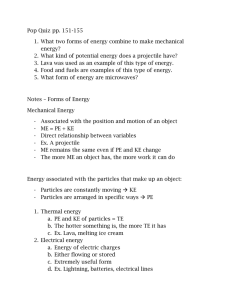
Pop Quiz pp. 151-155 What two forms of energy combine to make
... b. The hotter something is, the more TE it has c. Ex. Lava, melting ice cream 2. Electrical energy a. Energy of electric charges b. Either flowing or stored c. Extremely useful form d. Ex. Lightning, batteries, electrical lines ...
... b. The hotter something is, the more TE it has c. Ex. Lava, melting ice cream 2. Electrical energy a. Energy of electric charges b. Either flowing or stored c. Extremely useful form d. Ex. Lightning, batteries, electrical lines ...


Energy and Temperature
... Many chemical reactions either create or release energy when they occur. Forms of energy include: ...
... Many chemical reactions either create or release energy when they occur. Forms of energy include: ...

Thermochemistry ch 16 energy diagrams phase
... • Measuring in heat is done using units called Joules. • One Joule is = 0.2390 calories • One calorie = 4.184 Joules • One Calorie = 1000 calories (note the capital C) = 1 kcal • How many Joules are in a bowl of breakfast cereal and milk which contain 340 Calories? ...
... • Measuring in heat is done using units called Joules. • One Joule is = 0.2390 calories • One calorie = 4.184 Joules • One Calorie = 1000 calories (note the capital C) = 1 kcal • How many Joules are in a bowl of breakfast cereal and milk which contain 340 Calories? ...

NSTA Meteorology Reading 5 • Weather and the Redistribution of
... ‣ Temperature gradients created by imbalances in rates of heating and cooling from once place to another within the atmosphere ‣ Many different kinds of energy ‣ Energy can be transformed from one type to another ‣ The total amount of energy remains the same (energy s conserved) ‣ 4 types of energy ...
... ‣ Temperature gradients created by imbalances in rates of heating and cooling from once place to another within the atmosphere ‣ Many different kinds of energy ‣ Energy can be transformed from one type to another ‣ The total amount of energy remains the same (energy s conserved) ‣ 4 types of energy ...

ENERGY
... • Energy cannot be created or destroyed; it only changes form • Energy in = energy out • Heat, light and sound are common forms of energy transfer ...
... • Energy cannot be created or destroyed; it only changes form • Energy in = energy out • Heat, light and sound are common forms of energy transfer ...
Friday PS 11-2 - elyceum-beta
... transferred or transformed to another system • The units for work and energy are the same ...
... transferred or transformed to another system • The units for work and energy are the same ...

work and energy
... In circuits, the current is a flow of tiny charged particles called electrons. These come from atoms. Electrons can transfer energy from a battery or a light bulb. They have electrical potential energy. ...
... In circuits, the current is a flow of tiny charged particles called electrons. These come from atoms. Electrons can transfer energy from a battery or a light bulb. They have electrical potential energy. ...

Form Of - eduScapes
... tiny particles called atoms. Atoms are made of even smaller particles called electrons, protons, and neutrons. Applying a force can make some of the electrons move. Radiant Energy is electromagnetic energy that travels in transverse waves. ...
... tiny particles called atoms. Atoms are made of even smaller particles called electrons, protons, and neutrons. Applying a force can make some of the electrons move. Radiant Energy is electromagnetic energy that travels in transverse waves. ...


Properties of Matter
... created nor destroyed in a chemical reaction, it can be changed from one form to another but the total amount remains the same. Law of conservation of matter : matter is neither created nor destroyed during a chemical reaction, ie., the total weight of substances before they react is the same as aft ...
... created nor destroyed in a chemical reaction, it can be changed from one form to another but the total amount remains the same. Law of conservation of matter : matter is neither created nor destroyed during a chemical reaction, ie., the total weight of substances before they react is the same as aft ...

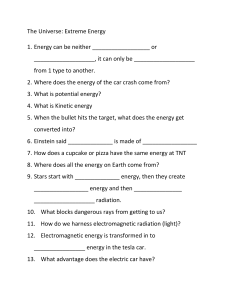
Name: KEY Class Period: GTT (7th) – SCIENCE OF TECHNOLOGY
... Work is defined as the result of a force moving an object a distance 14. STEM stands for: Science Technology Engineering Mathematics ...
... Work is defined as the result of a force moving an object a distance 14. STEM stands for: Science Technology Engineering Mathematics ...

File
... Energy • In this unit, we will study chemical systems & their energy – Energy is the ability to do work • All of these systems contain kinetic and potential energy – Kinetic energy – all particles are in motion – Potential energy – stored in the bonds of compounds ...
... Energy • In this unit, we will study chemical systems & their energy – Energy is the ability to do work • All of these systems contain kinetic and potential energy – Kinetic energy – all particles are in motion – Potential energy – stored in the bonds of compounds ...

Geothermal energy
... The work-energy theorem states that whenever work is done, energy changes -When there is no change in energy we can say that no work was done The more KE something has, the more energy is required to stop it ...
... The work-energy theorem states that whenever work is done, energy changes -When there is no change in energy we can say that no work was done The more KE something has, the more energy is required to stop it ...

Name Block ______ Test Date Energy Study Guide Define energy
... kinetic energy—how do the energies change on a roller coaster. Potential energy- stored energy Kinetic energy- energy in motion All forms of energy are a combination of potential and kinetic. As potential energy decreases, kinetic energy increases and vice versa. The highest potential energy is when ...
... kinetic energy—how do the energies change on a roller coaster. Potential energy- stored energy Kinetic energy- energy in motion All forms of energy are a combination of potential and kinetic. As potential energy decreases, kinetic energy increases and vice versa. The highest potential energy is when ...

Activation energy
... • Activation energy is the energy needed to start a reaction and break chemical bonds in the reactants. – This is why a flammable material, like gasoline, does not burn without a spark or flame. – The spark supplies the activation energy to start the reaction. ...
... • Activation energy is the energy needed to start a reaction and break chemical bonds in the reactants. – This is why a flammable material, like gasoline, does not burn without a spark or flame. – The spark supplies the activation energy to start the reaction. ...

Matter and Energy
... Electrons when in motion create electricity and magnetic fields. Electrons give off a -1 charge, which in return balances it out with the proton who gives off a +1 charge. ...
... Electrons when in motion create electricity and magnetic fields. Electrons give off a -1 charge, which in return balances it out with the proton who gives off a +1 charge. ...

Matter and Energy mike jacob
... Electrons when in motion create electricity and magnetic fields. Electrons give off a -1 charge, which in return balances it out with the proton who gives off a +1 charge. ...
... Electrons when in motion create electricity and magnetic fields. Electrons give off a -1 charge, which in return balances it out with the proton who gives off a +1 charge. ...

Energy can be transferred - cms16-17
... one form to another such as: · Someone striking a gong A person uses chemical energy in their cells which changes to “movement energy” when they move their arm through the air. The “movement energy” changes to sound energy when the gong is struck. ...
... one form to another such as: · Someone striking a gong A person uses chemical energy in their cells which changes to “movement energy” when they move their arm through the air. The “movement energy” changes to sound energy when the gong is struck. ...
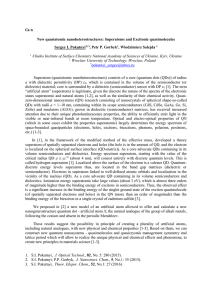
New quasiatomic nanoheterostructures: Superatoms and Excitonic
... In [1], in the framework of the modified method of the effective mass, developed a theory superatom of spatially separated electrons and holes (the hole is in the amount of QD, and the electron is localized on the spherical surface interface (QD-matrix)). As a core advocate QDs containing in its vol ...
... In [1], in the framework of the modified method of the effective mass, developed a theory superatom of spatially separated electrons and holes (the hole is in the amount of QD, and the electron is localized on the spherical surface interface (QD-matrix)). As a core advocate QDs containing in its vol ...

Chapter 2
... b. chemical bonds of glucose molecule 2. kinetic energy - energy in an object in motion a. water in a stream - allows mill to grind corn b. broken glucose bonds -> ATP -> muscles work 3. Forms of Energy a. chemical energy - energy in chemical bonds I. ATP (adenosine triphosphate) - stores energy b. ...
... b. chemical bonds of glucose molecule 2. kinetic energy - energy in an object in motion a. water in a stream - allows mill to grind corn b. broken glucose bonds -> ATP -> muscles work 3. Forms of Energy a. chemical energy - energy in chemical bonds I. ATP (adenosine triphosphate) - stores energy b. ...

potential energy.
... space, they are often used for communication. • Nuclear energy - Nuclear power plants use fission – splitting the nuclei of atoms apart to release energy. The sun uses fusion – two hydrogen nuclei combine the larger helium nuclei. (A tiny amount of mass is lost in the process – which produces huge a ...
... space, they are often used for communication. • Nuclear energy - Nuclear power plants use fission – splitting the nuclei of atoms apart to release energy. The sun uses fusion – two hydrogen nuclei combine the larger helium nuclei. (A tiny amount of mass is lost in the process – which produces huge a ...