
Slide 1
... and it is looking more and more likely that today’s young people will have to make major lifestyle changes in the future. The young people of today are also the policy-makers of tomorrow and as such, it is vital that they are well informed and are given the opportunity to contribute to decision-maki ...
... and it is looking more and more likely that today’s young people will have to make major lifestyle changes in the future. The young people of today are also the policy-makers of tomorrow and as such, it is vital that they are well informed and are given the opportunity to contribute to decision-maki ...

Slide 1
... Combines observations, modelling and applications: creating new knowledge about Western Australia’s climate Focussed on the south-west Building regional capacity Strategic research to assist decision making by the State partners Science priorities determined by a user-driven panel ...
... Combines observations, modelling and applications: creating new knowledge about Western Australia’s climate Focussed on the south-west Building regional capacity Strategic research to assist decision making by the State partners Science priorities determined by a user-driven panel ...

4 Industry sectors
... The Tasmanian forestry sector is an integrated industry that encompasses both native forest and plantation resources (softwood and hardwood), the production of logs, woodchips, hardwood and softwood sawn timber, pulp and paper production, veneer, fuel wood and other wood products. Tasmanian forest b ...
... The Tasmanian forestry sector is an integrated industry that encompasses both native forest and plantation resources (softwood and hardwood), the production of logs, woodchips, hardwood and softwood sawn timber, pulp and paper production, veneer, fuel wood and other wood products. Tasmanian forest b ...

PTFCC-AlbayPresentation
... Climate Change: The Philippine Response Strategic Framework and Action Plan Version 1 ...
... Climate Change: The Philippine Response Strategic Framework and Action Plan Version 1 ...

Humanity Has A Significant Effect on Climate – The AGU... To Accurately Communicate The Current Understanding Of What is Certain...
... It is also important to recognize that changes in the global radiative forcings (global warming or cooling) represent only a subset of climate change. The ocean is the component of the climate system that is best suited for quantifying climate system heat change. There are major unresolved issues c ...
... It is also important to recognize that changes in the global radiative forcings (global warming or cooling) represent only a subset of climate change. The ocean is the component of the climate system that is best suited for quantifying climate system heat change. There are major unresolved issues c ...

Hauger Climate security
... “In 2010, more than 30 million people in Asia and the Pacific were displaced by environmental disasters such as storms and floods... Climate change is expected to increase the frequency of extreme weather events, bringing about significant changes in migration patterns. This will pose a major threat ...
... “In 2010, more than 30 million people in Asia and the Pacific were displaced by environmental disasters such as storms and floods... Climate change is expected to increase the frequency of extreme weather events, bringing about significant changes in migration patterns. This will pose a major threat ...

Climate Smart Communities (CSC) is a network of New York
... Two types of actions enable Climate Smart Communities to minimize the risks of climate change and reduce its long-term costs. 1. Reducing Greenhouse Gas (GHG) Emissions: Starting now to reduce GHG emissions and create permanent sinks that remove GHG from the atmosphere; these actions will help stabi ...
... Two types of actions enable Climate Smart Communities to minimize the risks of climate change and reduce its long-term costs. 1. Reducing Greenhouse Gas (GHG) Emissions: Starting now to reduce GHG emissions and create permanent sinks that remove GHG from the atmosphere; these actions will help stabi ...


Topic 2 - Climate & Change
... A developing country (LEDC) Low greenhouse gas emissions – 2.6 tonnes per person per year (world average = 6.8) Produce less than 1% all green house gases. 99% of Egypt’s people live in 5% land area as so much is desert. Average rainfall = less than 10mm/yr The River Nile is an important water suppl ...
... A developing country (LEDC) Low greenhouse gas emissions – 2.6 tonnes per person per year (world average = 6.8) Produce less than 1% all green house gases. 99% of Egypt’s people live in 5% land area as so much is desert. Average rainfall = less than 10mm/yr The River Nile is an important water suppl ...

Download country indicators
... electricity consumers; Feed-in-Tariff; Special fund for the promotion, development and use of grid-integrated renewable electricity; Mini-grid and off-grid renewable power systems for remote areas and islands and diverse scientific and technological research programmes Source: ...
... electricity consumers; Feed-in-Tariff; Special fund for the promotion, development and use of grid-integrated renewable electricity; Mini-grid and off-grid renewable power systems for remote areas and islands and diverse scientific and technological research programmes Source: ...

PDF
... modeling studies were conducted at 45 sites in the United States for wheat, maize, soybean, potato, citrus, tomato, sorghum, rice, and hay under dryland and irrigated conditions. Yields were simulated assuming current varieties and planting schedules, as well as assuming varieties and planting sched ...
... modeling studies were conducted at 45 sites in the United States for wheat, maize, soybean, potato, citrus, tomato, sorghum, rice, and hay under dryland and irrigated conditions. Yields were simulated assuming current varieties and planting schedules, as well as assuming varieties and planting sched ...

REPORT ON NEW ZEALAND`S VIEWS ON THE POSSIBLE
... this Declaration, consistent with the Pacific Plan, the Pacific Islands Framework for Action on Climate Change, and other existing regional and international initiatives, including examining the potential for regional climate change insurance arrangements, and building regional expertise in the deve ...
... this Declaration, consistent with the Pacific Plan, the Pacific Islands Framework for Action on Climate Change, and other existing regional and international initiatives, including examining the potential for regional climate change insurance arrangements, and building regional expertise in the deve ...

Prediction as a Technology
... climate change and variability on multidecadal time scales. 5. Attempts to significantly influence regional and local-scale climate based on controlling CO2 emissions alone is an inadequate policy for this purpose. 6. The assessment of the spectrum of threats to regional and local societal and envir ...
... climate change and variability on multidecadal time scales. 5. Attempts to significantly influence regional and local-scale climate based on controlling CO2 emissions alone is an inadequate policy for this purpose. 6. The assessment of the spectrum of threats to regional and local societal and envir ...

International Tourist Arrivals, 1950-2020
... Presentation by Mr. Gabor Vereczi Chief, Environment and Quality Section ...
... Presentation by Mr. Gabor Vereczi Chief, Environment and Quality Section ...
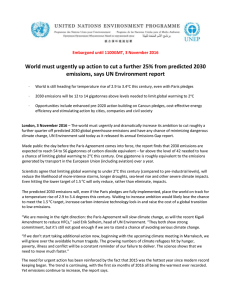
World must urgently up action to cut a further 25% from predicted
... a chance of limiting global warming to 2oC this century. One gigatonne is roughly equivalent to the emissions generated by transport in the European Union (including aviation) over a year. Scientists agree that limiting global warming to under 2oC this century (compared to pre-industrial levels), wi ...
... a chance of limiting global warming to 2oC this century. One gigatonne is roughly equivalent to the emissions generated by transport in the European Union (including aviation) over a year. Scientists agree that limiting global warming to under 2oC this century (compared to pre-industrial levels), wi ...
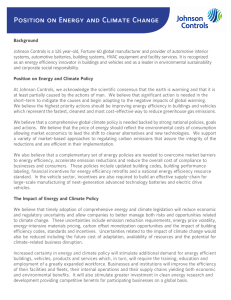
Position on Energy and Climate Change
... efficiency codes, standards and incentives. Uncertainties related to the impact of climate change would also be reduced including the future cost of adaptation, availability of resources and the potential for climate-related business disruption. Increased certainty in energy and climate policy will ...
... efficiency codes, standards and incentives. Uncertainties related to the impact of climate change would also be reduced including the future cost of adaptation, availability of resources and the potential for climate-related business disruption. Increased certainty in energy and climate policy will ...

Notes on Alley and Climate Change
... physicist Robert Socolow that climate stabilization “could be achieved if society picked seven actions, or wedges, each starting from zero in the year 2004 and growing to avoid emissions of 1 gigaton of carbon per year in 2054. Pacala and Socolow provided fifteen options, of which any seven would su ...
... physicist Robert Socolow that climate stabilization “could be achieved if society picked seven actions, or wedges, each starting from zero in the year 2004 and growing to avoid emissions of 1 gigaton of carbon per year in 2054. Pacala and Socolow provided fifteen options, of which any seven would su ...

climate change
... inflows to flush the rivers. Species such as black bream depend on freshwater inflows for successful spawning and prolonged drought is likely to adversely impact recruitment. Species with low tolerance to warmer water temperatures could decline, and long-lived species unable to adjust quickly to cha ...
... inflows to flush the rivers. Species such as black bream depend on freshwater inflows for successful spawning and prolonged drought is likely to adversely impact recruitment. Species with low tolerance to warmer water temperatures could decline, and long-lived species unable to adjust quickly to cha ...

North Atlantic Climate Change as a Response to Indian Ocean
... records. So, the main rationale for this work is that we can understand the kinds of natural shifts the climate system is capable of. In the end, we find that these shifts are much larger than the instrumental record, they persisted for centuries, and they involved very large areas (at least the who ...
... records. So, the main rationale for this work is that we can understand the kinds of natural shifts the climate system is capable of. In the end, we find that these shifts are much larger than the instrumental record, they persisted for centuries, and they involved very large areas (at least the who ...

PPT - unece
... - Need for comprehensive information/data - Many different needs, producers and users - Need for communication and coordination ...
... - Need for comprehensive information/data - Many different needs, producers and users - Need for communication and coordination ...

Chapter 14
... Philippines had measurable short-term effects on global temperatures. Describe and briefly explain these effects. ...
... Philippines had measurable short-term effects on global temperatures. Describe and briefly explain these effects. ...


Climate Change
... • Because it is longwave energy (not shortwave like the energy carried by the rays from the sun), some of it gets trapped by the greenhouse gases. • This causes the earth to be warmer than it would without the greenhouse ...
... • Because it is longwave energy (not shortwave like the energy carried by the rays from the sun), some of it gets trapped by the greenhouse gases. • This causes the earth to be warmer than it would without the greenhouse ...

Global Climate Change
... stratosphere. The boundary that separates the two layers, the tropopause, is as high as nine miles above the equator and as low as five miles above the poles. In an astounding development, a 2003 study showed that this tropopause has shifted upward over the last two decades by more than 900 feet. [1 ...
... stratosphere. The boundary that separates the two layers, the tropopause, is as high as nine miles above the equator and as low as five miles above the poles. In an astounding development, a 2003 study showed that this tropopause has shifted upward over the last two decades by more than 900 feet. [1 ...
Effects of global warming on humans

Climate change has brought about possibly permanent alterations to our planet’s geological, biological and ecological systems. The Intergovernmental Panel on Climate Change (IPCC) contended in 2003 that “there is new and stronger evidence that most of the warming observed over the last 50 years is attributable to human activities”. These changes have led to the emergence of large-scale environmental hazards to human health, such as extreme weather, ozone depletion, increased danger of wildland fires, loss of biodiversity, stresses to food-producing systems and the global spread of infectious diseases. The World Health Organization (WHO) estimates that 160,000 deaths, since 1950, are directly attributable to climate change. Many believe this to be a conservative estimate.To date, a neglected aspect of the climate change debate, much less research has been conducted on the impacts of climate change on health, food supply, economic growth, migration, security, societal change, and public goods, such as drinking water, than on the geophysical changes related to global warming. Human impacts can be both negative and positive. Climatic changes in Siberia, for instance, are expected to improve food production and local economic activity, at least in the short to medium term. Numerous studies suggest, however, that the current and future impacts of climate change on human society are and will continue to be overwhelmingly negative.The majority of the adverse effects of climate change are experienced by poor and low-income communities around the world, who have much higher levels of vulnerability to environmental determinants of health, wealth and other factors, and much lower levels of capacity available for coping with environmental change. A report on the global human impact of climate change published by the Global Humanitarian Forum in 2009, estimated more than 300,000 deaths and about $125 billion in economic losses each year, and indicating that most climate change induced mortality is due to worsening floods and droughts in developing countries. This also raises questions of climate justice, since the 50 least developed countries of the world account for not more than 1% of worldwide emissions of greenhouse gases.