
WhySciTeachersWEB ppt
... Since 2005, the Academies of Science for the G8+5 countries have called on world leaders to limit the threat of climate change. We have advised prompt action to deal with the causes of climate change and cautioned that some climate impacts are inevitable. However, progress in reducing global greenh ...
... Since 2005, the Academies of Science for the G8+5 countries have called on world leaders to limit the threat of climate change. We have advised prompt action to deal with the causes of climate change and cautioned that some climate impacts are inevitable. However, progress in reducing global greenh ...

Planning for climate change adaptation: North Doddington Farm
... studies highlighting different aspects of land management to address both mitigation and adaptation. This series has been written for advisers and farmers working on ES and other environmental land management initiatives. ...
... studies highlighting different aspects of land management to address both mitigation and adaptation. This series has been written for advisers and farmers working on ES and other environmental land management initiatives. ...

Climate Change – Can science teachers play a part
... Since 2005, the Academies of Science for the G8+5 countries have called on world leaders to limit the threat of climate change. We have advised prompt action to deal with the causes of climate change and cautioned that some climate impacts are inevitable. However, progress in reducing global greenh ...
... Since 2005, the Academies of Science for the G8+5 countries have called on world leaders to limit the threat of climate change. We have advised prompt action to deal with the causes of climate change and cautioned that some climate impacts are inevitable. However, progress in reducing global greenh ...

Potential impacts of climate change on the Wet Tropics
... Introduction SAC recognises climate change as one of the major threats to biodiversity at both the species and ecosystem levels in the WHA. Climate change will lead to severe adverse impacts on habitats and wildlife as well as on ecosystems and the goods and services they provide society. In general ...
... Introduction SAC recognises climate change as one of the major threats to biodiversity at both the species and ecosystem levels in the WHA. Climate change will lead to severe adverse impacts on habitats and wildlife as well as on ecosystems and the goods and services they provide society. In general ...

Natural or Unnatural Disasters: the Relative Vulnerabilities of Southeast Asian megacities to Climate Change
... sia is among the regions of the world most vulnerable to climate change. Climate change and climatic variability have and will continue to impact all sectors, from national and economic security to human health, food production, infrastructure, water availability and ecosystems. The evidence of clim ...
... sia is among the regions of the world most vulnerable to climate change. Climate change and climatic variability have and will continue to impact all sectors, from national and economic security to human health, food production, infrastructure, water availability and ecosystems. The evidence of clim ...

POST 121 a - Parliament UK
... absence of noticeable climate change), due to demographic and lifestyle changes. Adaptations could include improving predictions of yields, controlling leaks, providing new supplies, and encouraging demand management (e.g. through the use of water-efficient appliances). Innovating in Construction an ...
... absence of noticeable climate change), due to demographic and lifestyle changes. Adaptations could include improving predictions of yields, controlling leaks, providing new supplies, and encouraging demand management (e.g. through the use of water-efficient appliances). Innovating in Construction an ...

power point presentation
... Atmospheric Atmospheric CO2 content is presently rising at 0.4-0.48 % annually, faster than at any time in the past 500 million years A doubling of CO2 levels in the atmosphere is expected to induce a rise in average global temperature of between 3-4°C. ...
... Atmospheric Atmospheric CO2 content is presently rising at 0.4-0.48 % annually, faster than at any time in the past 500 million years A doubling of CO2 levels in the atmosphere is expected to induce a rise in average global temperature of between 3-4°C. ...

Selected Evidence on Climate Change Issue (from procon.org) Pro
... Human-produced CO2 is warming the earth, not natural CO2 released from the ocean and other "carbon sinks." CO2 from fossil fuel combustion has a specific isotopic ratio [48] that is different from CO2 released by natural "carbon sinks." 20th century measurements of CO2 isotope ratios in the atmosphe ...
... Human-produced CO2 is warming the earth, not natural CO2 released from the ocean and other "carbon sinks." CO2 from fossil fuel combustion has a specific isotopic ratio [48] that is different from CO2 released by natural "carbon sinks." 20th century measurements of CO2 isotope ratios in the atmosphe ...


20090831_Analysis_Climate_Change_India
... • Sea level rise will lead to increased coastal inundation • Amplified by stronger tropical cyclones • Large impact in river deltas • Salt water intrusion ...
... • Sea level rise will lead to increased coastal inundation • Amplified by stronger tropical cyclones • Large impact in river deltas • Salt water intrusion ...

crop and water resource modelling - START
... extension agents and meteorological offices oDesign of the user interface oAspects of the core model Outputs include figures 1 and 2 (right), detailing the possible effect of forecast implementation on costs to farmers (figure 1) and levels of trust in the forecasts (figure 2). The prototype model ...
... extension agents and meteorological offices oDesign of the user interface oAspects of the core model Outputs include figures 1 and 2 (right), detailing the possible effect of forecast implementation on costs to farmers (figure 1) and levels of trust in the forecasts (figure 2). The prototype model ...

Climate Change
... converted the domesticated land, from less than 10% about 150 years ago, to about 35% now. Use of fertilizers to increase agricultural productivity to feed the growing population now result in more nitrogen fixation due to human activities than due to natural processes, since about 1980. Further, ov ...
... converted the domesticated land, from less than 10% about 150 years ago, to about 35% now. Use of fertilizers to increase agricultural productivity to feed the growing population now result in more nitrogen fixation due to human activities than due to natural processes, since about 1980. Further, ov ...

Consultation on setting New Zealand`s post
... century … No robust trends in annual numbers of tropical storms, hurricanes and major hurricanes counts have been identified over the past 100 years in the North Atlantic basin” • “In summary, there continues to be a lack of evidence and thus low confidence regarding the sign of trend in the magnitu ...
... century … No robust trends in annual numbers of tropical storms, hurricanes and major hurricanes counts have been identified over the past 100 years in the North Atlantic basin” • “In summary, there continues to be a lack of evidence and thus low confidence regarding the sign of trend in the magnitu ...

Global Warming and the IPCC Gordon J. Aubrecht, II Physics
... anthropogenic warming has had a discernible influence on many physical and biological systems. Other effects of regional climate changes on natural and human environments are emerging, although many are difficult to discern due to adaptation and non-climatic drivers. More specific information is now ...
... anthropogenic warming has had a discernible influence on many physical and biological systems. Other effects of regional climate changes on natural and human environments are emerging, although many are difficult to discern due to adaptation and non-climatic drivers. More specific information is now ...

climate change - Hans von Storch
... concerning violent and illegal acts against the conductors. ...
... concerning violent and illegal acts against the conductors. ...

CLIMATE CHANGE: IMPLICATIONS FOR COMMERCIAL
... magazines12 have widely discussed a variety of detrimental risks caused by climate change. It is a “hot” topic for property law professors as well as real estate lawyers13. There are four principal risks that have been identified. Water scarcity and drought produce the sand storms that occur with gr ...
... magazines12 have widely discussed a variety of detrimental risks caused by climate change. It is a “hot” topic for property law professors as well as real estate lawyers13. There are four principal risks that have been identified. Water scarcity and drought produce the sand storms that occur with gr ...

Climate Change Adaptation in New England Agriculture
... in livestock. Stress from higher temperatures, humidity, and increased exposure to sunlight can decrease animal health and productivity, and increase their water requirements.10 Although it affects all livestock, dairy cattle are particularly sensitive because of their lower temperature thresholds. ...
... in livestock. Stress from higher temperatures, humidity, and increased exposure to sunlight can decrease animal health and productivity, and increase their water requirements.10 Although it affects all livestock, dairy cattle are particularly sensitive because of their lower temperature thresholds. ...

Blue Grenadier
... Key unknown is the upper temperature tolerances of the eggs and larvae. There also remains high uncertainty around how climate change will influence changes in sea temperatures at depths below 400 m where blue grenadier spend a large portion of their lives. This hinders our ability to predict if the ...
... Key unknown is the upper temperature tolerances of the eggs and larvae. There also remains high uncertainty around how climate change will influence changes in sea temperatures at depths below 400 m where blue grenadier spend a large portion of their lives. This hinders our ability to predict if the ...

Climate Change Mitigation Within The Project Financing Sector
... Haniehalsadat Aboutorabifard ([email protected]) ...
... Haniehalsadat Aboutorabifard ([email protected]) ...
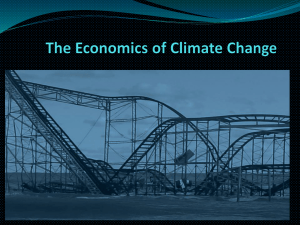
The Economics of Climate Change
... All countries/people are affected. Poorest suffer earliest and most. ...
... All countries/people are affected. Poorest suffer earliest and most. ...

Solomon Islands
... Solomon Islands Solomon Islands1 presented a theme on climate change. The contribution of Solomon Islands to global greenhouse gas emissions and its role in causing climate change is insignificant, but as a vulnerable island state, it must act responsibly to avert the worst global effects and conseq ...
... Solomon Islands Solomon Islands1 presented a theme on climate change. The contribution of Solomon Islands to global greenhouse gas emissions and its role in causing climate change is insignificant, but as a vulnerable island state, it must act responsibly to avert the worst global effects and conseq ...

Section 2: The Impacts of Climate Change
... States, where water shortages often already pose challenges. Areas affected by drought are also expected to increase. As the atmosphere becomes warmer, it can hold more water, increasing the length of time between rain events and increasing the amount of rainfall in an individual event. As a result, ...
... States, where water shortages often already pose challenges. Areas affected by drought are also expected to increase. As the atmosphere becomes warmer, it can hold more water, increasing the length of time between rain events and increasing the amount of rainfall in an individual event. As a result, ...

Other Emerging Issues
... – Human activity has “very likely” been the driving force in climate change over the last 50 years; – The probability that warming is caused by natural climatic processes alone is less than 5%; – World temperatures could rise by between 1.1 and 6.4 °C (2.0 and 11.5 °F) during the 21st century; ...
... – Human activity has “very likely” been the driving force in climate change over the last 50 years; – The probability that warming is caused by natural climatic processes alone is less than 5%; – World temperatures could rise by between 1.1 and 6.4 °C (2.0 and 11.5 °F) during the 21st century; ...

Memo from Tom Steyer to Anderson Cooper
... Climate change is a top-‐tier issue for Democratic voters—and in the past few years taking action on climate change has become central to Democratic elected officials’ policy agendas across this country. ...
... Climate change is a top-‐tier issue for Democratic voters—and in the past few years taking action on climate change has become central to Democratic elected officials’ policy agendas across this country. ...
kyoto_protocol
... Among the countries that have made binding commitments under the Protocol, only those of central and eastern Europe and the former Soviet Union have emissions below target levels. However, these emission decreases are for the most part due to economic decline, rather than improvements in energy effi ...
... Among the countries that have made binding commitments under the Protocol, only those of central and eastern Europe and the former Soviet Union have emissions below target levels. However, these emission decreases are for the most part due to economic decline, rather than improvements in energy effi ...
Effects of global warming on humans

Climate change has brought about possibly permanent alterations to our planet’s geological, biological and ecological systems. The Intergovernmental Panel on Climate Change (IPCC) contended in 2003 that “there is new and stronger evidence that most of the warming observed over the last 50 years is attributable to human activities”. These changes have led to the emergence of large-scale environmental hazards to human health, such as extreme weather, ozone depletion, increased danger of wildland fires, loss of biodiversity, stresses to food-producing systems and the global spread of infectious diseases. The World Health Organization (WHO) estimates that 160,000 deaths, since 1950, are directly attributable to climate change. Many believe this to be a conservative estimate.To date, a neglected aspect of the climate change debate, much less research has been conducted on the impacts of climate change on health, food supply, economic growth, migration, security, societal change, and public goods, such as drinking water, than on the geophysical changes related to global warming. Human impacts can be both negative and positive. Climatic changes in Siberia, for instance, are expected to improve food production and local economic activity, at least in the short to medium term. Numerous studies suggest, however, that the current and future impacts of climate change on human society are and will continue to be overwhelmingly negative.The majority of the adverse effects of climate change are experienced by poor and low-income communities around the world, who have much higher levels of vulnerability to environmental determinants of health, wealth and other factors, and much lower levels of capacity available for coping with environmental change. A report on the global human impact of climate change published by the Global Humanitarian Forum in 2009, estimated more than 300,000 deaths and about $125 billion in economic losses each year, and indicating that most climate change induced mortality is due to worsening floods and droughts in developing countries. This also raises questions of climate justice, since the 50 least developed countries of the world account for not more than 1% of worldwide emissions of greenhouse gases.