
Global Climate Change
... stratosphere. The boundary that separates the two layers, the tropopause, is as high as nine miles above the equator and as low as five miles above the poles. In an astounding development, a 2003 study showed that this tropopause has shifted upward over the last two decades by more than 900 feet. [1 ...
... stratosphere. The boundary that separates the two layers, the tropopause, is as high as nine miles above the equator and as low as five miles above the poles. In an astounding development, a 2003 study showed that this tropopause has shifted upward over the last two decades by more than 900 feet. [1 ...

AASHTODesign-Meyer - Subcommittee on Design
... • Sensitivity, location, and timeframe of a proposed action determines the degree to which consideration of these predictions or projections is warranted ...
... • Sensitivity, location, and timeframe of a proposed action determines the degree to which consideration of these predictions or projections is warranted ...

Physics Behind the Climate Change
... respond to high energy EMR in UV region. agree that the net effect will be warming, the amount of warming (and other changes) given by various models is different. The current central warming estimate, developed by the Intergovernmental Panel on Climate Change (IPCC), is a global average temperature ...
... respond to high energy EMR in UV region. agree that the net effect will be warming, the amount of warming (and other changes) given by various models is different. The current central warming estimate, developed by the Intergovernmental Panel on Climate Change (IPCC), is a global average temperature ...

Climate change, community wellbeing and social justice
... Himalayan-Hindu Khush glacier in central Asia – currently expected to disappear by 2040 at the latest – will remove the main source of water for approximately 1.3 billion people in the region. 6 . The human impact: Australia and Victoria Grant provided us with a range number of CSIRO statistics abou ...
... Himalayan-Hindu Khush glacier in central Asia – currently expected to disappear by 2040 at the latest – will remove the main source of water for approximately 1.3 billion people in the region. 6 . The human impact: Australia and Victoria Grant provided us with a range number of CSIRO statistics abou ...

A recent study published in Nature Climate Change
... The researchers feel that the results show the Earth's climate is moving to a new regime where the rate of temperature change is dominated by rising greenhouse gas emissions. The lead author suggests the study highlights the need for humans to adapt, but he says the impacts of an extended period of ...
... The researchers feel that the results show the Earth's climate is moving to a new regime where the rate of temperature change is dominated by rising greenhouse gas emissions. The lead author suggests the study highlights the need for humans to adapt, but he says the impacts of an extended period of ...
How reliable are climate models? By Laure Montandon 3/19/07 ATOC7500
... • non-trivial variations among in situ instrumental datasets, • large error in proxy data (e.g. tree rings, ice cores, lake sediments, etc.) ⇒ climate record is an indispensable resource but with limitations ...
... • non-trivial variations among in situ instrumental datasets, • large error in proxy data (e.g. tree rings, ice cores, lake sediments, etc.) ⇒ climate record is an indispensable resource but with limitations ...

Allen_Climate_Change
... Carbon dioxide increase appears to correlate well with recent increase in temperature. But a correlation alone doesn’t necessarily indicate cause and effect. [Examples] ...
... Carbon dioxide increase appears to correlate well with recent increase in temperature. But a correlation alone doesn’t necessarily indicate cause and effect. [Examples] ...

CLIMATE CHANGE: MYTHS AND REALITIES
... percent below 1990 levels – eight years ahead of target – and now has pledged to keep them there at least until 2010. Alcoa is aiming to reduce its emissions 25 percent below 1990 levels by 2010. DuPont is aiming for a 65 percent reduction. We recently studied several companies that have taken on ta ...
... percent below 1990 levels – eight years ahead of target – and now has pledged to keep them there at least until 2010. Alcoa is aiming to reduce its emissions 25 percent below 1990 levels by 2010. DuPont is aiming for a 65 percent reduction. We recently studied several companies that have taken on ta ...

The Cocktail to Conversation Guide Global Warming
... effects, are not well understood and so cannot be modeled accurately. The predictions of future climatic changes are hypotheses, not scientific facts. IPCC scientists have argued that climate models will not reproduce the temperature trends we have seen over the last century unless human effects are ...
... effects, are not well understood and so cannot be modeled accurately. The predictions of future climatic changes are hypotheses, not scientific facts. IPCC scientists have argued that climate models will not reproduce the temperature trends we have seen over the last century unless human effects are ...


Matthew Kiernan Speech
... Response rates from corporates and support from investors continues to grow ...
... Response rates from corporates and support from investors continues to grow ...

1 - Australian Sustainable Development Institute
... • Cyclonic events hit northern coasts • Severe flooding in Qld, NSW • Dengue outbreak Cairns, > 350 cases ...
... • Cyclonic events hit northern coasts • Severe flooding in Qld, NSW • Dengue outbreak Cairns, > 350 cases ...

1 CLIMATE CHANGE AWARENESS the ability to factor climate
... necessary decisions in terms of what kind of food to buy or promote. There are also many other complicating factors such as the ‘multiplier effect’ for aircraft – emissions at altitude have as much as three times the impact on climate change, something which is often ignored when it comes to conscie ...
... necessary decisions in terms of what kind of food to buy or promote. There are also many other complicating factors such as the ‘multiplier effect’ for aircraft – emissions at altitude have as much as three times the impact on climate change, something which is often ignored when it comes to conscie ...

download the project brief
... and financing mechanisms. The concept of CSA is evolving and there is no one-size-fits-all blueprint for how it might be pursued. What does the project aim to achieve? The long-term desired outcome is more effective agricultural policies, aligned with climate change policies that enhance food securi ...
... and financing mechanisms. The concept of CSA is evolving and there is no one-size-fits-all blueprint for how it might be pursued. What does the project aim to achieve? The long-term desired outcome is more effective agricultural policies, aligned with climate change policies that enhance food securi ...


Key Questions about Climate Change2015
... Island & coastal populations, and low income countries will have the most difficulty mitigating negative impacts • Food security risks are greatest for those who are poor, isolated, landless, and/or living near sea level (example Bangladesh ...
... Island & coastal populations, and low income countries will have the most difficulty mitigating negative impacts • Food security risks are greatest for those who are poor, isolated, landless, and/or living near sea level (example Bangladesh ...
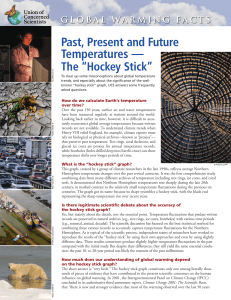
Past, Present and Future Temperatures
... How do we calculate Earth’s temperature over time? Over the past 150 years, surface air and water temperatures have been measured regularly at stations around the world. Looking back earlier in time, however, it is difficult to accurately reconstruct global average temperatures because written recor ...
... How do we calculate Earth’s temperature over time? Over the past 150 years, surface air and water temperatures have been measured regularly at stations around the world. Looking back earlier in time, however, it is difficult to accurately reconstruct global average temperatures because written recor ...
Climate is the average meteorological conditions—temperature
... http://members.optushome.com.au/wingchan1/ian/globwarm/what.htm ...
... http://members.optushome.com.au/wingchan1/ian/globwarm/what.htm ...

International Institutional Responses to Climate Change in a Post
... following sources, designated in the class schedule with the icons listed ...
... following sources, designated in the class schedule with the icons listed ...

Project brochure
... The job is massive, but along the way exciting new opportunities will be created. Let’s adapt! Five knowledge-driven countries are taking action to anticipate the local effects of climate change and develop regional adaptation strategies. Scientists and civil servants from Belgium, England, Germany, ...
... The job is massive, but along the way exciting new opportunities will be created. Let’s adapt! Five knowledge-driven countries are taking action to anticipate the local effects of climate change and develop regional adaptation strategies. Scientists and civil servants from Belgium, England, Germany, ...

Perspectives from the Green Climate Fund
... 1.0 Reduced emissions through increased low-emission energy access and power generation 2.0 Reduced emissions through increased access to low-emission transport 3.0 Reduced emissions from buildings, cities, industries and appliances 4.0 Reduced emissions from land use, deforestation, forest degradat ...
... 1.0 Reduced emissions through increased low-emission energy access and power generation 2.0 Reduced emissions through increased access to low-emission transport 3.0 Reduced emissions from buildings, cities, industries and appliances 4.0 Reduced emissions from land use, deforestation, forest degradat ...

Climate change and future impacts on food
... trends, and how climate change might impact on food security in the region in the future. 1 It should be noted that whilst the current drought has been caused by lack of rainfall, the disaster is man-made. Many of the worst affected areas are also some of the poorest, least developed and most neglec ...
... trends, and how climate change might impact on food security in the region in the future. 1 It should be noted that whilst the current drought has been caused by lack of rainfall, the disaster is man-made. Many of the worst affected areas are also some of the poorest, least developed and most neglec ...

Presentación de PowerPoint
... • The poor are suffering and will suffer more with climate change. They are at greatest risk to face human development reversals leading to low human development traps. • Climate change is an urgent matter. We need to act now. • Both mitigation and adaptation are needed to truly fight climate change ...
... • The poor are suffering and will suffer more with climate change. They are at greatest risk to face human development reversals leading to low human development traps. • Climate change is an urgent matter. We need to act now. • Both mitigation and adaptation are needed to truly fight climate change ...

CLIMATE CHANGE 2001: IMPACTS, ADAPTATION, AND
... This volume, Climate Change 2001: Impacts, Adaptation, and Vulnerability, is the Working Group II (WGII) contribution to the Third Assessment Report (TAR) of the Intergovernmental Panel on Climate Change (IPCC). The companion volumes of the TAR are Climate Change 2001: the Scientific Basis (WGI) and ...
... This volume, Climate Change 2001: Impacts, Adaptation, and Vulnerability, is the Working Group II (WGII) contribution to the Third Assessment Report (TAR) of the Intergovernmental Panel on Climate Change (IPCC). The companion volumes of the TAR are Climate Change 2001: the Scientific Basis (WGI) and ...

Slide 1
... efficiency of policies that address the impacts of climate change.” The EC Green paper ‘Adapting to climate change in Europe- options for EU action’ (2007) ...
... efficiency of policies that address the impacts of climate change.” The EC Green paper ‘Adapting to climate change in Europe- options for EU action’ (2007) ...
Effects of global warming on humans

Climate change has brought about possibly permanent alterations to our planet’s geological, biological and ecological systems. The Intergovernmental Panel on Climate Change (IPCC) contended in 2003 that “there is new and stronger evidence that most of the warming observed over the last 50 years is attributable to human activities”. These changes have led to the emergence of large-scale environmental hazards to human health, such as extreme weather, ozone depletion, increased danger of wildland fires, loss of biodiversity, stresses to food-producing systems and the global spread of infectious diseases. The World Health Organization (WHO) estimates that 160,000 deaths, since 1950, are directly attributable to climate change. Many believe this to be a conservative estimate.To date, a neglected aspect of the climate change debate, much less research has been conducted on the impacts of climate change on health, food supply, economic growth, migration, security, societal change, and public goods, such as drinking water, than on the geophysical changes related to global warming. Human impacts can be both negative and positive. Climatic changes in Siberia, for instance, are expected to improve food production and local economic activity, at least in the short to medium term. Numerous studies suggest, however, that the current and future impacts of climate change on human society are and will continue to be overwhelmingly negative.The majority of the adverse effects of climate change are experienced by poor and low-income communities around the world, who have much higher levels of vulnerability to environmental determinants of health, wealth and other factors, and much lower levels of capacity available for coping with environmental change. A report on the global human impact of climate change published by the Global Humanitarian Forum in 2009, estimated more than 300,000 deaths and about $125 billion in economic losses each year, and indicating that most climate change induced mortality is due to worsening floods and droughts in developing countries. This also raises questions of climate justice, since the 50 least developed countries of the world account for not more than 1% of worldwide emissions of greenhouse gases.