
Abigail Adams John Adams Samuel Adams Mercy
... He made an all-night ride back from Boston to warn his community of the British invasion ...
... He made an all-night ride back from Boston to warn his community of the British invasion ...
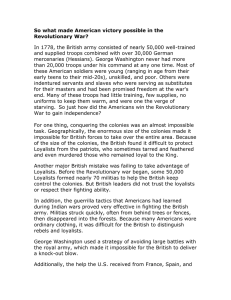
So what made American victory possible in the Revolutionary War
... So what made American victory possible in the Revolutionary War? In 1778, the British army consisted of nearly 50,000 well-trained and supplied troops combined with over 30,000 German mercenaries (Hessians). George Washington never had more than 20,000 troops under his command at any one time. Most ...
... So what made American victory possible in the Revolutionary War? In 1778, the British army consisted of nearly 50,000 well-trained and supplied troops combined with over 30,000 German mercenaries (Hessians). George Washington never had more than 20,000 troops under his command at any one time. Most ...

ch6s2sg
... •Other Europeans who had recently moved to the United States joined the ___________________ cause •Even with help, the Continental Army still needed large amounts of ______________ to continue to fight the war Money Problems •Getting money to finance the war was a ___________________ problem •Contin ...
... •Other Europeans who had recently moved to the United States joined the ___________________ cause •Even with help, the Continental Army still needed large amounts of ______________ to continue to fight the war Money Problems •Getting money to finance the war was a ___________________ problem •Contin ...

Class_Notes_files/American Revolution
... A. Fighting in the last years took place in the south. B. British captured the coastal cities of Savannah, Charleston, and Wilmington C. General Charles Cornwallis defeated American forces ...
... A. Fighting in the last years took place in the south. B. British captured the coastal cities of Savannah, Charleston, and Wilmington C. General Charles Cornwallis defeated American forces ...

saratoga-yorktown-treaty-of-paris
... They began to shoot the Native American scouts first, and then the British ____________. The Colonists victory at Saratoga was the ___________ ___________ in the war. ...
... They began to shoot the Native American scouts first, and then the British ____________. The Colonists victory at Saratoga was the ___________ ___________ in the war. ...

creation of the united states
... • TREATY OF PARIS, 1783 • The Treaty of Paris, signed on September 3, 1783, and approved by the Congress of the ...
... • TREATY OF PARIS, 1783 • The Treaty of Paris, signed on September 3, 1783, and approved by the Congress of the ...

Contributors to the Cause of Liberty
... • Loyalists treated poorly-many moved to Britain or Canada ...
... • Loyalists treated poorly-many moved to Britain or Canada ...

Rev. War Biography Answer Key John Paul Jones 1.) He was a
... 3.) He was a great speaker 4.) The Constitution 5.) Virginia Thomas Paine 1.) He was a great writer and his writing helped people join the Revolutionary cause 2.) Common sense 3.) He served in the Continental Army and he helped give money to the war effort 4.) The French Revolution 5.) Religion Samu ...
... 3.) He was a great speaker 4.) The Constitution 5.) Virginia Thomas Paine 1.) He was a great writer and his writing helped people join the Revolutionary cause 2.) Common sense 3.) He served in the Continental Army and he helped give money to the war effort 4.) The French Revolution 5.) Religion Samu ...
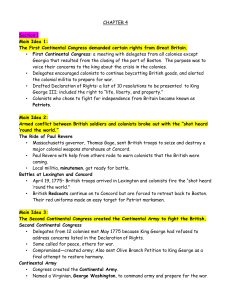
CHAPTER 4 Section 1 Main Idea 1: The First Continental Congress
... the colonial militia to prepare for war. • Drafted Declaration of Rights: a list of 10 resolutions to be presented to King George III; included the right to “life, liberty, and property.” • Colonists who chose to fight for independence from Britain became known as Patriots. Main Idea 2: Armed confli ...
... the colonial militia to prepare for war. • Drafted Declaration of Rights: a list of 10 resolutions to be presented to King George III; included the right to “life, liberty, and property.” • Colonists who chose to fight for independence from Britain became known as Patriots. Main Idea 2: Armed confli ...

George Washington
... Washington pulled his small force back into Fort Necessity where he was overwhelmed (1754) by the French. He was the commander of Virginia’s frontier troops as a colonel. Left the army in 1758. Also the first President of the United States. Took office (Apr.30, 1789) in New York City. William Howe E ...
... Washington pulled his small force back into Fort Necessity where he was overwhelmed (1754) by the French. He was the commander of Virginia’s frontier troops as a colonel. Left the army in 1758. Also the first President of the United States. Took office (Apr.30, 1789) in New York City. William Howe E ...

A. Revolution Notes
... power to tax or create currency 3. Most Americans Loyalists or indifferent 4. Supply shortages 5. A long war ...
... power to tax or create currency 3. Most Americans Loyalists or indifferent 4. Supply shortages 5. A long war ...

Chapter 8 - America Secedes from the Empire
... Rhode Island. They were planning a Franco American attack on New York. John Jay John Jay was the First Chief Justice of the United States, and also an American statesman and jurist. Elected to the Continental Congress, he also helped negotiate the Treaty of Paris w/ Great Britain, ending the America ...
... Rhode Island. They were planning a Franco American attack on New York. John Jay John Jay was the First Chief Justice of the United States, and also an American statesman and jurist. Elected to the Continental Congress, he also helped negotiate the Treaty of Paris w/ Great Britain, ending the America ...

The First Continental Congress was a convention of delegates from
... American Revolution. It was called in response to the passage of the Coercive Acts (also known as Intolerable Acts by the Colonial Americans) by the British Parliament. The Intolerable Acts had punished Boston for the Boston Tea Party. The Congress was attended by 56 members appointed by the legisla ...
... American Revolution. It was called in response to the passage of the Coercive Acts (also known as Intolerable Acts by the Colonial Americans) by the British Parliament. The Intolerable Acts had punished Boston for the Boston Tea Party. The Congress was attended by 56 members appointed by the legisla ...


American Revolution People Cheat Sheet
... James Armistead – enslaved African American in Virginia; Marquis de Lafayette recruited him as a spy for the Continental Army. Posing as a double agent, forager and servant at British headquarters, he moved freely between the lines with vital information on British troop movements for Lafayette; con ...
... James Armistead – enslaved African American in Virginia; Marquis de Lafayette recruited him as a spy for the Continental Army. Posing as a double agent, forager and servant at British headquarters, he moved freely between the lines with vital information on British troop movements for Lafayette; con ...

What were the significant advantages and disadvantages for the
... Loyalists and many Indian tribes: The Cherokees of the Carolinas, were firmly committed to the British, as were four of the six Iroquois Nations of New York. By contrast, the Americans were economically and militarily weak. They [did not have] a strong central government and a source of revenue [mon ...
... Loyalists and many Indian tribes: The Cherokees of the Carolinas, were firmly committed to the British, as were four of the six Iroquois Nations of New York. By contrast, the Americans were economically and militarily weak. They [did not have] a strong central government and a source of revenue [mon ...

The Revolution Begins Answers
... 2b. Why did the British army march on Lexington and Concord? To destroy the militia weapons stored in Concord. Place: Massachusetts colony Massachusetts part of New England colonies ...
... 2b. Why did the British army march on Lexington and Concord? To destroy the militia weapons stored in Concord. Place: Massachusetts colony Massachusetts part of New England colonies ...
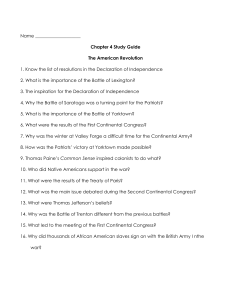
Name
... 8. How was the Patriots’ victory at Yorktown made possible? 9. Thomas Paine’s Common Sense inspired colonists to do what? 10. Who did Native Americans support in the war? 11. What were the results of the Treaty of Paris? 12. What was the main issue debated during the Second Continental Congress? 13. ...
... 8. How was the Patriots’ victory at Yorktown made possible? 9. Thomas Paine’s Common Sense inspired colonists to do what? 10. Who did Native Americans support in the war? 11. What were the results of the Treaty of Paris? 12. What was the main issue debated during the Second Continental Congress? 13. ...

Document
... Give a short outline of the French and Indian War; its causes, land claims of the parties involved, peace settlement and the war’s implications for the future of the American colonies. What taxation policy did Britain apply to the American colonies after 1763 and how did American colonists react to ...
... Give a short outline of the French and Indian War; its causes, land claims of the parties involved, peace settlement and the war’s implications for the future of the American colonies. What taxation policy did Britain apply to the American colonies after 1763 and how did American colonists react to ...
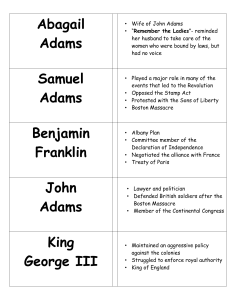
Abagail Adams Samuel Adams Benjamin Franklin
... ride back from Boston to warn his community of the impending British invasion Served in the army and fought at the Battle of Saratoga ...
... ride back from Boston to warn his community of the impending British invasion Served in the army and fought at the Battle of Saratoga ...

Print › Ch6 The Declaration of Independence | Quizlet
... a pamphlet written by Thomas Paine. It was first published anonymously on January 10, 1776, at the beginning of the American Revolution. Common Sense, was signed, "Written by an Englishman", and it became an immediate success. Paine donated his royalties from Common Sense to George Washington's Cont ...
... a pamphlet written by Thomas Paine. It was first published anonymously on January 10, 1776, at the beginning of the American Revolution. Common Sense, was signed, "Written by an Englishman", and it became an immediate success. Paine donated his royalties from Common Sense to George Washington's Cont ...

President Washington Study Facts
... 1754 Lieutenant Colonel Washington leads attack on the French Canadians at Fort Duquesne 1754 Battle of Fort Necessity - Washington's only military surrender 1759 Married Martha Dandridge Custis 1774 Delegate to the First Continental Congress 1775 Delegate to the Second Continental Congress. Appeare ...
... 1754 Lieutenant Colonel Washington leads attack on the French Canadians at Fort Duquesne 1754 Battle of Fort Necessity - Washington's only military surrender 1759 Married Martha Dandridge Custis 1774 Delegate to the First Continental Congress 1775 Delegate to the Second Continental Congress. Appeare ...
