
Chapter 7: Revolutionary War notes/packet
... 8. Since they didn’t have much of an army in the south, they used another tactic called ________________________________. This is swift ______________________ attacks. The most well known for fighting like this was _____________________________. The main character in the movie The Patriot was based ...
... 8. Since they didn’t have much of an army in the south, they used another tactic called ________________________________. This is swift ______________________ attacks. The most well known for fighting like this was _____________________________. The main character in the movie The Patriot was based ...

Early War - Humble ISD
... 19. Even with foreign help, what huge challenge did the Continental Army face? ...
... 19. Even with foreign help, what huge challenge did the Continental Army face? ...

9–1 leaders during the american revolution
... each battalion. There Lexington and was credited with were two all-black killing Pitcairn at Bunker Hill. regiments—from Salem’s bravery won the attention Rhode Island and and admiration of General Massachusetts. Washington, who asked The 400-strong R.I. regiment won to meet fame in the Battle of Su ...
... each battalion. There Lexington and was credited with were two all-black killing Pitcairn at Bunker Hill. regiments—from Salem’s bravery won the attention Rhode Island and and admiration of General Massachusetts. Washington, who asked The 400-strong R.I. regiment won to meet fame in the Battle of Su ...
Chapter 4 powerpoint
... • General Charles Cornwallis moved British forces to Yorktown, Virginia, in 1781. • Washington’s Continental Army and French troops under Comte de Rochambeau surrounded the British. • Cornwallis surrendered on October 19, 1781, after weeks of fighting. Patriots took 8,000 prisoners–the largest Briti ...
... • General Charles Cornwallis moved British forces to Yorktown, Virginia, in 1781. • Washington’s Continental Army and French troops under Comte de Rochambeau surrounded the British. • Cornwallis surrendered on October 19, 1781, after weeks of fighting. Patriots took 8,000 prisoners–the largest Briti ...

American Revolution 8.1A Identify the major eras and events in U.S.
... escape and encouraged German soldiers to desert the British army, became a broker to the French consul and paymaster to French troops in America Patrick Henry: a member of the Virginia House of Burgesses, spoke against the Stamp Act, famous quote ―Give me liberty or give me death,‖ during the Revolu ...
... escape and encouraged German soldiers to desert the British army, became a broker to the French consul and paymaster to French troops in America Patrick Henry: a member of the Virginia House of Burgesses, spoke against the Stamp Act, famous quote ―Give me liberty or give me death,‖ during the Revolu ...

Patriots versus Loyalists Timeline
... approved by the Continental Congress in 1781 as the first Constitution of the United States of America. Battle of Bunker Hill – June 17, 1775: An early battle in the American Revolutionary War fought between Patriot rebels and British soldiers. The battle was ultimately won by the British, but the P ...
... approved by the Continental Congress in 1781 as the first Constitution of the United States of America. Battle of Bunker Hill – June 17, 1775: An early battle in the American Revolutionary War fought between Patriot rebels and British soldiers. The battle was ultimately won by the British, but the P ...

American Revolution Quiz 2 Study Guide
... 4. I was a prominent lawyer during this time period. One of my cases was defending the British soldiers who were put on trial for the Boston Massacre. I felt these men deserved a fair trial, and I wanted to show the world that Americas believed in justice even if the British did not. I championed th ...
... 4. I was a prominent lawyer during this time period. One of my cases was defending the British soldiers who were put on trial for the Boston Massacre. I felt these men deserved a fair trial, and I wanted to show the world that Americas believed in justice even if the British did not. I championed th ...

How did Congress struggle between peace and war with Britain?
... The Battle of Bunker Hill showed: 1. Americans could fight bravely. 2. The British would not be easy to defeat. ...
... The Battle of Bunker Hill showed: 1. Americans could fight bravely. 2. The British would not be easy to defeat. ...

Chapter Assessment
... Colonists believed that only their colonial assemblies had the right to tax them because they had a say in that government, not the king. Continental Congress The First Continental Congress advised colonies to establish militias and arm themselves. The Second Continental Congress made George W ...
... Colonists believed that only their colonial assemblies had the right to tax them because they had a say in that government, not the king. Continental Congress The First Continental Congress advised colonies to establish militias and arm themselves. The Second Continental Congress made George W ...

Chapter 2
... • Patriots tried to attack individual British ships; attacked British supply ports and merchant ships • John Paul Jones – one of the most successful American captains – One of his most famous victories was against the British warship ...
... • Patriots tried to attack individual British ships; attacked British supply ports and merchant ships • John Paul Jones – one of the most successful American captains – One of his most famous victories was against the British warship ...

June 2012 - RootsWeb
... leadership of Virginia’s Peyton Randolph, called for a boycott of British products and agreed to meet again in the spring. ...
... leadership of Virginia’s Peyton Randolph, called for a boycott of British products and agreed to meet again in the spring. ...

Timeline - WordPress.com
... Intolerable Acts were intended to isolate radicals like the Sons of Liberty; It backfired and created sympathies from other colonies for Mass. ...
... Intolerable Acts were intended to isolate radicals like the Sons of Liberty; It backfired and created sympathies from other colonies for Mass. ...

Chapter 5 Section 4: The War Begins
... marched upon Breed’s Hill, the Americans were successful on the first 2 waves of British troops, but the 3rd wave of British troops were successful in taking Breed’s Hill because the Americans __________________________________. ...
... marched upon Breed’s Hill, the Americans were successful on the first 2 waves of British troops, but the 3rd wave of British troops were successful in taking Breed’s Hill because the Americans __________________________________. ...

American Revolution Study Guide
... words were: “I only regret that I have but one life to lose for my country.” 9. The very first battle of the war took place at _______________ on April 18, 1775, when U.S. militia tried to stop the British from advancing to destroy colonists’ ammunition. 10._______________ was the British military g ...
... words were: “I only regret that I have but one life to lose for my country.” 9. The very first battle of the war took place at _______________ on April 18, 1775, when U.S. militia tried to stop the British from advancing to destroy colonists’ ammunition. 10._______________ was the British military g ...

Towards Revolution
... The War continued in earnest for three more years though. Much of this fighting involved indecisive engagements in the South and the Western frontiers. ...
... The War continued in earnest for three more years though. Much of this fighting involved indecisive engagements in the South and the Western frontiers. ...

NOTES ON THE AMERICAN REVOLUTION European nations were
... • Thaddeus Kosciusko: Polish military engineer helping Patriots • Baron Friedrich von Steuben: German military commander who helped train American troops ...
... • Thaddeus Kosciusko: Polish military engineer helping Patriots • Baron Friedrich von Steuben: German military commander who helped train American troops ...


April 14, 1775
... June 28, 1776 - In South Carolina, American forces at Fort Moultrie successfully defend Charleston against a British naval attack and inflict heavy damage on the fleet. June-July, 1776 - A massive British war fleet arrives in New York Harbor consisting of 30 battleships with 1200 cannon, 30,000 sold ...
... June 28, 1776 - In South Carolina, American forces at Fort Moultrie successfully defend Charleston against a British naval attack and inflict heavy damage on the fleet. June-July, 1776 - A massive British war fleet arrives in New York Harbor consisting of 30 battleships with 1200 cannon, 30,000 sold ...


September 25, 2008 and September 26, 2008
... 70 minutemen gathered at Lexington and faced a much larger British force. The colonists were defeated. British marched on to Concord. Weapons were already removed. Minutemen fire! Shot Heard Round the World: the start of the Revolutionary War Redcoats - name the Patriots gave to the British soldiers ...
... 70 minutemen gathered at Lexington and faced a much larger British force. The colonists were defeated. British marched on to Concord. Weapons were already removed. Minutemen fire! Shot Heard Round the World: the start of the Revolutionary War Redcoats - name the Patriots gave to the British soldiers ...

Second Six Weeks Review
... 25) _________________________ brought soldiers from France to help the Continental Army. L5 26) The __________________________________________ provided the first government for all 13 states although very weak and had to later be replaced. L7 27) “Unalienable rights” are best illustrated as rights g ...
... 25) _________________________ brought soldiers from France to help the Continental Army. L5 26) The __________________________________________ provided the first government for all 13 states although very weak and had to later be replaced. L7 27) “Unalienable rights” are best illustrated as rights g ...

The revolutionary War
... • No town meetings allowed in Massachusetts – Boston under military rule • Trying to isolate Massachusetts, but only strengthened the colonies unity ...
... • No town meetings allowed in Massachusetts – Boston under military rule • Trying to isolate Massachusetts, but only strengthened the colonies unity ...
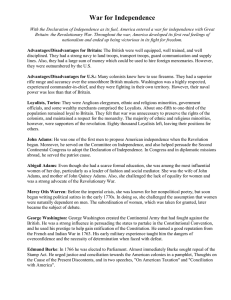
Vocab 4 - War of Independence
... John Adams: He was one of the first men to propose American independence when the Revolution began. Moreover, he served on the Committee on Independence, and also helped persuade the Second Continental Congress to adopt the Declaration of Independence. In Congress and in diplomatic missions abroad, ...
... John Adams: He was one of the first men to propose American independence when the Revolution began. Moreover, he served on the Committee on Independence, and also helped persuade the Second Continental Congress to adopt the Declaration of Independence. In Congress and in diplomatic missions abroad, ...

Just the Facts …American Revolution
... It was ignored. Declaration of Independence – formal declaration written mainly by Thomas Jefferson and signed on July 4, 1776. It stated that men possess unalienable rights. It also listed grievances against King ...
... It was ignored. Declaration of Independence – formal declaration written mainly by Thomas Jefferson and signed on July 4, 1776. It stated that men possess unalienable rights. It also listed grievances against King ...

Terms to Know 2nd 6 Weeks 1. French and Indian War: War fought
... Boston. On the bridge back, they met 300 minutemen. The British were forced to retreat, and the Americans claimed victory. 16.George Washington: Virginian, patriot, general, and president. Lived at Mount Vernon. Led the Revolutionary Army in the fight for independence. First President of the United ...
... Boston. On the bridge back, they met 300 minutemen. The British were forced to retreat, and the Americans claimed victory. 16.George Washington: Virginian, patriot, general, and president. Lived at Mount Vernon. Led the Revolutionary Army in the fight for independence. First President of the United ...