
Name - cloudfront.net
... f. John Paul Jones: __________________________________________________________________________________ g. George Rogers Clark: ______________________________________________________________________________ h. Nathan Hale: ______________________________________________________________________________ ...
... f. John Paul Jones: __________________________________________________________________________________ g. George Rogers Clark: ______________________________________________________________________________ h. Nathan Hale: ______________________________________________________________________________ ...

The Articles of Confederation: A Failed Experiment Once the
... role of the national government. The Continental Congress had directed the war effort without clearly defined powers. Rather, it had assumed specific powers on an as-needed basis. Now, however, the new nation had a clearly organized government. The only problem was that the national government had b ...
... role of the national government. The Continental Congress had directed the war effort without clearly defined powers. Rather, it had assumed specific powers on an as-needed basis. Now, however, the new nation had a clearly organized government. The only problem was that the national government had b ...
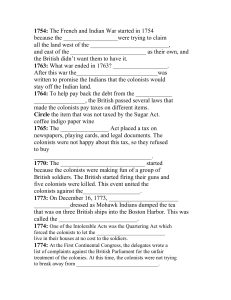
1754: The French and Indian War started in 1754
... because the colonists were making fun of a group of British soldiers. The British started firing their guns and five colonists were killed. This event united the colonists against the___________________. 1773: On December 16, 1773, _______________________ ____________dressed as Mohawk Indians dumped ...
... because the colonists were making fun of a group of British soldiers. The British started firing their guns and five colonists were killed. This event united the colonists against the___________________. 1773: On December 16, 1773, _______________________ ____________dressed as Mohawk Indians dumped ...

The War for Independence
... August, the untrained and poorly equipped colonial troops soon retreated. By late fall, the British had pushed Washington’s army across the Delaware River into Pennsylvania. Desperate for an early victory, Washington risked everything on one bold stroke set for Christmas night, 1776. In the face of ...
... August, the untrained and poorly equipped colonial troops soon retreated. By late fall, the British had pushed Washington’s army across the Delaware River into Pennsylvania. Desperate for an early victory, Washington risked everything on one bold stroke set for Christmas night, 1776. In the face of ...

Content Reading 8-2.5 Key Points The British tried to take
... Key conflicts of the American Revolution took place in South Carolina and affected the state and the outcome of the Revolutionary War. American forces thwarted the British attempt to split the colonies and won a victory at Saratoga. This victory was a turning point in the war because it led to an Am ...
... Key conflicts of the American Revolution took place in South Carolina and affected the state and the outcome of the Revolutionary War. American forces thwarted the British attempt to split the colonies and won a victory at Saratoga. This victory was a turning point in the war because it led to an Am ...

Stiahnuť prednášku
... under arms at one time. Armies were small by European standards of the era; the greatest number of men that Washington personally commanded in the field at any one time was fewer than 17,000. This could be attributed to tactical preferences, but it also could be because of lack of powder on the Amer ...
... under arms at one time. Armies were small by European standards of the era; the greatest number of men that Washington personally commanded in the field at any one time was fewer than 17,000. This could be attributed to tactical preferences, but it also could be because of lack of powder on the Amer ...

Lexington and Concord
... Dawes ride through the night of April 18 warning the countryside Paul Revere was NOT the only rider Paul Revere actually got caught by the British ...
... Dawes ride through the night of April 18 warning the countryside Paul Revere was NOT the only rider Paul Revere actually got caught by the British ...

Building a Nation
... What is a Republic?? • When people choose representatives to make the laws ...
... What is a Republic?? • When people choose representatives to make the laws ...

The Causes of the American Revolution
... • Over the course of the war, some 231,000 men spent time in military service, amounting to roughly one-quarter of the white male population over age sixteen. Close to 20,000 women served in the Continental army as cooks, washerwomen, and nurses. ...
... • Over the course of the war, some 231,000 men spent time in military service, amounting to roughly one-quarter of the white male population over age sixteen. Close to 20,000 women served in the Continental army as cooks, washerwomen, and nurses. ...

Ch 6 Lecture 1
... Aug 1776 British crush Washington on Long Island Retreat to Brooklyn Heights, then NY, then NJ Fight and run tactic Crossing of Delaware- Christmas 1776 Defeats Brits at Trenton and Princenton ...
... Aug 1776 British crush Washington on Long Island Retreat to Brooklyn Heights, then NY, then NJ Fight and run tactic Crossing of Delaware- Christmas 1776 Defeats Brits at Trenton and Princenton ...

Road To Independence
... Benedict Arnold raised a force of 400 to seize Fort Ticonderoga on Lake Champlain. • Fort Ticonderoga was rich with military supplies. • Arnold joined with Ethan Allen’s forces, the Green Mountain boys, and caught the British by surprise. The British surrendered. • Later Arnold later conspired to su ...
... Benedict Arnold raised a force of 400 to seize Fort Ticonderoga on Lake Champlain. • Fort Ticonderoga was rich with military supplies. • Arnold joined with Ethan Allen’s forces, the Green Mountain boys, and caught the British by surprise. The British surrendered. • Later Arnold later conspired to su ...

... 1. Who wrote the Declaration of Independence? Thomas Jefferson When was it written? 1776 Why was it necessary? It told King George III that the colonists wanted to separate from Britain and it explained why they wanted to form their own nation. 2. The Patriots were colonists who were fighting for fr ...

During the Revolutionary War, the Second Continental Congress
... President, Peyton Randolph, and Secretary, Charles Thomson. Randolph was soon called away by other duties, and succeeded by John Hancock as President. Other notable members of the Congress included Thomas Jefferson,Benjamin Franklin, and John Adams. By the time the Second Continental Congress met, t ...
... President, Peyton Randolph, and Secretary, Charles Thomson. Randolph was soon called away by other duties, and succeeded by John Hancock as President. Other notable members of the Congress included Thomas Jefferson,Benjamin Franklin, and John Adams. By the time the Second Continental Congress met, t ...

7G_06NA_The_American..
... independence from Britain. 4. The colonists fought and won the war for freedom. Major battles were fought from 1776 to 1781. Early battles were centered in the Middle States. A turning point for the Americans occurred in October 1777 at Saratoga, New York. Following this victory, Americans rec ...
... independence from Britain. 4. The colonists fought and won the war for freedom. Major battles were fought from 1776 to 1781. Early battles were centered in the Middle States. A turning point for the Americans occurred in October 1777 at Saratoga, New York. Following this victory, Americans rec ...

Ch2Sec23PP - Mrs. Lehman Mrs. Lehman
... Plan, by Ben Franklin, that called for a council of representatives appointed by the colonial assemblies and a president general appointed by the king ...
... Plan, by Ben Franklin, that called for a council of representatives appointed by the colonial assemblies and a president general appointed by the king ...

Revolution PowerPoint
... •June 1776: British ships commanded by General William Howe approached New Your Harbor •Washington expecting the British moved his troops onto Long Island. •British forces consisted of 32,000 fully supplied soldiers. •Washington's army consisted of 23,000 poorly equipped and trained men and were no ...
... •June 1776: British ships commanded by General William Howe approached New Your Harbor •Washington expecting the British moved his troops onto Long Island. •British forces consisted of 32,000 fully supplied soldiers. •Washington's army consisted of 23,000 poorly equipped and trained men and were no ...

Chapter 28: AMERICA IN A WORLD AT WAR
... o Large new groups of population now with motivation to fight- increase in support for independence ...
... o Large new groups of population now with motivation to fight- increase in support for independence ...

revolution
... Americans on Lexington Green and marched off to Concord with new regiments who had ...
... Americans on Lexington Green and marched off to Concord with new regiments who had ...

People of the American Revolution One of the first colonist to
... Held many state and federal offices during and after the War Powerful writer and used this ability to support the revolutionary cause Wrote “Common Sense”- a pamphlet that highlighted British exploits in the colonies American silversmith who served as courier for revolutionary cause “Paul Revere’s R ...
... Held many state and federal offices during and after the War Powerful writer and used this ability to support the revolutionary cause Wrote “Common Sense”- a pamphlet that highlighted British exploits in the colonies American silversmith who served as courier for revolutionary cause “Paul Revere’s R ...

To Revolution Unit Study Guide
... 11. The approval of what document by the Second Continental Congress on July 4, 1776 led to full-scale rebellion by the colonists? Who was the primary author of the document? What movement in Europe was the source of most of the philosophy of the document? 12. What two groups of people objected to b ...
... 11. The approval of what document by the Second Continental Congress on July 4, 1776 led to full-scale rebellion by the colonists? Who was the primary author of the document? What movement in Europe was the source of most of the philosophy of the document? 12. What two groups of people objected to b ...

American Revolution - woosteramericanlit
... and, because the colonies lacked elected representation in the governing British Parliament, many colonists considered to be illegal. After protests in Boston, the British sent combat troops, the Americans mobilized their militia, and fighting broke out in 1775. Although Loyalists were about 15-20% ...
... and, because the colonies lacked elected representation in the governing British Parliament, many colonists considered to be illegal. After protests in Boston, the British sent combat troops, the Americans mobilized their militia, and fighting broke out in 1775. Although Loyalists were about 15-20% ...
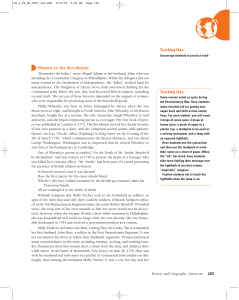
About Women/Loyalists/Patriot
... and ill-equipped farmers, clerks, shopkeepers, and the like, who lacked military supplies and basic necessities, such as shoes and uniforms. Prospects for the new nation looked poor—until the Battle of Saratoga, New York, in October 1777. Soldiers of the Continental army and local militia pinned dow ...
... and ill-equipped farmers, clerks, shopkeepers, and the like, who lacked military supplies and basic necessities, such as shoes and uniforms. Prospects for the new nation looked poor—until the Battle of Saratoga, New York, in October 1777. Soldiers of the Continental army and local militia pinned dow ...

Sugar Act
... • Britain wanted the colonies to help pay the debt • The Sugar Act was the first attempt to do so ...
... • Britain wanted the colonies to help pay the debt • The Sugar Act was the first attempt to do so ...
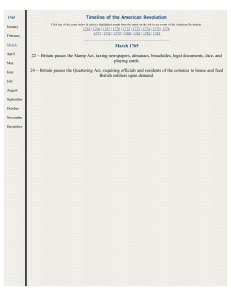
March 1765 22 ~ Britain passes the Stamp Act, taxing newspapers
... publisher, James Rivington, was attempting to print both viewpoints of growing conflict in the Colonies. ...
... publisher, James Rivington, was attempting to print both viewpoints of growing conflict in the Colonies. ...

Chapter 5 Road to independence
... enlisting after Lexington & Concord due to Southern fears of possible revolts • Many states ignored the ban, by end of war every state but South Carolina had African American Regiments • British promised freedom to any slave who fought on their side ...
... enlisting after Lexington & Concord due to Southern fears of possible revolts • Many states ignored the ban, by end of war every state but South Carolina had African American Regiments • British promised freedom to any slave who fought on their side ...