
Chains (1) - Mercer Island School District
... pamphlet called Common Sense. In it, Paine called on colonists to overthrow its British tyrants and to become independent. Over 120,000 copies were distributed throughout the colonies and Paine’s words persuaded many to support the Patriot cause. Despite Washington’s ragtag army, the Continental Arm ...
... pamphlet called Common Sense. In it, Paine called on colonists to overthrow its British tyrants and to become independent. Over 120,000 copies were distributed throughout the colonies and Paine’s words persuaded many to support the Patriot cause. Despite Washington’s ragtag army, the Continental Arm ...

Ch. 5-6 Study Focus.indd
... battles of Lexington/Concord and Breeds Hill/Bunker Hill. G. What happened at the 2nd Continental Congress? 1. What was the Olive Branch Petition and why was it important? 2. What role did Thomas Paine have on the call for independence? H. Why did the delegates draft the Declaration of Independence? ...
... battles of Lexington/Concord and Breeds Hill/Bunker Hill. G. What happened at the 2nd Continental Congress? 1. What was the Olive Branch Petition and why was it important? 2. What role did Thomas Paine have on the call for independence? H. Why did the delegates draft the Declaration of Independence? ...

Thomas Gordon - Family Search
... father being a descendant of the Huntley Gordons. In 1750, at the age of five, young Thomas Gordon came to America with his mother, Jane Stewart Gordon and established their home in the northeastern edge of Albemarle County, Virginia, near the town of Gordonsville. Here he grew to manhood and reside ...
... father being a descendant of the Huntley Gordons. In 1750, at the age of five, young Thomas Gordon came to America with his mother, Jane Stewart Gordon and established their home in the northeastern edge of Albemarle County, Virginia, near the town of Gordonsville. Here he grew to manhood and reside ...

The Revolution Begins
... for potential armed conflict w/ the British Most colonial leaders, though, believed war w/ Britain would be a disaster The colonies had no standing army or navy Britain, on the other hand, had: A highly-trained & experienced army The World’s largest & most powerful navy ...
... for potential armed conflict w/ the British Most colonial leaders, though, believed war w/ Britain would be a disaster The colonies had no standing army or navy Britain, on the other hand, had: A highly-trained & experienced army The World’s largest & most powerful navy ...

Chapter 5 (Notes)
... Second Continental Congress Convenes (May 10, 1775) June 1775--Congress appoints George Washington commander of the Continental Army On June 17, 1775 the colonists and the British forces engage in their first major battle (Battle of Bunker Hill). The British forces had to retreat on two occasio ...
... Second Continental Congress Convenes (May 10, 1775) June 1775--Congress appoints George Washington commander of the Continental Army On June 17, 1775 the colonists and the British forces engage in their first major battle (Battle of Bunker Hill). The British forces had to retreat on two occasio ...

Chapter 7 The Road to Revolution 1763
... London officials developed a plan for capturing the vital Hudson River valley in 1777. It would sever New England from the rest of the states and paralyze the American cause. The main invading force, lead by General Burgoyne, would push down towards Lake Champlain from Canada. General Howe's troops ...
... London officials developed a plan for capturing the vital Hudson River valley in 1777. It would sever New England from the rest of the states and paralyze the American cause. The main invading force, lead by General Burgoyne, would push down towards Lake Champlain from Canada. General Howe's troops ...

Washington at Brooklyn
... forces landed on Manhattan itself. The American commander on Long Island was Major General Israel Putnam, the 58-year-old architect of the Battle of Bunker Hill. A Connecticut man, “Old Put” knew next to nothing about the local terrain. Neither did Washington or any other general in his army. Worse, ...
... forces landed on Manhattan itself. The American commander on Long Island was Major General Israel Putnam, the 58-year-old architect of the Battle of Bunker Hill. A Connecticut man, “Old Put” knew next to nothing about the local terrain. Neither did Washington or any other general in his army. Worse, ...

Road to Independence The First Continental Congress
... English Subjects: The colonists’ rights as English subjects are _limited_________________ by the English rights__Patritos_____________ The Patriots have exaggerated __problems________________ with gReat BRitian. _______Loyalists___________ The colonists have _repeatedly_________________ petitioned t ...
... English Subjects: The colonists’ rights as English subjects are _limited_________________ by the English rights__Patritos_____________ The Patriots have exaggerated __problems________________ with gReat BRitian. _______Loyalists___________ The colonists have _repeatedly_________________ petitioned t ...

A Revolution Indeed, 1774-1783
... (April 1775) / Arrest J. Hancock & S. Adams After dispersing Lexington’s militia, British face significant armed opposition in Concord Forced to retreat to Boston ...
... (April 1775) / Arrest J. Hancock & S. Adams After dispersing Lexington’s militia, British face significant armed opposition in Concord Forced to retreat to Boston ...

How the Allied Victory at Yorktown Won American Independence
... There was no question that, if they chose to, the British could continue to occupy their coastal bases indefinitely. It was equally obvious however that they were apparently unable to destroy the Continental Army or to conquer the rebellious colonies. It was unrealistic, and perhaps unwise, for the ...
... There was no question that, if they chose to, the British could continue to occupy their coastal bases indefinitely. It was equally obvious however that they were apparently unable to destroy the Continental Army or to conquer the rebellious colonies. It was unrealistic, and perhaps unwise, for the ...

The Second Continental Congress 2
... By the time the Second Continental Congress met, the American Revolutionary War had already started with the Battles of Lexington and Concord. The Congress was to take charge of the war effort. For the first few months of the struggle, the Patriots had carried on their struggle in an ad-hoc (formed ...
... By the time the Second Continental Congress met, the American Revolutionary War had already started with the Battles of Lexington and Concord. The Congress was to take charge of the war effort. For the first few months of the struggle, the Patriots had carried on their struggle in an ad-hoc (formed ...

Unit 2 Review Grid
... I can compare and contrast the two sides of the American Revolution. 4. Colonists who were loyal to the King of England and did not want to break away from British rule were called what? ...
... I can compare and contrast the two sides of the American Revolution. 4. Colonists who were loyal to the King of England and did not want to break away from British rule were called what? ...

07.I The War for Independence| WHAT STRATEGIES and tactics did
... surviving on little more than “fire-cake,” a mixture of flour and water baked hard before the fire that, according to Waldo, turned “guts to pasteboard.” Two thousand men were without shoes; others were without blankets and had to sit up all night about the fires to keep from freezing. Washington fi ...
... surviving on little more than “fire-cake,” a mixture of flour and water baked hard before the fire that, according to Waldo, turned “guts to pasteboard.” Two thousand men were without shoes; others were without blankets and had to sit up all night about the fires to keep from freezing. Washington fi ...

Famous Revolutionary Figures and their contributions
... 1) What was the first battle of the American Revolution? Who won? 2) What was the shot heard round the world? 3) What was the second battle of the American Revolution? Who won? 4) Why was the Battle of Bunker Hill encouraging to the Patriots? 5) Where did the battle truly take place? 6) What battle ...
... 1) What was the first battle of the American Revolution? Who won? 2) What was the shot heard round the world? 3) What was the second battle of the American Revolution? Who won? 4) Why was the Battle of Bunker Hill encouraging to the Patriots? 5) Where did the battle truly take place? 6) What battle ...

AMERICAN REVOLUTION UNIT TEST
... • The Boston Port Bill became effective on June 1, 1774. The King closed Boston Harbor to everything but British ships. • The Quartering Act was established on March 24, 1765. The King sent lots of British troops to Boston. The colonists had to house and feed the British troops. If the colonists did ...
... • The Boston Port Bill became effective on June 1, 1774. The King closed Boston Harbor to everything but British ships. • The Quartering Act was established on March 24, 1765. The King sent lots of British troops to Boston. The colonists had to house and feed the British troops. If the colonists did ...

The American Revolutionary War
... The American Revolutionary War (1775-1783), also known as the American War of Independence, was a war between the Kingdom of Great Britain and thirteen British colonies on the North American continent (as well as some naval conflict). The war was the culmination of the political American Revolution, ...
... The American Revolutionary War (1775-1783), also known as the American War of Independence, was a war between the Kingdom of Great Britain and thirteen British colonies on the North American continent (as well as some naval conflict). The war was the culmination of the political American Revolution, ...

American History – A Survey
... o March 17, 1776 – Evacuation Day – British left Boston for Nova Scotia Departure of the British marked a shift in strategy more than an admission of defeat o Moore’s Creek Bridge in North Carolina Band of Patriots crushed Loyalist uprising – February ...
... o March 17, 1776 – Evacuation Day – British left Boston for Nova Scotia Departure of the British marked a shift in strategy more than an admission of defeat o Moore’s Creek Bridge in North Carolina Band of Patriots crushed Loyalist uprising – February ...
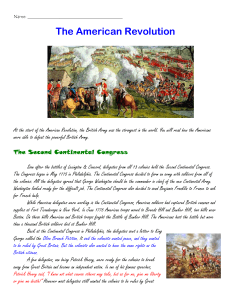
The American Revolution - Mrs. Anci`s Classroom
... Nathan Hale was a brave American spy at the Battle of Long Island. He was caught by the British and hanged. Just before he died, Hale said, “My only regret is that I have but one life to give for my country.” Washington had two victories at the end of 1776. The first victory was the surprise attack ...
... Nathan Hale was a brave American spy at the Battle of Long Island. He was caught by the British and hanged. Just before he died, Hale said, “My only regret is that I have but one life to give for my country.” Washington had two victories at the end of 1776. The first victory was the surprise attack ...

Timeline of the American Revolution Notes 1. Battle of Lexington
... Description: A convention of delegates from the thirteen colonies that met soon after the American Revolutionary War on May 10, 1775 in Philadelphia, PA, was known as the Second Continental Congress. This managed the colonial war effort and began moving towards independence with the adoption of the ...
... Description: A convention of delegates from the thirteen colonies that met soon after the American Revolutionary War on May 10, 1775 in Philadelphia, PA, was known as the Second Continental Congress. This managed the colonial war effort and began moving towards independence with the adoption of the ...

Concept Stations - Dunkleman History
... June 17, 1775, Major General William Howe, leading the British forces, could have easily surrounded the Americans with his ships at sea, but instead chose to march his troops uphill. Howe might have believed that the Americans would retreat in the face of a smashing, head-on attack. He was wrong. Hi ...
... June 17, 1775, Major General William Howe, leading the British forces, could have easily surrounded the Americans with his ships at sea, but instead chose to march his troops uphill. Howe might have believed that the Americans would retreat in the face of a smashing, head-on attack. He was wrong. Hi ...

.~ag~J
... for all the colonies during the Revolutionary War. The Articles of Confederation acted as the first constitution for the United States. The Articles were drawn up by the Second Continental Congress and were in use until the Constitution was signed in 1787. The Articles were weak because the colonist ...
... for all the colonies during the Revolutionary War. The Articles of Confederation acted as the first constitution for the United States. The Articles were drawn up by the Second Continental Congress and were in use until the Constitution was signed in 1787. The Articles were weak because the colonist ...

unit 2 guide
... 1. What economic and political factors fueled the colonist’s desire for independence? ...
... 1. What economic and political factors fueled the colonist’s desire for independence? ...

PowerPoint-Notes Unit 3 Lesson 2
... • Many of the British colonies in North America had began to protest taxation as long as they were not represented in British Parliament. • 12 of the 13 colonies sent representatives to the First Continental Congress; Georgia was not represented. • Urged colonies to establish “Committees of Safety” ...
... • Many of the British colonies in North America had began to protest taxation as long as they were not represented in British Parliament. • 12 of the 13 colonies sent representatives to the First Continental Congress; Georgia was not represented. • Urged colonies to establish “Committees of Safety” ...

Key Battles of the Ameri can Revo l u ti o n
... regulars along with local militia that had been raised in the city. Richard Montgomery and Benedict Arnold led a force of about 1,200 American army forces and Canadian militia in a multi-pronged attack on the city, which, due to bad weather and bad timing, did not start well, and ended with Montgome ...
... regulars along with local militia that had been raised in the city. Richard Montgomery and Benedict Arnold led a force of about 1,200 American army forces and Canadian militia in a multi-pronged attack on the city, which, due to bad weather and bad timing, did not start well, and ended with Montgome ...

What is this war called?
... replaced Gage and lands in New York • Parliament authorized more than 50,000 more troops be sent to the colonies – left Boston and moved to Staten Island ...
... replaced Gage and lands in New York • Parliament authorized more than 50,000 more troops be sent to the colonies – left Boston and moved to Staten Island ...