
23Neurotransmitter22012-09
... firing during quiet wakefulness and a sustained activation if the subject is stressed or excited. Their firing decreases markedly during slow-wave sleep and virtually disappears during REM sleep. ...
... firing during quiet wakefulness and a sustained activation if the subject is stressed or excited. Their firing decreases markedly during slow-wave sleep and virtually disappears during REM sleep. ...
Central Nervous System Drugs
... Central nervous system drugs-that is, drugs that affect the spinal cord and the brainare used to treat several neurological (nervous system) and psychiatric problems. For instance, antiepileptic drugs reduce the activity of overexcited brain areas and reduce or eliminate seizures. Antipsychotic drug ...
... Central nervous system drugs-that is, drugs that affect the spinal cord and the brainare used to treat several neurological (nervous system) and psychiatric problems. For instance, antiepileptic drugs reduce the activity of overexcited brain areas and reduce or eliminate seizures. Antipsychotic drug ...
Central Nervous System Drugs
... Central nervous system drugs-that is, drugs that affect the spinal cord and the brainare used to treat several neurological (nervous system) and psychiatric problems. For instance, antiepileptic drugs reduce the activity of overexcited brain areas and reduce or eliminate seizures. Antipsychotic drug ...
... Central nervous system drugs-that is, drugs that affect the spinal cord and the brainare used to treat several neurological (nervous system) and psychiatric problems. For instance, antiepileptic drugs reduce the activity of overexcited brain areas and reduce or eliminate seizures. Antipsychotic drug ...

BIOPSYCHOLOGY notes
... the recepter and float back into the synapse. When this happens, the receptor stops sending chemical signals to the cell body, and it waits for another serotonin molecule to ...
... the recepter and float back into the synapse. When this happens, the receptor stops sending chemical signals to the cell body, and it waits for another serotonin molecule to ...

Illness Beliefs of Depressed Chinese-American Patients
... Oftentimes, their complaints are seen as “somatizing,” disregarding obvious depressive states. One reason for this apparent disregard may be the stigma that is attached to psychiatric symptoms in Chinese culture, compared to the relative acceptance of physical complaints. In a study of primary care ...
... Oftentimes, their complaints are seen as “somatizing,” disregarding obvious depressive states. One reason for this apparent disregard may be the stigma that is attached to psychiatric symptoms in Chinese culture, compared to the relative acceptance of physical complaints. In a study of primary care ...

CNS Introduction
... Transmitter recognition. Receptors exist on postsynaptic cells, which recognize the transmitter. Binding of a neurotransmitter to its receptor initiates a signal transduction event. Termination of action. -hydrolysis (for acetylcholine and peptides) -reuptake into neurons by specific transporters su ...
... Transmitter recognition. Receptors exist on postsynaptic cells, which recognize the transmitter. Binding of a neurotransmitter to its receptor initiates a signal transduction event. Termination of action. -hydrolysis (for acetylcholine and peptides) -reuptake into neurons by specific transporters su ...

Depressive and Bipolar Disorders
... • Typically lose interest in activities & relationships and take pleasure in nothing • Despite best efforts, everything from conversation to bathing is an unbearable, exhausting effort • Often exaggerated feelings of inadequacy, worthlessness, hopelessness, or guilt ...
... • Typically lose interest in activities & relationships and take pleasure in nothing • Despite best efforts, everything from conversation to bathing is an unbearable, exhausting effort • Often exaggerated feelings of inadequacy, worthlessness, hopelessness, or guilt ...

Dementia Delirium Depression - Georgia Gerontology Society
... due to getting up frequently to use the bathroom at night. Her adult daughter reports that Ms. Smith has had difficulty remembering things lately like appointments and names. ...
... due to getting up frequently to use the bathroom at night. Her adult daughter reports that Ms. Smith has had difficulty remembering things lately like appointments and names. ...

CNS Stimulants - AODAConnection
... chronic use of amphetamines and can last even for months beyond the cessation of its use. Free radical production that damages the cells in the brain may be at the root of this neuronal destruction. Amphetamines can cause behavioral stereotypey. This is when an individual continues engaging in simpl ...
... chronic use of amphetamines and can last even for months beyond the cessation of its use. Free radical production that damages the cells in the brain may be at the root of this neuronal destruction. Amphetamines can cause behavioral stereotypey. This is when an individual continues engaging in simpl ...

Depression - Übersetzung Englisch
... ■ You yourself can contribute to your treatment. Sport and physical activity are very important. You don’t have to go in for anything strenuous or push yourself unnecessarily. Try to set yourself achievable goals: a walk in the fresh air, a short bicycle ride. You choose what you like doing. ■ Other ...
... ■ You yourself can contribute to your treatment. Sport and physical activity are very important. You don’t have to go in for anything strenuous or push yourself unnecessarily. Try to set yourself achievable goals: a walk in the fresh air, a short bicycle ride. You choose what you like doing. ■ Other ...

Depression - Patienten
... ■ You yourself can contribute to your treatment. Sport and physical activity are very important. You don’t have to go in for anything strenuous or push yourself unnecessarily. Try to set yourself achievable goals: a walk in the fresh air, a short bicycle ride. You choose what you like doing. ■ Other ...
... ■ You yourself can contribute to your treatment. Sport and physical activity are very important. You don’t have to go in for anything strenuous or push yourself unnecessarily. Try to set yourself achievable goals: a walk in the fresh air, a short bicycle ride. You choose what you like doing. ■ Other ...

Committee Opinion 630
... Perinatal depression and other mood disorders, such as bipolar disorder and anxiety disorders (3), can have devastating effects on women, infants, and families; maternal suicide exceeds hemorrhage and hypertensive disorders as a cause of maternal mortality (4). Perinatal depression often goes unreco ...
... Perinatal depression and other mood disorders, such as bipolar disorder and anxiety disorders (3), can have devastating effects on women, infants, and families; maternal suicide exceeds hemorrhage and hypertensive disorders as a cause of maternal mortality (4). Perinatal depression often goes unreco ...

BIOL 2402 Lecture Outline Chapter 5
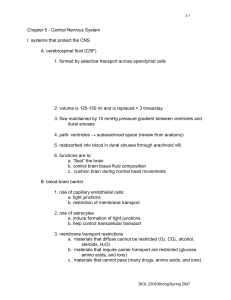
... each full cycle lasts about 90 minutes, and in each successive cycle the amount of paradoxical/REM sleep increases paradoxical sleep involves low muscle tone, increased cortical activity, and dreaming switching between slow wave/NREM and paradoxical/REM is controlled by paradoxical/REM “sleep-on” ne ...
... each full cycle lasts about 90 minutes, and in each successive cycle the amount of paradoxical/REM sleep increases paradoxical sleep involves low muscle tone, increased cortical activity, and dreaming switching between slow wave/NREM and paradoxical/REM is controlled by paradoxical/REM “sleep-on” ne ...
Slide () - AccessAnesthesiology
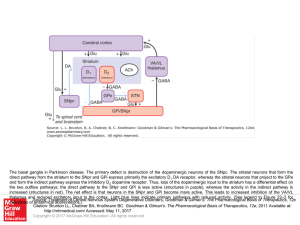
... The basal ganglia in Parkinson disease. The primary defect is destruction of the dopaminergic neurons of the SNpc. The striatal neurons that form the direct pathway from the striatum to the SNpr and GPi express primarily the excitatory D1 DA receptor, whereas the striatal neurons that project to the ...
... The basal ganglia in Parkinson disease. The primary defect is destruction of the dopaminergic neurons of the SNpc. The striatal neurons that form the direct pathway from the striatum to the SNpr and GPi express primarily the excitatory D1 DA receptor, whereas the striatal neurons that project to the ...

Altered Associative Learning and Learned Helplessness
... depicting right-sided hypoactivity to positive and left-sided hyperactivity to negative stimuli. Moreover, increased activation in an extended medial prefrontal network during self-referential processing was found in depressed individuals [26]. Thus, biased information processing in depression as pr ...
... depicting right-sided hypoactivity to positive and left-sided hyperactivity to negative stimuli. Moreover, increased activation in an extended medial prefrontal network during self-referential processing was found in depressed individuals [26]. Thus, biased information processing in depression as pr ...


Mood Disorders and Medical Illness: A Major Public Health Problem
... controversies surrounding various approaches are summarized by Robinson (2003). The findings of treatment studies showing efficacy of antidepressants, electroconvulsive therapy, psychostimulants, and cognitive behavioral therapy in patients with poststroke depression are of considerable clinical imp ...
... controversies surrounding various approaches are summarized by Robinson (2003). The findings of treatment studies showing efficacy of antidepressants, electroconvulsive therapy, psychostimulants, and cognitive behavioral therapy in patients with poststroke depression are of considerable clinical imp ...
Norepinephrine as a neurotransmitter
... release of excitatory neurotransmitter from the second neuron. b.Calcium ion channels are inactivated • Seen in the action of endogenous opioids in pain reduction; inhibits the release of substance P that promotes pain ...
... release of excitatory neurotransmitter from the second neuron. b.Calcium ion channels are inactivated • Seen in the action of endogenous opioids in pain reduction; inhibits the release of substance P that promotes pain ...

Screening for Perinatal Depression
... Perinatal depression and other mood disorders, such as bipolar disorder and anxiety disorders (3), can have devastating effects on women, infants, and families; maternal suicide exceeds hemorrhage and hypertensive disorders as a cause of maternal mortality (4). Perinatal depression often goes unreco ...
... Perinatal depression and other mood disorders, such as bipolar disorder and anxiety disorders (3), can have devastating effects on women, infants, and families; maternal suicide exceeds hemorrhage and hypertensive disorders as a cause of maternal mortality (4). Perinatal depression often goes unreco ...

Physiological Effects of Physical Exercise on Depression (Cont.)
... - The initial study is based on a literature review of all related articles concerning physical therapy and depression since 1990. - The secondary delimitation the study is restricted to a cross sectional screening of the depression in a female student population. ...
... - The initial study is based on a literature review of all related articles concerning physical therapy and depression since 1990. - The secondary delimitation the study is restricted to a cross sectional screening of the depression in a female student population. ...

The Two Faces of Depression: Withdrawn or Aggressive
... psychiatric illness physical illness medication reactions The PRIMARY symptom ...
... psychiatric illness physical illness medication reactions The PRIMARY symptom ...
emotion_08
... perception of the exciting fact, and that our feeling of the same changes as they occur is the emotion. Common sense says, we lose our fortune, are sorry and weep; we meet a bear, are frightened and run; we are insulted by a rival, and angry and strike. The hypothesis here to be defended says that t ...
... perception of the exciting fact, and that our feeling of the same changes as they occur is the emotion. Common sense says, we lose our fortune, are sorry and weep; we meet a bear, are frightened and run; we are insulted by a rival, and angry and strike. The hypothesis here to be defended says that t ...

Bi Polar Affective Disorder
... disorder, as a transition to the schizophrenic spectrum). The precise relationship of personality disorders to the disease spectra is uncertain and an unsolved general problem of psychiatric classification. BP-I (-II), bipolar-I disorder type I (II); D, major depression, d, minor depression; M, mani ...
... disorder, as a transition to the schizophrenic spectrum). The precise relationship of personality disorders to the disease spectra is uncertain and an unsolved general problem of psychiatric classification. BP-I (-II), bipolar-I disorder type I (II); D, major depression, d, minor depression; M, mani ...

No Slide Title
... Major Depressive Episode • Depressed mood • Loss of interest in pleasurable activities • Decrease or increase in appetite OR significant weight loss or gain • Persistently increased or decreased sleep • Psychomotor agitation or retardation ...
... Major Depressive Episode • Depressed mood • Loss of interest in pleasurable activities • Decrease or increase in appetite OR significant weight loss or gain • Persistently increased or decreased sleep • Psychomotor agitation or retardation ...
Biology of depression

Scientific studies have found that numerous brain areas show altered activity in patients suffering from depression, and this has encouraged advocates of various theories that seek to identify a biochemical origin of the disease, as opposed to theories that emphasize psychological or situational causes. Several theories concerning the biologically based cause of depression have been suggested over the years, of which the most prominent and widely researched is the monoamine hypothesis.